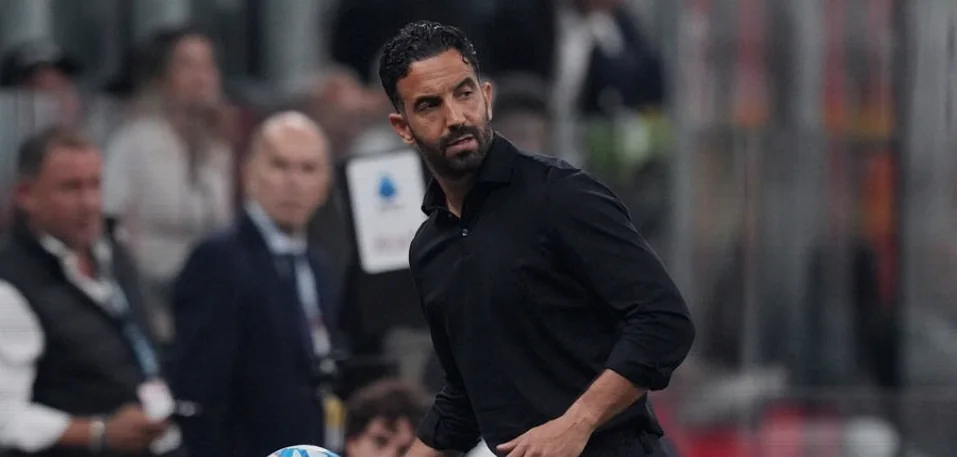
Milan’s 3-0 victory over Lecce gave Ruben Amorim more than a comfortable Sunday evening: it offered a clearer picture of the side he wants to build. His team found the right moments to run beyond the visiting defence, controlled the match after taking the lead and moved to within two points of first place, while their coach kept his assessment deliberately calm.
“It was a good win,” Amorim said afterwards. “I liked the movements, especially the runs in behind. We managed the game and understood the opponent well.”
Those runs were the main difference from Milan’s recent outings against Lazio and Benfica, when possession had too often gone into feet through central areas. Against Lecce, Milan were more willing to challenge the defensive line. Christian Pulisic’s opening goal came from precisely that idea: a ball played forward and a run timed to attack the space.
There was history in the result, too. Amorim has begun his Milan tenure with three wins and two draws from his first five matches, a sequence no Rossoneri coach had managed since Nils Liedholm. The Portuguese was not tempted into comparisons with Arrigo Sacchi or Fabio Capello, however. “It is a different era, but we are improving,” he said.
Freedom, adaptation and the midfield balance
Amorim felt his players had been given greater licence against Lecce after looking overly rigid in previous matches. “Today they had more freedom,” he explained. “In the last few games we had been a little static and too restrained.”
There was also an adjustment in the defensive positions, with Gila operating almost as a full-back in a four-man line. Amorim presented it as a necessary response rather than a permanent declaration. “I cannot repeat my mistakes. If we do not have the attributes to play in a certain way, we have to adapt,” he said. “We will return to building with three, but we will see. In Italy, coaches are very good, particularly at matching opponents man for man.”
Luka Modric remained central to the discussion around Milan’s rhythm. Amorim believes the Croatian benefits when his side can keep the ball for sustained periods, rather than turn every contest into a sequence of transitions. “With Modric, we need to have possession for a long time, but he is ready to play whenever we need him,” he said. “If the match is only about transitions, it is not good for him or for Jashari. In possession-based matches he is perfect; in the others we will assess it. But he can play every game.”
Jashari, despite being mentioned in that context, did not leave the bench against Lecce. The midfielder’s absence was one of the few unresolved notes on a night that otherwise strengthened Amorim’s hand.
The coach also looked back at points Milan feel they left behind. “We must remain balanced in our judgments, but we deserved more points,” he said. “We deserved more against Lazio, and against Juventus we conceded at the end.” Milan are only two points off the summit, and the Lecce result has given that argument greater weight: the early record is encouraging, but Amorim’s attention remains fixed on making the team less predictable and more complete.