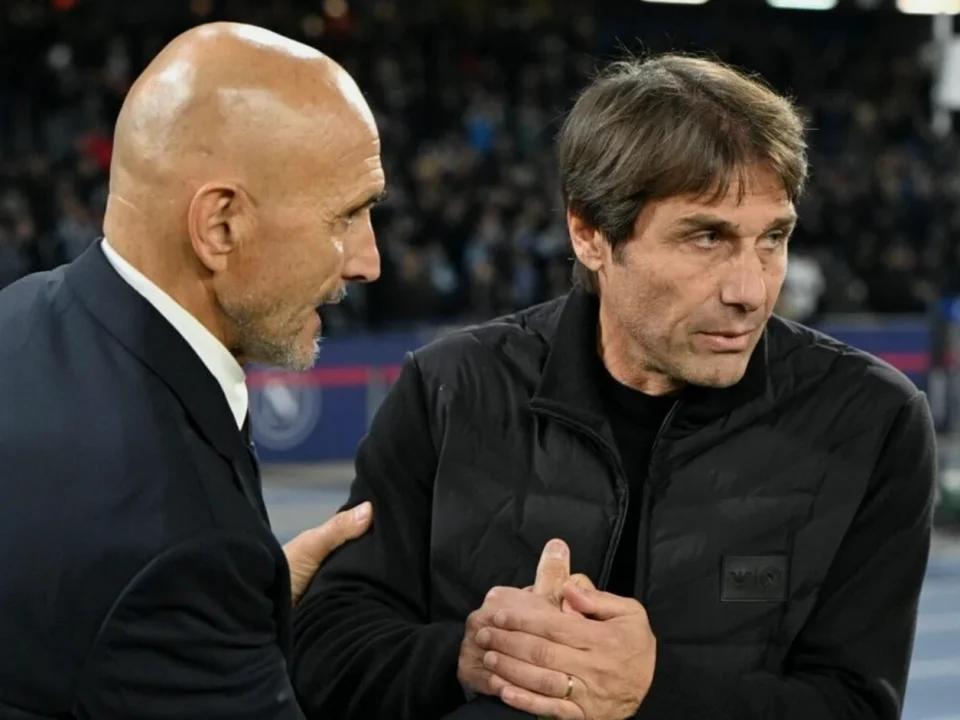
Antonio Conte remains outside the dugout, but his language is already that of a coach measuring the next great obligation. He does not describe a return as a matter of simply taking a job. The project, the pressure and the possibility of restoring a club’s identity would have to be there.
The coach and the club
Conte has said he would consider returning during the season only if the opportunity carried real weight. He is drawn to clubs that have, in his view, drifted away from their own history: places where he could revive that tradition and make it visible again.
For him, those are not comfortable appointments. He wants an environment in which expectation is unavoidable and where the objective is not merely to take part. It is a description that naturally invites attention from England, where Manchester United are in a difficult early spell under Michael Carrick.
United have taken five points from five matches, leaving them ten behind Manchester City and seven adrift of Arsenal. The feeling around the club is that another transitional campaign could be developing, and Conte’s past in the Premier League with Chelsea and Tottenham makes England a familiar stage for such a challenge.
There are fewer obvious openings elsewhere among the major European leagues. In Serie A, however, Conte’s name will remain part of the conversation for as long as he is unattached, even after his spells with Inter and Napoli.
Juventus and an unfinished connection
A return to Juventus carries a particular history. Conte’s first coaching relationship with the club ended in 2014, after difficult transfer discussions involving Juan Iturbe and Juan Cuadrado and the remark that came to symbolise the separation: the question of expecting luxury dining on a ten-euro budget.
Juventus have not won the Scudetto since 2020, while their last Champions League success came in 1996. The gap in Europe will reach 30 years this season, a striking contrast with the sequence of domestic trophies the club collected, especially through the 2010s.
Conte’s outlook remains closely aligned with the old Juventus demand for victory. He accepts that only one side can finish first each year, but believes a coach must give supporters, players and directors the conviction that success is possible.
That conviction comes from both triumph and defeat. Conte recalled Italy’s loss to Brazil on penalties in the 1994 World Cup final, arguing that history remembers the champions rather than the side containing Roberto Baggio and Franco Baresi that fell short. He made the same point through Italy’s golden-goal defeat to France at Euro 2000.
His own career supplied further examples. He won the Champions League with Juventus against Ajax in a penalty shoot-out, but also lost three other finals in the competition. For Conte, those experiences explain the intensity he seeks to pass on to his squads: a final may appear to offer another chance, but that chance is never guaranteed.
What Conte wants from the next chapter
Conte’s message is that success is built through work rather than expectation. He has won extensively, he has also lost at the highest level, and he believes achievement cannot simply arrive on its own.
That may also help explain why he has not returned to the Italy national team. A national-team role would require a long commitment, potentially four years, without the same immediate certainty of building a winning cycle.
Manchester, Milan and Turin are different football worlds, each with its own boardroom and sporting pressures. Yet they share the kind of burden Conte appears to be seeking: a major club where the task is not to manage decline quietly, but to restore the belief that trophies should again be within reach.