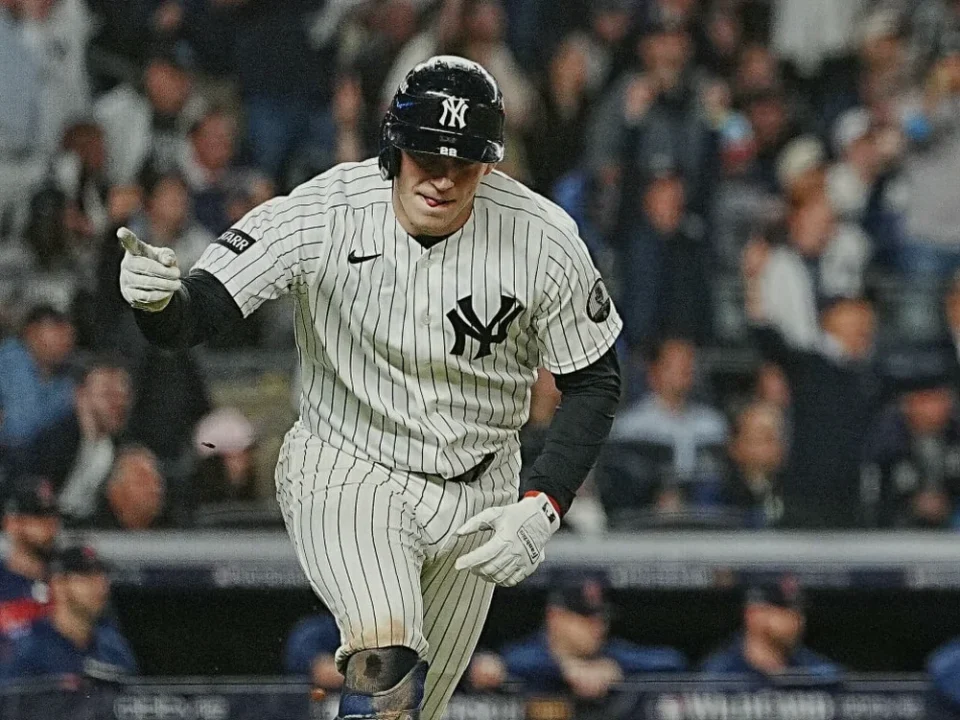
Ben Rice walked out of the Wild Card Series looking like the Yankees’ answer to Aaron Judge’s absence. With Judge still uncertain for the opening of the postseason, Rice supplied two more home runs against Boston after hitting 41 during the regular season, and now the Bronx lineup turns toward Tampa Bay with its hottest left-handed threat front and center.
The Yankees open the American League Division Series against the Rays on Saturday at 6:30 p.m. ET, with TBS, truTV, UniMas and HBO Max carrying Game 1. Tampa Bay finished as the American League’s top club, but Rice gave its pitchers a rough ride over 13 regular-season meetings.
Quick facts
- Rice hit .356 against Tampa Bay, with a .431 on-base percentage, .889 slugging percentage and a 1.320 OPS.
- He hit seven home runs in 13 games against the Rays during the regular season.
- Against Rays ace Drew Rasmussen, Rice went 1-for-10 with five strikeouts, though his lone hit was a homer.
- Rice is batting .347 with a .855 slugging percentage against four-seam fastballs across the regular season and playoffs, with 17 homers.
- His .970 OPS against right-handed pitching ranks sixth in the Majors this season.
There is one large caution sign inside all those Rice numbers: Rasmussen. The right-hander held Rice to a 50% swing-and-miss rate and could get two turns in a best-of-five series. That matchup may tell the story early, because Tampa Bay already showed a clear blueprint for keeping Rice from sitting on a heater.
Rasmussen fed him cutters 41% of the time, well above his 27% cutter rate against left-handed batters overall. Changeups made up 23% of his pitches to Rice, while four-seam fastballs accounted for only six of 39 pitches, or 15%. When Rasmussen did go upstairs with the four-seamer, it generally came with two strikes.
The broader Rays staff followed much the same script. Tampa Bay right-handers used changeups 25% of the time against Rice and cutters 21%; left-handers leaned on changeups and sweepers at 24% each. The Rays threw him only 18% four-seamers, even using more sinkers — 36 — than four-seam fastballs, at 33.
That approach is not simply a reaction to one Yankee slugger. Tampa Bay used four-seam fastballs just under 28% of the time this year, placing it among the 10 lowest rates in baseball and in the bottom three of the American League, ahead of only Boston and Kansas City in that category. The Rays also led the Majors in changeup use at 21%.
Rasmussen, closer Bryan Baker, Nick Martinez, Griffin Jax and Ian Seymour all throw changeups in volume. Tampa Bay is comfortable using the pitch even in same-handed matchups, and Rice should expect plenty of offspeed offerings rather than a parade of straight fastballs.
That makes sense against a hitter who has punished four-seamers better than anybody in the sport. Rice’s +25 runs created against that pitch leads the Majors, ahead of Bryce Harper at +23, Pete Crow-Armstrong and Bryce Eldridge at +20, and Yordan Alvarez and Kazuma Okamoto at +18.
Rice has handled cutters and changeups well enough over the full season; the four-seamer is simply where he becomes dangerous in a hurry. Sinkers offered Tampa Bay a possible soft spot during the regular season, when Rice posted a minus-2 run value against them. But Boston’s Wild Card pitching gave the Yankees a reminder that those numbers can change in one at-bat.
Both of Rice’s Game 1 homers against the Red Sox came against 97 mph sinkers. He took a left-on-left offering from Erik Miller out, then did the same to a Brayan Bello sinker from the right side of the mound. He also lashed a 110 mph double off a 99 mph, high-zone four-seamer from Boston ace Payton Tolle.
Rice has already hurt several Tampa Bay arms despite the club’s preference for movement pitches. He homered off Peralta’s changeup and Seymour’s sinker, doubled off a Martinez changeup, and collected hits against Martinez’s cutter and Seymour’s sweeper. Rasmussen has had the upper hand, with Jax also giving Rice some trouble, but the rest of the Rays’ menu has not been untouchable.
Freddy Peralta presents another wrinkle. His long-standing fastball-heavy reputation remains intact to a degree, as he has thrown roughly half four-seamers to left-handed power hitters since joining Tampa Bay. Still, the Rays increased his changeup usage against lefties from just under 24% before the trade deadline to 34% after acquiring him.
The Yankees also should see a more favorable platoon landscape than they did against Boston. More than 70% of Tampa Bay’s pitches this season came from right-handers, compared with barely 40% for the lefty-loaded Red Sox. Rice’s .970 OPS against righties trails only Yordan Alvarez, Rafael Devers, Harper, Juan Soto and Nick Kurtz.
Even when Tampa Bay brings a lefty, Rice is no longer an easy matchup. His .803 OPS in lefty-versus-lefty situations includes three Wild Card Series hits against Boston southpaws: the Miller homer, the double off Tolle and a single against Alec Gamboa.
Judge’s status will remain a major October conversation, but Rice has already made himself the Yankees hitter Tampa Bay must solve. The Rays have the pitching depth and the game plan to make him work for every mistake. Rice has the season-long production, and the fresh October swings, to make one mistake enough.