AC Milan’s meeting with Benfica at San Siro will carry a private weight for Ruben Amorim, Gonçalo Ramos and Diego Moreira. All three came through Benfica’s academy at Seixal, and each will face the club that shaped the earliest part of his football life.
Benfica’s academy returns to the Milan stage
Amorim and Ramos have already acknowledged that emotion will be part of the occasion, even if the demands of the match leave little room for nostalgia. Moreira shares the same connection, having also developed in Benfica’s system before joining Milan.
The Benfica Campus has long been one of European football’s most productive development centres. Its work is visible not only in the players who reach the first team, but in the transfer income generated when leading talents move abroad.
Quick facts
- Benfica have generated more than €600 million from academy-player sales during the past decade.
- Joao Felix remains the academy’s biggest sale, joining Atletico Madrid for €126 million.
- Ruben Dias moved to Manchester City for €71 million, while Joao Neves joined Paris Saint-Germain for €66 million.
- Gonçalo Ramos was sold to PSG for €65 million, with a possible further €15 million in bonuses.
- Benfica aim to promote at least two academy players to the senior squad each season.
- About 600 young players are currently involved in the club’s competitive development pathway.
The Seixal site reflects the scale of that commitment. Benfica Campus includes nine pitches, three of them artificial surfaces, while the main synthetic field has seating for 2,600 spectators. The academy building contains 86 rooms, two gyms, 28 changing rooms, two dining areas, two auditoriums, swimming pools, hot tubs and a sauna.
That infrastructure has helped Benfica create a familiar cycle: develop a player, give him a route to senior football, then decide whether his future is in Lisbon or elsewhere. The club’s major outgoing deals include Victor Lindelof to Manchester United for €35 million, Renato Sanches to Bayern Munich for €35 million, Bernardo Silva to Monaco for €15.7 million and Joao Cancelo to Valencia for €15 million.
There is still a strong academy presence within the current Benfica group. Goalkeepers Soares and Ferreira, defender Tomas Araujo, full-backs Banjaqui and Neto, and forward Cabral are among those who have come through the club’s youth structure.
Araujo’s path
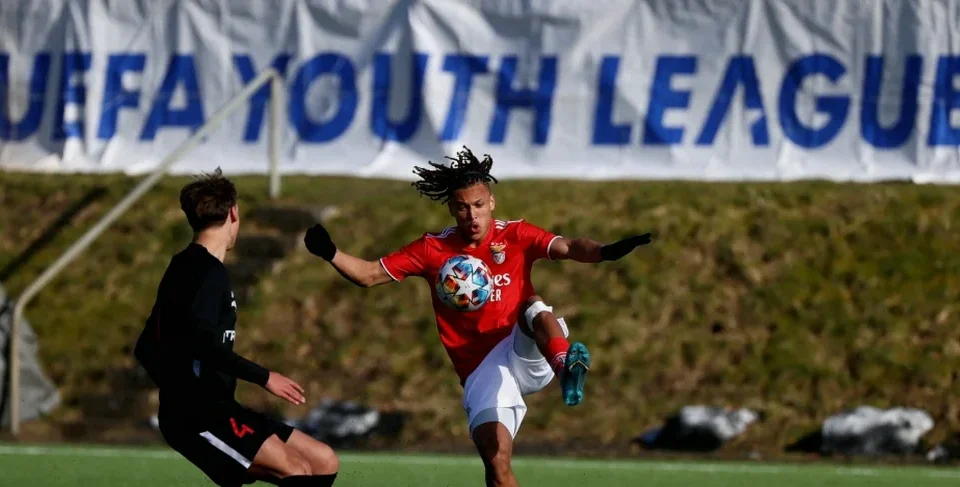
Araujo, who won the 2021-22 UEFA Youth League alongside Moreira, will be among the substitutes at San Siro. He joined Benfica at 14 and described reaching the senior side as the fulfilment of the ambition shared by every boy entering the academy.
He said wearing Benfica’s first-team shirt brought a special feeling, and reflected on the people who guided him through the system. Pedro Alvaro and Alexandre Penetra were early reference points, while Nicolas Otamendi and Antonio Silva became regular examples through their performances.
Araujo also stressed that the relationships formed in the academy had lasting value. He credited the staff around the programme for their professional support, but said the human side of his Benfica years had made the deepest personal mark.
The Youth League triumph remains the standout trophy of his youth career, though he regards the wider journey as equally significant. Looking back, he said, also underlines how much he has progressed as a player. Marco Silva considers the defender an important member of the group.
Development before sales
Guilherme Muller, who leads Benfica’s academy operation, views the club’s transfer record as an outcome rather than the central purpose. For him, the greatest satisfaction comes when former academy players succeed, regardless of where their careers take them.
He said the €600 million-plus raised over 10 years reflects two decades of investment. Yet Benfica’s primary task, he insisted, is to prepare young players for the club’s own first team rather than simply produce assets for sale.
The structure rests on what Muller described as two foundations: facilities and culture. The physical side includes Benfica Campus, the Lisbon hub and six training centres across Portugal; the other side is made up of staff, shared principles and a common methodology.
At the centre is the “Formar à Benfica” framework, a detailed guide covering expectations for each position, the playing model and the profiles the club wants to develop. Coaches are expected to work within it, while retaining enough freedom to add their own ideas.
Selection is based on potential rather than present form alone, because the two do not always align in young players. Benfica also uses a psychology department and a programme designed to help players and their families manage the pressure created by expectation.
For Milan’s three former Benfica boys, that whole process comes back into view on one evening at San Siro. The fixture is part of the season’s immediate business, but it is also a reminder that Benfica’s academy continues to shape matches far beyond Lisbon.
SEO Title: AC Milan’s Benfica connection: Amorim, Ramos and Moreira return to their roots
SEO Description: Ruben Amorim, Gonçalo Ramos and Diego Moreira face Benfica at San Siro as the Portuguese club’s academy model, major sales and next generation come into focus.