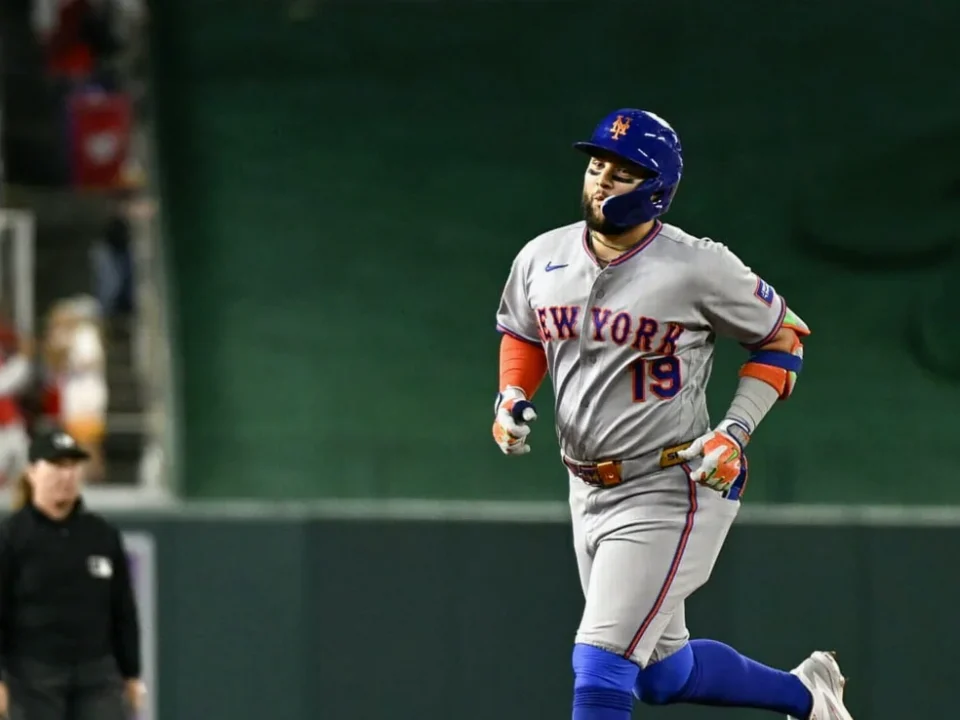
Bo Bichette’s first offseason decision with the Mets will arrive almost as soon as the World Series curtain falls. He has five days after the Fall Classic ends to choose whether to walk away from the final two years and $86 million on his three-year, $126 million deal, but the safer clubhouse read is that he will stay put in New York for at least one more season.
Key takeaways
- Bichette must decide shortly after the World Series whether to exercise his contract opt-out.
- His current agreement pays $42 million per season, tied for the sixth-largest annual salary in Major League history.
- The Mets shortstop has another opt-out clause available following the 2027 season.
- Bichette has said he expects New York’s young roster to take a step forward next year.
- He and his wife, Alexis, have expressed comfort with their life in the city.
New York offers more than a paycheck
An opt-out usually begins with one of three motives: a player wants a new home, sees a better chance to win elsewhere, or believes the market will pay more. Bichette has not publicly suggested that either of the first two is pushing him toward the door.
In August, Bichette spoke optimistically about the Mets’ direction, pointing to the combination of hungry younger players and veterans with long résumés. He said a disappointing season can sharpen a club’s edge, adding that he expects the group to arrive better prepared and more motivated next year.
“I have no doubt that this club will improve next year,” Bichette said. “There is still plenty of talent in that room, especially young talent that is hungry, along with players who have accomplished a lot in this game.”
The off-field fit appears solid as well. Bichette said Alexis “loves living” in New York, while describing the city as a comfortable home for the family. He also acknowledged the weight that comes with playing under New York’s spotlight, but framed that pressure as part of the appeal.
“As difficult as New York can be as a place to play, there is something special about that level of expectation,” he said. “There is something about trying to climb that mountain.”
The contract math favors another year with the Mets
Bichette could test a market that does not project to be especially deep in impact infielders. Before joining the Mets, he reportedly passed on a Phillies proposal worth nearly $200 million across eight years, choosing the shorter $126 million arrangement with the possibility of reaching free agency again quickly.
A new deal worth more than $100 million is not impossible if he opts out now, and that would exceed the $86 million still owed to him by the Mets. But matching the annual value of his present contract would be another matter entirely.
The $42 million average annual value on Bichette’s deal is tied for sixth all-time, trailing only contracts held by Shohei Ohtani, Kyle Tucker, Juan Soto, Max Scherzer and Justin Verlander. Mets owner Steve Cohen’s club has handed out four of those six contracts, while the Dodgers account for the other two.
Bichette did not perform at that salary level in 2026. His career OPS stood at .806 when he signed and ranked 39th among active major leaguers; after the 2026 season, it had slipped to .788, placing him 53rd. Even with limited premium hitting available in free agency, a comparable $42 million yearly commitment would be difficult to find.
That is where the second opt-out changes the equation. Bichette can return for 2027, rebuild his market at age 28, then revisit free agency after that season at 29. A strong year would give him another chance to pursue a larger overall payday. If New York becomes the place he wants to remain, he can instead finish the deal and reach the market at 30 with the remaining $86 million secured.
The paperwork will not be final until after the World Series, so the possibility of a surprise remains. Still, with another escape hatch waiting after 2027 and a record-level annual salary already in hand, Bichette has plenty of reason to keep his uniform in the Mets’ locker room.