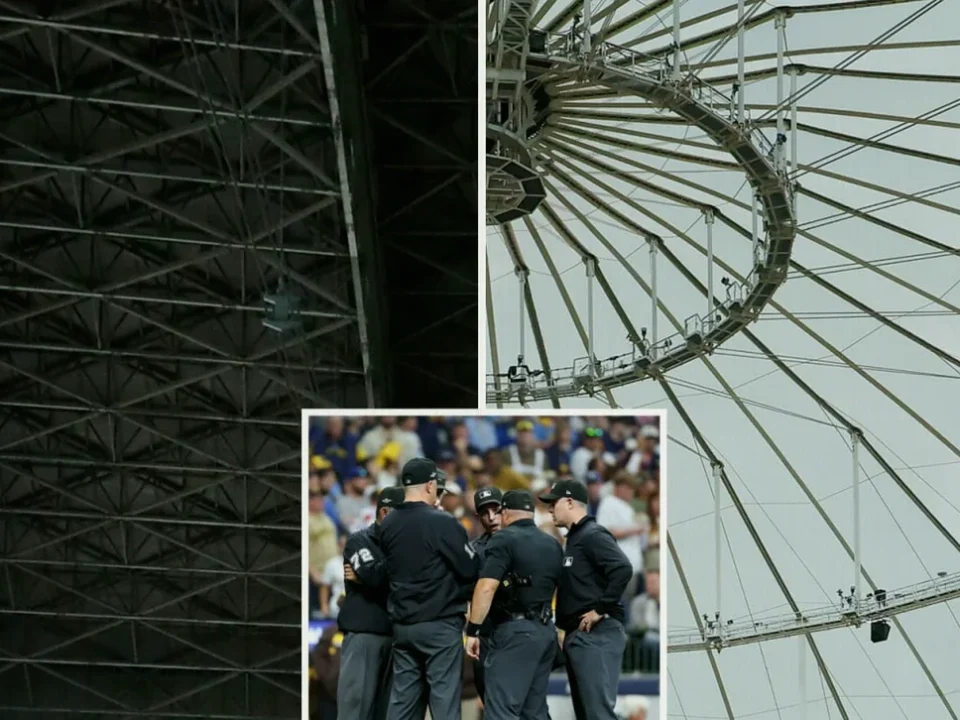
Milwaukee’s American Family Field and Tampa Bay’s Tropicana Field could become more than the settings for this World Series. With cool weather expected in Wisconsin and a permanently enclosed dome awaiting in St. Petersburg, the Brewers and Rays may play the first Fall Classic staged entirely indoors — with roof cables and catwalk rings carrying a real chance of entering the box score.
Game 1 is set for 8 p.m. ET tonight, with Milwaukee opening the series at American Family Field. Forecast temperatures near 60 degrees at first pitch for Games 1 and 2 make a closed roof the likely call. Once the series shifts to Tropicana Field for Games 3 and 4, and Game 5 if needed, there will be no open-air alternative.
The final decision in Milwaukee does not belong solely to the Brewers. During the regular season, a club with a retractable roof chooses whether to start open or closed. In the postseason, MLB’s Commissioner or an appointed official controls roof movement after consulting with the home club and the umpire crew chief. Regular-season decisions in Milwaukee generally fall around the 60-to-65-degree range.
That could put this series in unusual company. Globe Life Field hosted the entire neutral-site 2020 World Series, but its roof was open for Games 1, 2 and 4. The Rangers and D-backs both played in enclosed parks during the 2023 World Series, yet Chase Field opened its roof for Games 3 through 5. Tropicana Field, meanwhile, remains a steady 72 degrees under its roof.
Milwaukee’s overhead home-field wrinkle
American Family Field’s roof has already helped decide a postseason game this year. In Game 1 of the National League Division Series against San Diego, the Brewers held a 3-2 lead in the ninth when Ty France drove a ball high toward deep left field. The ball struck a cable or support structure and dropped into left fielder Jackson Chourio’s glove for the second out.
France’s potential go-ahead shot became an out, and Milwaukee held on to win. Whether the ball was headed fair or foul without the contact remains a point of debate. Brewers manager Pat Murphy and third baseman Joey Ortiz believed it was traveling foul from their angles, while the Padres were left to consider the other possibility.
San Diego challenged the call, arguing that the ball might have contacted the structure over foul ground, which would have made it dead. Replay upheld the ruling. Under Milwaukee’s ground rules, a ball that hits the roof, truss or cable above fair territory remains live. If it is caught, the batter is retired and runners advance at their own risk.
A ball striking those structures above foul territory is dead. A ball hit over fair ground that then lands foul is ruled foul, while one that comes down in fair territory is fair.
Brewers third-base coach Matt Erickson had jokingly called it “incredible home-field advantage” after the play. The moment carried extra weight because cameras had caught Erickson predicting that kind of break during the pregame lineup exchange.
It was not the first fair ball at American Family Field to meet the roof. Philadelphia’s Jayson Werth hit a fly ball into the truss during the sixth inning of Game 4 of the 2008 NLDS; the ball fell back toward the infield and Brewers third baseman Craig Counsell made a diving catch. In April 2018, Reds hitter Scooter Gennett sent a ball toward right field that clipped a truss and fell into Eric Sogard’s glove for another out.
Those plays, along with France’s, are the only known cases of a fair ball contacting the Milwaukee roof system during a game. Foul balls have found the structure on other occasions.
Catwalks await in St. Petersburg
Tropicana Field presents a different kind of indoor challenge. The building was fully repaired after Hurricane Milton tore away its roof two years ago, forcing the Rays to spend a season playing outdoors at George M. Steinbrenner Field in Tampa. Back under the dome, the club returns to a park with artificial turf, difficult bounces and a white backdrop that can make high fly balls hard for visiting outfielders to locate.
Above the field sit four catwalk rings, labeled from highest to lowest as A, B, C and D. Their ground rules are specific:
- A fair ball hitting the C-ring or D-ring is a home run.
- A fair ball contacting the higher A-ring or B-ring remains live.
- A fair ball that lodges on either the A-ring or B-ring is a ground-rule double.
- A foul ball hitting any catwalk is dead.
The catwalks have been involved plenty. Entering the 2026 season, 200 fair balls had struck them. Five such balls have done so in postseason play, and each was ruled a home run. The latest came when Nelson Cruz hit the C-ring in Game 1 of the 2021 ALDS.
This year’s American League Division Series delivered another catwalk moment, though not a home run. In Game 2, Yankees hitter Spencer Jones sent a towering popup into shallow right-center that stayed aloft for 10 seconds before hitting the B-ring. Right fielder Victor Mesa Jr. caught the descending ball for an out.
So the World Series opens with more than pitchers, hitters and late-inning decisions in play. Milwaukee’s steel and cables may loom over the first two games, while Tampa Bay’s rings wait for the middle portion of the series. In an October matchup that may never see open sky, a ball hit just a little too high could alter an inning — or much more.