Justin Herbert’s frustration boiled over on the SoFi Stadium turf last week, and the Chargers now have a short turnaround to turn that emotion into cleaner football. Los Angeles will try to reset its offense against the Buffalo Bills on Sunday, with kickoff set for 1 p.m. ET on Fox, after an error-filled Week 2 loss to the Raiders left the unit searching for answers.
The defining sequence came on third-and-inches in the third quarter. Rookie receiver Tre’ Harris went in motion as the play clock neared zero, but Jake Slaughter’s snap struck Harris in the leg before the play could develop. Herbert recovered the loose ball, then erupted, shouting and pounding the turf while Harris remained down with his head pressed into the field.
It was an unusually visible display from the seventh-year quarterback, but it matched the Chargers’ offensive performance. Los Angeles lost six fumbles against Las Vegas, right tackle Joe Alt was flagged for three false starts, and Herbert did not connect on a throw traveling at least 20 yards in the air.
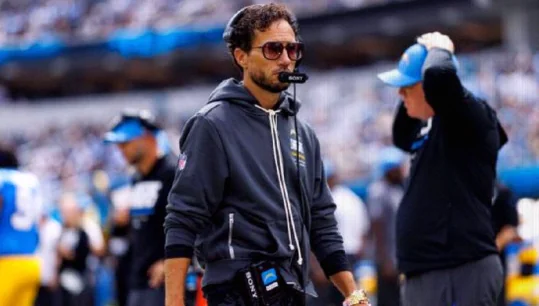
Coach Jim Harbaugh described the early issues as “growing pains,” while offensive coordinator Mike McDaniel acknowledged the offense has fallen well short of its own standards. Harris said the group understands it has to improve quickly.
The failed short-yardage play also illustrated why the Chargers’ start has generated questions about the operation of McDaniel’s new system. Had the snap been clean, Omarion Hampton appeared to have space to the left, with Harris positioned to lead the way. But the play never reached that point because of the pre-snap execution error.
With a 6-foot-6 quarterback and a 220-pound former first-round running back, the situation naturally invited questions about whether Los Angeles could have used a more basic sneak or downhill run. Herbert, however, did not blame the scheme’s complexity, saying every NFL offense carries a heavy workload and that the players must be prepared and fully understand their assignments.
McDaniel’s overhaul has yet to click
McDaniel arrived as one of the Chargers’ biggest offseason additions after Harbaugh dismissed Greg Roman following a 16-3 wild-card loss to the New England Patriots. Roman had been Harbaugh’s offensive coordinator in two separate NFL stops, but Los Angeles moved on after two uneven offensive seasons.
McDaniel had been fired after four years leading the Miami Dolphins, yet remained a coveted offensive coach and joined the Chargers to work with Herbert while learning under Harbaugh. General manager Joe Hortiz then reshaped the roster to fit McDaniel’s wide-zone preferences.
The Chargers signed running back Keaton Mitchell and fullback Alec Ingold after McDaniel identified both as important fits. They also added right guard Cole Strange, who had previous experience with McDaniel in Miami, and drafted speed receiver Brenen Thompson in part because of the coordinator’s input.
There was considerable optimism during the offseason, including McDaniel’s expectation that the receiving group could produce career-best numbers. Instead, Los Angeles has opened 2026 with five turnovers and seven fumbles, its highest fumble total through two games since at least 2000. It is also the worst two-game fumble start for an offense coached by McDaniel.
McDaniel said he has weighed reducing the volume of the offense while he learns his new personnel, but he does not want to make a reactionary change simply because the results have been poor. His responsibility, he said, is to adapt rather than abandon the system or stubbornly repeat what worked elsewhere.
The early statistical contrast is sharp. In the first two weeks of 2025, Roman’s Chargers offense posted a 75.82 efficiency rating, the NFL’s 10th-best mark over that span. McDaniel’s offense has registered a 17.97 rating through two games this season, ranking 29th.
McDaniel’s system also uses motion before the snap on 74.1% of plays, compared with 59.2% under Roman last season. Roman’s attack was often criticized for its simpler structure, but the current version has looked more disjointed than any Chargers offense during the Harbaugh era.
Inside the building, the belief remains that the design is not fundamentally broken. Players have been troubled by mistakes showing up on game days that they say were largely absent during offseason work and training camp. One member of the organization characterized them as errors normally expected during OTAs rather than in September.
McDaniel said Herbert has taken too much responsibility for the struggles, and the coordinator has increased his meetings with the quarterback in recent weeks. McDaniel noted that both the starting quarterback and play-caller can feel isolated when a team is struggling, and said their approach has been to make sure neither is handling the pressure alone.
Herbert sees room for optimism in the film despite the ugly results. The Chargers, he said, can identify numerous missed opportunities and plays that were close to breaking open. Against Buffalo, they will need to turn those near misses into completions, first downs and ball security.