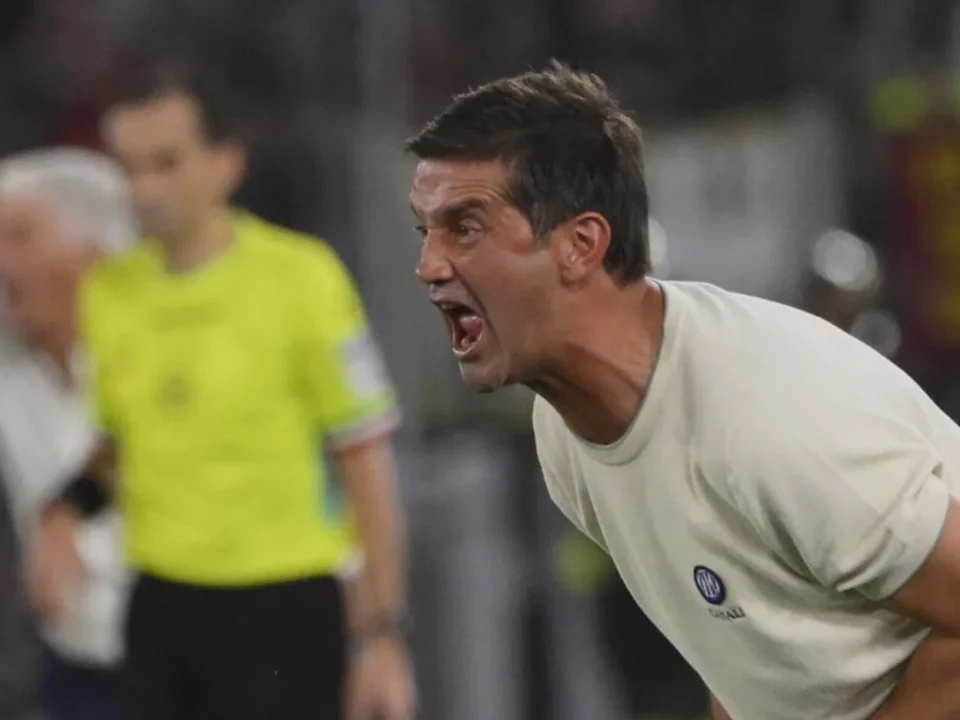
Inter’s draw at Roma carried more than the value of a point. Two goals behind at the Olimpico, the Nerazzurri returned after half-time with greater order and conviction, turning a troubled opening into a response that again underlined Cristian Chivu’s authority over his squad.
Chivu’s authority is now visible across Inter
A year ago, the appointment of the Romanian coach prompted understandable questions. He was taking charge of a first team for the first time, inheriting players coming off a major and painful disappointment. Those reservations have since receded. After winning the Scudetto and Coppa Italia last season, Chivu has established himself as a coach whose instructions are heard and followed.
The response in Rome was particularly telling. A frantic reaction could easily have produced a disjointed performance, but Inter instead became more composed as well as more aggressive. Lautaro Martinez and his team-mates played with the urgency required, while improving their concentration and attention compared with the first half.
- Chivu publicly backs his players and regularly highlights their quality, personality and willingness to work.
- He is quick to protect individuals when their performances are questioned, most recently goalkeeper Martinez.
- Behind closed doors, however, he does not avoid confrontation when standards have not been met.
- His ability to combine protection with firm internal demands has helped him retain the group’s trust.
The Olimpico reaction did not erase the defensive concern
Chivu did not reveal the detail of his half-time intervention after the match, but his displeasure was clear. The defensive work had fallen below Inter’s level, and the eventual draw did not remove his frustration.
The Roma match was not an isolated warning. Inter have now gone two goals down in four successive games, a pattern that cannot be treated as a minor flaw even when the side finds a way back into the contest. Chivu is expected to continue working on those lapses until the team stop putting themselves in such positions.
What Inter must correct
- They must begin matches with sharper concentration and greater defensive determination.
- They need to read dangerous situations earlier rather than chasing games after conceding.
- The improvement seen after the interval in Rome must become the standard from the opening whistle.
There is recent evidence that Chivu’s anger can produce a lasting correction. A year ago, Inter lost away to Juventus after being overtaken late in the match. The coach was furious with what he regarded as careless management of the ball: at a moment requiring authority and directness, too many players had chosen delicacy instead. That attitude was not seen again after the Juventus defeat.
Selection decisions reflect a coach prepared to act
Chivu’s control is also evident in his substitutions. Inter’s replacements have often brought either a fresh contribution or a different solution, rather than merely filling time. Yet he does not usually make an immediate public judgement on a player at half-time.
Even when a first half has gone badly, as it did against Roma, he tends to allow a short period after the restart for a response. If that response does not arrive quickly enough, he makes the change. It is a measured approach, but one that leaves little doubt about the standards expected.
- Players are given the opportunity to address a poor spell on the pitch.
- The team is asked to show a clear reaction early in the second half.
- If the performance remains short of the required level, Chivu intervenes from the bench.
The international break offers time for a reset
Inter have been granted a week away, although the work will be split by international duty. Thirteen members of the squad have joined their national teams, while those remaining in Milan will begin the corrective work under Chivu’s supervision.
Once the full group returns, the message is likely to be repeated. After the evidence of recent weeks, it would be a surprise to see an Inter side that is passive from the start, slow to assess danger or soft in its defensive approach when the season resumes. The coach has shown that he will accept neither repeated carelessness nor a squad that fails to respond.