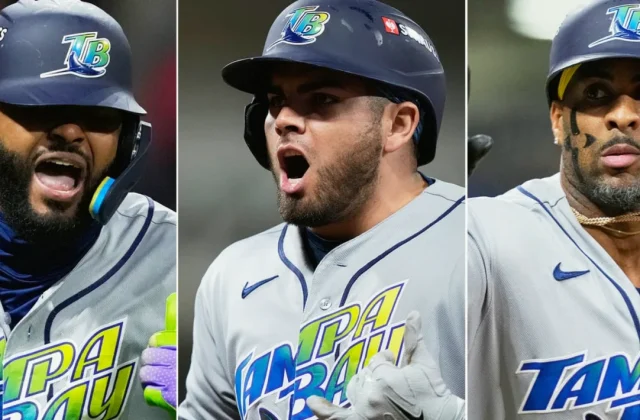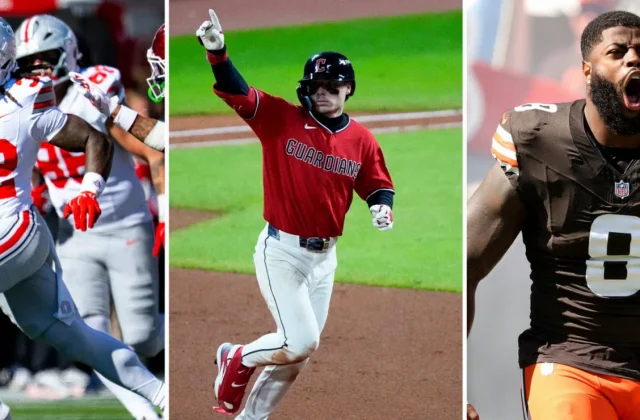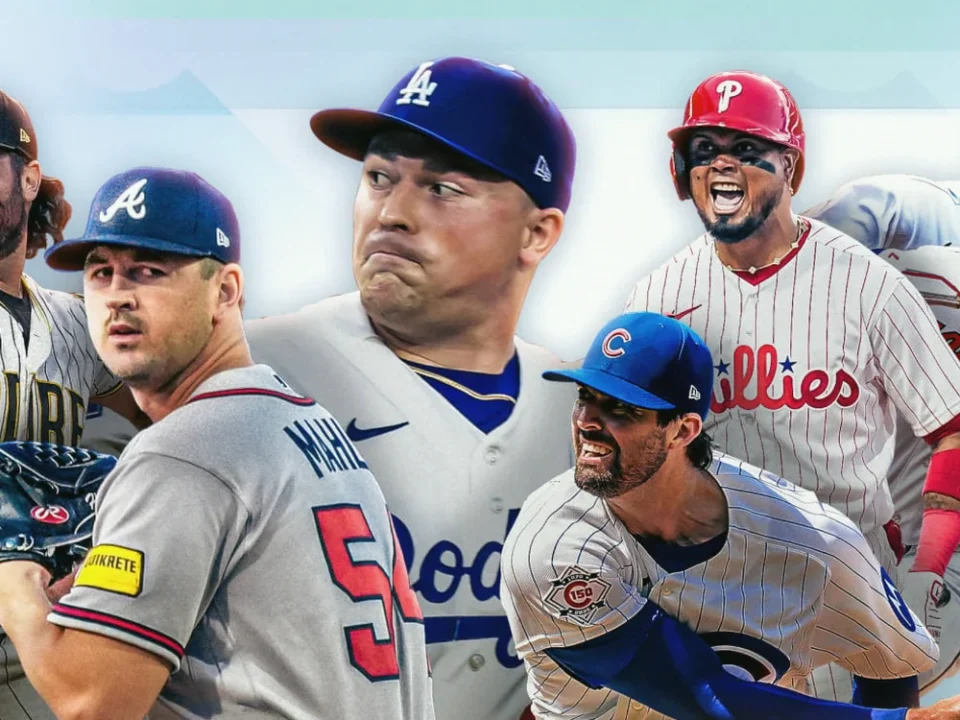
September has a way of sorting out the Trade Deadline. The loudest name in August is not always the deal that matters most when the postseason bracket takes shape. This year’s buyers have made their cases in different ways: Cleveland repaired weak spots, Los Angeles added a potential October ace, Philadelphia rearranged its whole infield, and several contenders found innings where they needed them most.
All statistics are through Thursday’s games, except where noted from Friday’s action.
Cleveland turned thin spots into playable positions
The Guardians were barely above .500 at the Deadline, hardly the usual profile of an aggressive buyer. Cleveland has generally kept its moves modest at this time of year, aside from the 2016 addition of Andrew Miller. This time, the front office acted with more urgency.
The result has been one of the American League’s sharpest climbs. Cleveland’s playoff probability rose 34.6 percentage points, reaching 77.3%, the third-largest increase in the majors since the end of July. Its World Series probability climbed from 3.4% to 5.4%, also third-best behind only Tampa Bay and Milwaukee.
The Guardians did not chase one marquee player. They lifted the bottom of the roster.
The outfield had been a persistent power shortage. From 2021 through 2025, Cleveland outfielders ranked last in the majors with 206 home runs and a .362 slugging percentage. Entering Aug. 2, that group had managed 40 homers and a .352 slugging mark.
Jo Adell changed the look of that unit after arriving from the Angels. He has hit six home runs as a Guardian and produced a 107 wRC+. Since the move, Cleveland outfielders have batted .283/.358/.433 with 17 homers, bringing the club back to a league-average level in the corners and center.
Nathaniel Lowe addressed another opening. The Guardians ranked 28th in first-base fWAR before his arrival, and Lowe has represented an improvement on both sides of the ball. Left-hander Foster Griffin has not replicated his Washington results in a small Cleveland sample, but his core indicators remain largely sound. More importantly, he has supplied rotation depth and another possible postseason option.
That is what changed Cleveland’s path: fewer weak links, more usable October choices, and a real chance to pursue an American League bye.
Dodgers added the arm that can reshape October
Los Angeles was already built for October, which is why its playoff and championship projections have not moved dramatically. The Dodgers remain at a major league-best 24.8% World Series probability, and favorite status leaves limited room for a big numerical jump. Shohei Ohtani’s health has also remained a concern.
Still, no Deadline acquisition carried more top-end impact than Tarik Skubal. The left-hander has pitched to a 1.80 ERA in September, and worries that his NanoScope procedure might linger have eased. With Skubal joining Blake Snell and Yoshinobu Yamamoto, the Dodgers can put together a playoff rotation capable of controlling a short series.
The club is pursuing a third straight World Series championship, a feat achieved previously only by the Yankees and Athletics. The Yankees were the last team to do it, winning three in a row from 1998 through 2000.
October rewards teams that can concentrate innings in their best arms. The 2001 Diamondbacks offered the classic example: Randy Johnson and Curt Schilling accounted for 58.2% of Arizona’s postseason innings after throwing 34.6% of its regular-season innings, helping the club overcome a Seattle team that won a record 116 games. The Dodgers leaned into a similar postseason model last fall, though their workload was spread over more pitchers. Skubal gives them another way to do it again.
Philadelphia found value in the lineup shuffle
The Phillies have gone 23-13 since the Deadline and posted the fourth-largest increase in playoff probability, up 31 percentage points. Luis Arraez has been part of that rise, but his effect reaches beyond his own contact-heavy bat.
Arraez is having an exceptional defensive year at second base, worth plus-13 Outs Above Average and plus-11 Fielding Run Value. His presence allowed Bryson Stott to move to a position where he has been stronger defensively than he was at second, while Alec Bohm shifted to first base.
Bryce Harper’s move back to the outfield created another lineup ripple, pushing lighter-hitting outfield options out of regular work. One transaction effectively altered four positions.
Philadelphia averaged 4.35 runs per game before the Deadline, ranking 18th in baseball. Since then, the club has scored 4.8 runs per game, seventh in the majors. The trades cannot claim all the credit, but the change has come without a meaningful difference in the team’s fielding percentage.
The Phillies also acquired Brooks Raley. He has been inconsistent, though he has not finished a full season with an ERA higher than 2.80 since 2021. That record leaves open the possibility that he can become a useful left-handed piece in a postseason bullpen.
Padres and Cubs went after innings
San Diego has paid heavily in future talent during recent pushes, with James Wood, CJ Abrams and Leo De Vries among the notable names sent away. But the Padres had already committed to this roster and needed to strengthen it if they were going to reach October.
They have made the largest playoff-probability leap in baseball since Aug. 1, up 64.9 percentage points, while their World Series chances have increased by 2.6 points, fourth-most in the majors. Robbie Ray and Casey Mize have not been flawless, but both have taken innings that otherwise might have gone to less reliable arms.
The payoff shows in the staff’s work as a whole. San Diego ranked 16th with a 4.16 ERA through Aug. 2; since the Deadline, the Padres rank fourth at 3.41. The bridge to an elite bullpen is sturdier now, and that can matter greatly in a tight October series.
The Cubs took a similarly direct approach, though their need was more obvious. Chicago’s lineup was already potent and has become even more so, leading the majors at 5.9 runs per game since the Deadline after ranking fourth beforehand. Pete Crow-Armstrong’s continued rise has helped turn a strong offense into a relentless one.
Pitching was the issue, and Chicago addressed it aggressively by bringing in Clay Holmes, Kevin Gausman, David Peterson and late-inning option Ryan Zeferjahn. It is unusual for a contender to remake roughly 60% of a rotation during the season, but the Cubs had decided their existing staff was not sufficient.
Holmes has been the best of the newcomers, going 2-3 with a 3.46 ERA across 39 innings in seven starts. He is not Skubal, and none of the additions comes with automatic-ace certainty. But the Cubs now have a more credible run-prevention group behind an offense that can carry a series. The cost was substantial, including No. 2 prospect Jefferson Rojas in the Holmes deal, but Chicago obtained the different pitching staff it needed.
Mahle has given Atlanta the best immediate return
Tyler Mahle may be the Deadline’s strongest value pickup. After joining Atlanta, he posted a 1.25 ERA and 0.93 WHIP over 43 innings, worth 1.1 fWAR before his Friday start in Houston. He then worked six innings and allowed one run as the Braves secured a postseason berth.
Mahle has settled in as Atlanta’s No. 2 starter behind Chris Sale. The Braves’ playoff odds have not moved much, but their October rotation is more formidable than it was before the trade.
His adjustment has been subtle rather than dramatic. Mahle still works primarily off a mid-90s four-seam fastball and splitter, though he has leaned more heavily on the splitter and mostly put aside his slider. He also moved from a San Francisco defense that rated minus-13 OAA and minus-15 FRV to an Atlanta group rated plus-18 OAA and plus-17 FRV.
That better support may have helped Mahle attack the strike zone more frequently. Not every Deadline success requires a mechanical rebuild or a new pitch. Sometimes the player is largely the same, but the clubhouse, defense and opportunity around him are better.
That is the useful September measure of a trade: not who owned the August headlines, but which moves gave a club a clearer route into October and a better chance once it gets there.