Como and Roma arrive at this stage of the Serie A story from very different places, yet their owners share an increasingly clear idea of how a modern club should grow: invest in young players, protect financial balance and give a powerful coach a central role in the project.
Two owners at the top of Serie A’s wealth table
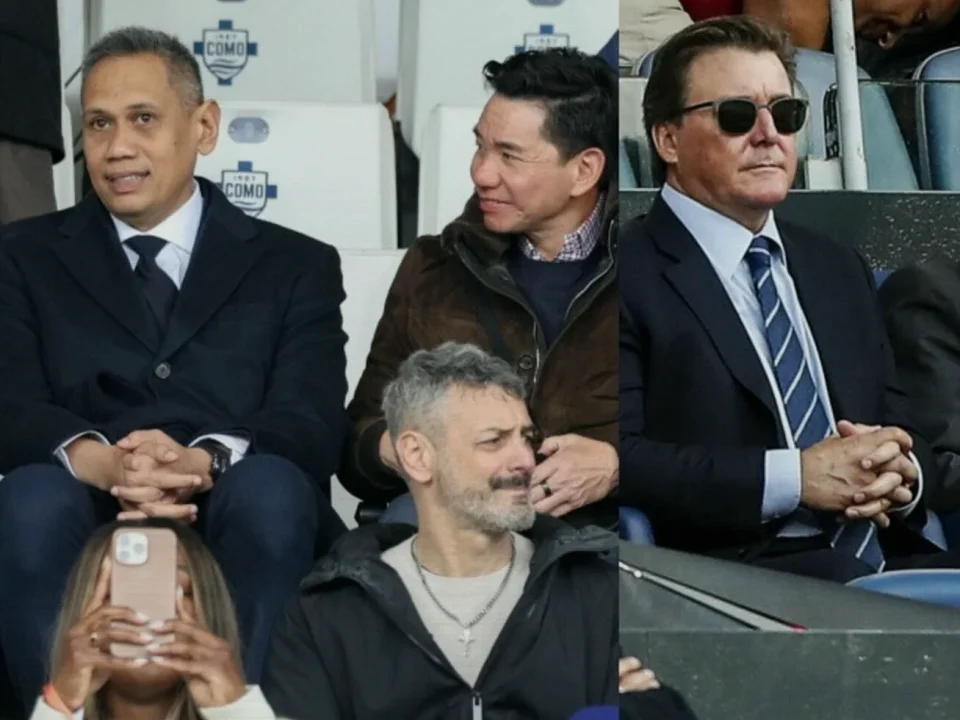
The Hartono family, which owns Como, stands as the wealthiest ownership group in the division, with an estimated combined fortune of $38.5 billion (€34.36 billion). Roma’s Friedkin family follows on $11.4 billion (€10.17 billion), while Bologna owners the Saputo family rank third with $6.4 billion (€5.71 billion).
That financial strength has taken distinct forms. The Hartonos first chose Como as a location for football documentaries in Indonesia before becoming fully involved in the game. The Friedkins, meanwhile, had already built a long-standing connection with cinema in Texas, through film production and the world around it.
Both families understand the value of an image beyond the pitch, although their football operations are not built in the same way. Como see sport, tourism and the Lake Como setting as parts of a wider lifestyle platform. Roma remain much more concentrated on football in the capital.
From Serie D to the Champions League
- Como began its rise from Serie D, a climb with few comparable examples in Italian football.
- The club’s progress accelerated through sustained investment and an increasingly ambitious sporting plan.
- At the end of last season, Como reached the Champions League for the first time, fulfilling an objective that had arrived quickly after the club’s climb through the divisions.
- Roma also returned to the Champions League at the end of the previous campaign, reaching a target the Friedkins had pursued since taking control in 2020.
The scale of the backing has been considerable. Como have committed around €400 million to the transfer market, while Roma’s investment has approached €1 billion. The figures alone do not erase the differences between the two clubs, but they explain why both projects have become prominent parts of the championship’s changing landscape.
Young players and strong coaching centres
Their recruitment strategy provides one of the clearest links. Over the past two years, the major investments approved by the Hartonos and the Friedkins have been directed towards players aged under 24. The intention is not merely to spend heavily, but to combine sporting progress with assets capable of developing in value.
Economic and financial sustainability has become a repeated principle for both ownerships. It sits behind their preference for gradual construction rather than a short-term race for immediate returns.
On the football side, Cesc Fabregas at Como and Gian Piero Gasperini at Roma have become the essential reference points. They are entrusted not only with the team’s identity, but also with market guidance and ideas for improving the clubs from within.
Como president Mirwan Suwarso is a constant presence in the city, reflecting the club’s close connection to its local setting. Roma are run through a more exclusively football-centred vision. Yet beneath the different styles, both clubs have placed their faith in young talent, managed growth and coaches given influence across the sporting structure.