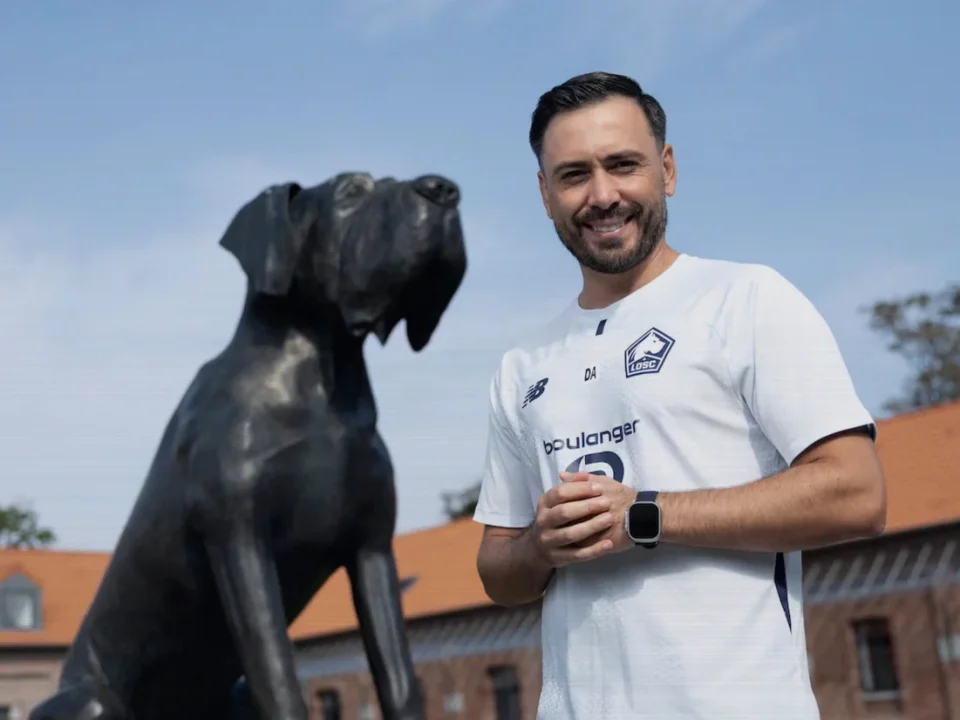
Davide Ancelotti has arrived at Lille with Champions League football, a stable club structure and a clear tactical purpose: to build a side that attacks quickly, plays forward and can live with the demands of Europe’s biggest nights. After a difficult spell following his work with Brazil at the World Cup, the Italian says the move to Domaine de Luchin came at the right moment.
Lille’s return to the Champions League is central to the appeal. Ancelotti sees a club growing without abandoning the financial discipline that has allowed it to remain competitive despite regular sales of leading players. He believes he has been given the squad required for the vertical football he wants to impose.
A Champions League club built to keep moving forward
Ancelotti described Lille as a project with firm standards and an established European presence. Alongside Paris Saint-Germain, he said, Lille are the only French club to have secured consecutive Champions League campaigns, with this representing their second appearance in three seasons.
- Lille have 32,500 members.
- The club’s average home attendance stands at 44,000.
- Ancelotti said the club has recorded positive financial figures while remaining competitive and qualifying for the Champions League.
- He credited planning rather than improvisation for Lille’s ability to withstand the departures of talents including Bouaddi and Matías Fernández.
He praised president Olivier Létang, who knew Carlo Ancelotti from his time as sporting director at Paris Saint-Germain alongside Leonardo. Davide Ancelotti said Létang had lifted Lille from financial difficulty and helped establish the club among the leading sides in France.
Létang enjoys discussing football with his coach but respects the boundaries of the role, Ancelotti said. The president places particular importance on discipline, while the Lille coach considers himself a protector of the values the club wants to uphold.
Competing with PSG remains a major challenge, though Ancelotti believes French football is more difficult than it is often given credit for. He pointed to a physical, high-intensity league which he considers close to the Premier League in that respect, and noted that many players eventually move to England. French television-rights problems have reduced the competition’s visibility, he said, but not its ability to produce talent.
Vertical football and the need to defend properly
Ancelotti wants his teams to move the ball with purpose rather than retain it merely for protection. For him, attacking actions, decisive chances and goals require speed.
“When you attack forward and run in behind, you create disorder,” he said. “That is much harder to defend than circulation from side to side, when opponents can adjust more easily.”
His preferred defensive shape depends on the squad’s transitional qualities, but the principle remains a compact block whether pressing high or sitting deep. He warned that a high press carries particular danger against teams capable of playing out and exploiting space behind the defence.
Pressing effectively, he argued, usually requires numerical equality in the first line, plus defenders able to survive one-on-one duels. Leaving an extra player at the back while allowing an opponent superiority during build-up can be punished, especially in leagues where teams are comfortable in possession.
A back four is his preferred starting point because of its flexibility. It can become a five-man defence without the ball, while possession play can be built with either two or three players at the base. A system with three centre-backs, by contrast, more naturally demands a three-player build-up.
Further forward, selection should dictate the shape. He used the example of a midfield containing Toni Kroos, Luka Modric and Casemiro as one that would point naturally towards a 4-3-3. Yet that system can become a 4-4-2 in the defensive phase, retaining density without forcing the team too deep and leaving two players high enough to offer an outlet.
Carlo Ancelotti’s tactical education under Arrigo Sacchi has long made the 4-4-2 important to him, Davide said.
Europe’s leading sides are setting a defensive standard
Ancelotti sees modern football’s major trend not in a single attacking system but in the seriousness with which elite teams defend. He referenced the progression from Rinus Michels’ Ajax and Total Football, through Sacchi’s Milan and its control of space, to the passing structures associated with Frank Rijkaard and Pep Guardiola at Barcelona.
Now, he believes, Champions League finalists tend to have a strong defensive identity regardless of their attacking style. Arsenal and PSG may play differently, he said, but both are constructed from that foundation.
One-to-one defending has become common among dominant sides such as Bayern Munich, PSG, Barcelona and Real Madrid when they press. It reduces the opponent’s time on the ball, but it also requires defenders of the calibre of Arsenal pair William Saliba and Gabriel, or PSG’s Marquinhos and Pacho.
Arsenal, he added, are not only capable of aggressive man-marking; they are also outstanding in a low block. His conclusion was uncomplicated: the leading trend is simply that a team must defend well.
Spain remain an inspiration. Ancelotti praised their technical level, use of the third man and ability to create numerical advantages as an expression of collective football. He highlighted Luis de la Fuente’s assessment after Spain beat France, when the coach distinguished between the world’s best individual players and the world’s best team.
For Ancelotti, Spain’s strength has come from sustaining an identity over many years, including periods when results brought criticism. He wants Italy to find similar coherence. Italy were traditionally defined by defensive strength, he said, but that has not been evident recently despite the quality of coaches such as Roberto Mancini and Luciano Spalletti.
He also warned against copying fashionable models without the players to execute them. Italy and Germany both moved towards possession football, he said, and Germany’s traditional production line of powerful centre-forwards suffered after Mario Gómez as the country pursued a different profile.
Coaches who have shaped his thinking
Carlo Ancelotti is his first reference point, but Davide also singled out Unai Emery for the defensive organisation and match preparation of his teams. Mikel Arteta’s current defensive work and Luis Enrique’s coaching were also praised.
He values Diego Simeone’s ability to prepare for major matches and locate weaknesses in an opponent, both with and without the ball. Roberto De Zerbi and Jürgen Klopp were named among other coaches from whom he believes there is much to learn.
Barcelona’s current directness appeals to him. Ancelotti said he enjoys watching Raphinha operate as a centre-forward, particularly his movement into space and the way Barcelona combine those runs with midfielders capable of finding them.
That point led him to Real Madrid’s midfield. Playing vertically is not only about filling a team with runners, he said; it also requires someone able to deliver the pass that releases them. With Kroos or Modric on the pitch, he said, movements beyond the defence were regularly rewarded with the right ball.
Kroos, Vinícius and the Madrid experience
Ancelotti believes Kroos cannot be replaced by a direct copy. Real Madrid lost the finest player in the world in his position, he said, a footballer who controlled a match’s rhythm and effectively dictated how it was played.
Kroos also covered around 11 kilometres per match, understood defensive work and possessed strong tactical awareness, according to Ancelotti. Davide particularly liked seeing him as a No. 6, though he said Kroos preferred playing higher as an No. 8 because the less glamorous work of second balls and duels could be left to the holding midfielder.
“You do not recover what he gave you,” Ancelotti said of Kroos. “He controlled the tempo, and losing that changed so many things for Madrid.”
He said Rodri would fit into any side, but argued that Madrid should not search for a replica of Kroos. The club, he believes, will find its own balance and remain competitive until the end, with or without Rodri.
Ancelotti spent four seasons as Carlo Ancelotti’s assistant at Real Madrid after first joining the club as a fitness coach. The experience has defined his career, he said, because every match at Madrid carries the weight of being the most important one. That relentless pressure creates an enduring standard.
- Davide Ancelotti joined Real Madrid as a fitness coach.
- He then served four seasons as assistant to his father.
- Following work connected to Brazil’s World Cup campaign, he moved quickly into the Lille project.
- He now leads Lille into another Champions League campaign with his own tactical ideas and ambitions.
Managing Madrid’s dressing room, in his view, requires balance. Strong personalities and confidence are essential, but ego must not become arrogance or selfishness. A coach must be demanding as well as close to his players; being only the friendly figure is not enough, but neither is acting solely as a general.
He defended Vinícius Júnior as a generous and committed team-mate, noting that the Brazilian scored in two Champions League finals during their time together. Vinícius, he said, does not hide, does not avoid training and is highly valued by those around him.
On the pitch, however, Ancelotti acknowledged that Vinícius’s direct style affects collective balance. The forward constantly takes on opponents and drives forward, meaning the team behind him needs a structure capable of absorbing the consequences. When Vinícius is in form, Ancelotti said, he can decide matches; the challenge is to prevent the team becoming stretched, particularly when another highly vertical threat such as Kylian Mbappé is also involved.
Ancelotti said Vinícius was wrong to make a gesture towards Xabi Alonso during the Clásico, expressing sympathy for Alonso because of their relationship. Respect for the coach, club, team-mates and supporters was required, he said, though he regarded the incident as a matter of the past rather than an explanation for Madrid failing to win major trophies.
He rejected the idea that Madrid’s players hold more authority than the coach. Players naturally dislike being substituted, he said, and Kroos, Modric and Casemiro all showed that frustration at times. But he insisted the dressing room remains under the manager’s control and described the players he worked with as highly professional.
Mourinho, Carlo Ancelotti and a future ambition
Ancelotti believes José Mourinho is the right coach for Real Madrid at this stage. He said Mourinho’s affection for the club, motivation and enthusiasm could have a positive influence on the squad.
He has followed Mourinho’s career closely and even interviewed him for his coaching qualification. Mourinho had always been generous towards him, including when they met as opponents, Ancelotti said.
The Lille coach noted that Mourinho won his first Champions League 20 years ago and remains one of football’s defining figures. He also identified with Mourinho’s path in some respects: neither had a major playing career, and both studied physical education. Mourinho’s training methodology was innovative when he began, Ancelotti said, and he changed the game in his own way.
Carlo Ancelotti, meanwhile, sits at the summit of the profession after everything he has achieved, his son said. Davide hopes his father’s special connection with Madrid could one day bring him back after his four-year Brazil contract, though he does not know what will happen.
As for his own future, Davide Ancelotti accepts that coaching Real Madrid is a dream, as it is for many managers. But he said such an opportunity must be earned through victories and status built over time.
For now, his focus is Lille: a club with Champions League ambitions, a sizeable support and a model built to survive the sale of stars. “We can speak for days about ideas and philosophy,” he said. “In the end, this is about winning matches.”