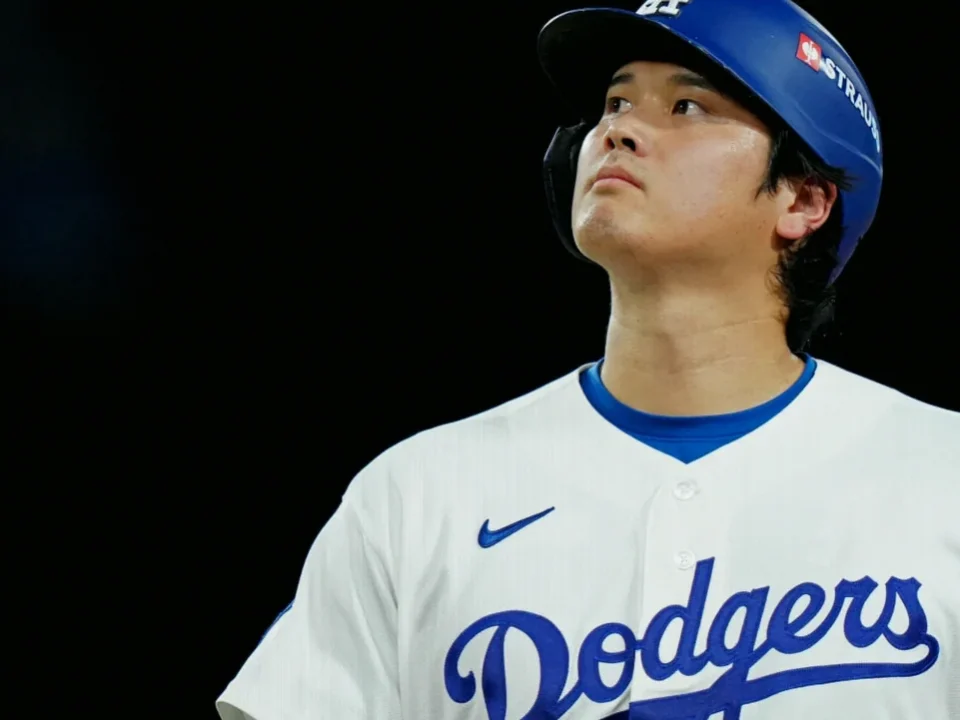
ATLANTA — Shohei Ohtani has not given the Dodgers much runway to judge his timing this fall, and the first two games of the National League Division Series have done little to settle the question. Los Angeles arrives at Truist Park with the series even at one game apiece, while its biggest bat is 2-for-8 with two strikeouts against the Braves.
Game 3 is set for Tuesday at 6 p.m. ET, with Chris Sale drawing the start for Atlanta. The left-hander’s presence could bring a different-looking Dodgers lineup, including the possibility that Ohtani moves down from the No. 2 spot.
Dodgers weighing a lineup adjustment
-
Ohtani played only eight games in September after landing on the injured list while dealing with lingering trouble in his right biceps and left knee. He totaled just 36 plate appearances during the final month before the postseason.
-
Atlanta used left-handed openers in each of the first two games, and Ohtani batted second both times.
-
Sale will be the Braves’ starting left-hander in Game 3, and manager Dave Roberts said he is willing to consider dropping Ohtani lower in the order.
“I’m open to it,” Roberts said. “If that happens, I’d talk with Shohei and explain the reasoning. In every conversation we’ve had, he has shown he is fully behind whatever gives the team the best chance.”
Roberts sees more than one issue at work. Ohtani may still be adjusting around the injuries that followed him for months, while the limited September action also left him trying to regain his regular rhythm. Still, the manager said the responsibility at the plate starts with pitch selection and putting together disciplined trips through the box.
“Everything revolves around Shohei because of the talent he has, and Atlanta knows it has to be careful,” Roberts said. “But if we keep offering at pitches off the plate, they will keep following that formula. We have to show discipline before they need to change.”
The Braves have found room off the plate
The early numbers show an unusually aggressive Ohtani. He has offered at five of the first eight pitches he has seen in the series, a 62.5% rate. During the regular season, his first-pitch swing rate was 36.7%, already above the MLB average of 30.3%.
| Category | NLDS through Game 2 | Regular season reference |
|---|---|---|
| Hits / at-bats | 2-for-8 (.250) | — |
| First-pitch swings | 5 of 8 chances (62.5%) | 36.7% |
| Pitches in strike zone | 13 of 34 (38.2%) | — |
| Chase rate | 9 swings on 20 balls (42.9%) | 30.0% |
| Whiff rate | 9 misses in 20 swings (45.0%) | — |
Atlanta has not simply poured strikes into the zone. Ohtani has received strikes on only 38.2% of the 34 pitches he has seen. Among 82 postseason hitters with at least 25 pitches, only 11 have seen a lower in-zone rate.
Yet he has chased 42.9% of pitches outside the zone, compared with 30% over the regular season. Among postseason players who have faced at least 20 pitches outside the zone, only Mauricio Dubón, Bryson Stott, Spencer Jones, Michael Harris II and Bryce Harper have posted higher chase rates.
That gap has allowed Atlanta to keep working at the edges. Ohtani has missed on nine of his 20 swings, with the Braves mixing pitch types and locations rather than relying on one lane.
Left-handers have changed the look
Four of the six Atlanta pitchers Ohtani has faced have been left-handed. Against those southpaws, 22 of the 25 pitches he has seen have been sinkers or cutters.
That approach stands out because Ohtani handled those offerings from lefties during the regular season. He hit .391 and slugged .891 against left-handed sinkers and cutters. In Statcast batting run value, only Kyle Schwarber, Corbin Carroll and Matt Olson ranked ahead of him in left-on-left matchups involving those two pitch types.
For now, however, Atlanta’s execution has outweighed that earlier record. The Braves have kept him from getting to the sort of contact that can change a game in one turn of the bat.
Ohtani has not homered since Aug. 18, a 20-game stretch that includes the first two NLDS contests, and he has driven in only one run during that span. Roberts suggested the search for that trademark damage may be contributing to the expanded zone.
“Power is a major part of who he is as a hitter,” Roberts said. “He knows what people are saying and what he hasn’t produced. Trying to hunt slugging in Game 3 may not be the best approach against this starter. But I do think he feels that responsibility to provide power.”
A reminder from last October
-
Last postseason, Ohtani opened the NLDS and NLCS in a deep slump, going 3-for-29 (.103) over four Division Series games and the first three Championship Series games.
-
That stretch included one triple, 14 strikeouts and five walks.
-
He answered in NLCS Game 4 with three home runs at the plate and 10 strikeouts over six scoreless innings on the mound.
This October offers no chance for a two-way rescue act. Ohtani is available only as a hitter, and his current physical limitations may make a repeat of that all-around performance unrealistic. But Roberts has not ruled out a moment that changes the series.
Asked whether Ohtani can still deliver something big, Roberts gave a short answer: “Absolutely.”