The Dodgers and Braves have spent enough October nights circling one another that Saturday’s opener at Dodger Stadium feels less like a fresh introduction than another chapter in a long-running rivalry. Los Angeles enters the best-of-five National League Division Series rested after a Wild Card Series bye, while Atlanta arrives tested after surviving Philadelphia. The Braves took five of six from the Dodgers during the regular season, but they now must beat a club carrying a formidable starting-pitching advantage and the weight of two consecutive championships.
Key takeaways
- Game 1 is scheduled for Saturday at 4 p.m. ET, 1 p.m. PT, at Dodger Stadium.
- Atlanta limited Los Angeles to a .580 OPS while winning five of the six head-to-head games this year.
- The Dodgers’ rotation features Tarik Skubal, Yoshinobu Yamamoto, Blake Snell and Tyler Glasnow.
- Matt Olson’s 41 homers and Michael Harris II’s all-around season give Atlanta several dangerous middle-of-the-order answers.
- Atlanta’s late-inning group, led by Raisel Iglesias and Robert Suarez, is a meaningful advantage over a Dodgers bullpen dealing with injuries and inconsistency.
Los Angeles owns much of the everyday lineup matchup
These franchises know the road. The Dodgers have reached the postseason in 14 straight seasons and won three World Series titles during the decade. Atlanta has collected 19 NL East crowns and owns two championships in the Wild Card Era. They met in back-to-back NL Championship Series in 2020 and 2021, and now meet again with a trip to the NLCS at stake.
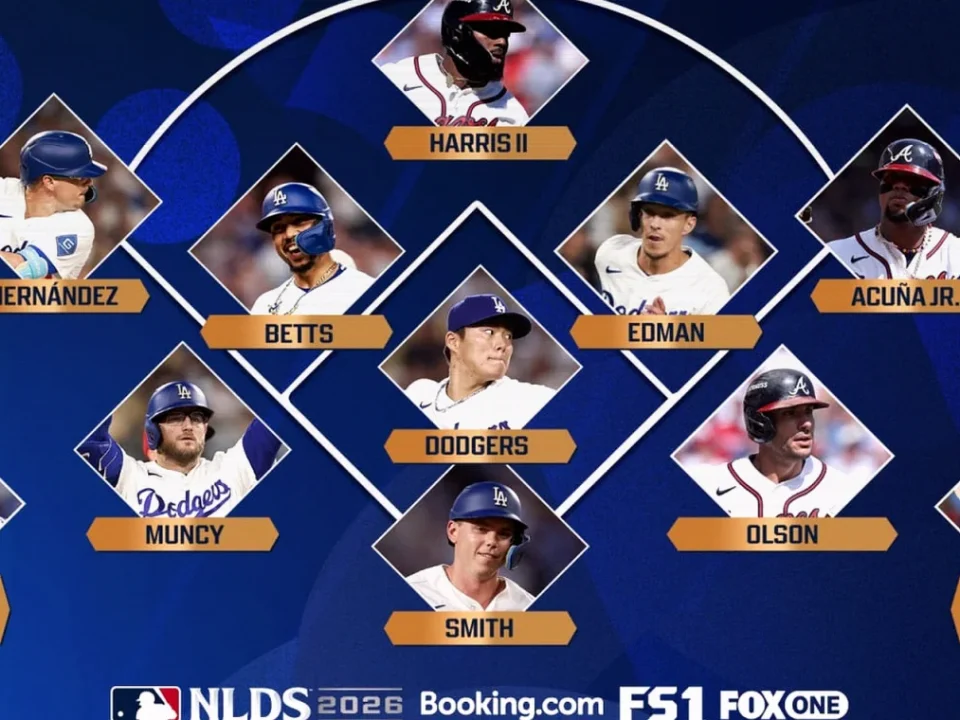
Behind the plate, Los Angeles has Will Smith back in form after a neck problem sidelined him for roughly three months. In 21 games after returning, Smith hit .290/.400/.548. Since debuting in 2019, his .829 OPS is the best among qualified MLB catchers. There is also the unusual October streak attached to his name: each of the last six World Series winners has rostered a Will Smith, either the Dodgers catcher or the now-retired pitcher.
Atlanta can counter with Drake Baldwin, who followed his Rookie of the Year season with an All-Star year. Baldwin hit .284/.358/.459 with 25 home runs and 21 doubles, though his time is divided between catcher and designated hitter. Sean Murphy’s injury-filled season has left the Braves with less certainty at the position, giving Smith and the Dodgers a narrow edge.
First base brings an especially familiar comparison. Matt Olson replaced Freddie Freeman in Atlanta after the 2021 season, and the two now anchor opposing lineups. Olson clubbed 41 homers and 34 doubles while again playing premium defense, including standout work in the Wild Card Series clincher. His production faded somewhat after the break, but the left-handed power remains imposing.
Freeman dealt with a right knee issue late in his age-36 season, and his extra-base impact disappeared in the second half. After the All-Star break, he recorded one homer and nine doubles. He remains a constant threat to reach base and carries an .853 postseason OPS over 79 games, but Olson has the stronger current power case.
The Dodgers also have the cleaner infield picture elsewhere. Tommy Edman appeared in only 84 games, his third consecutive season under 100, but produced a .714 OPS and brings more range than Ozzie Albies. Albies remains capable of changing a game with one swing, as he did with a key homer in Game 3 against Philadelphia, but his .293 on-base percentage reflects an overall offensive downturn.
At shortstop, Mookie Betts has made his late-career move from right field look increasingly natural. His second half included a .279/.357/.492 line, with improved results against fastballs. Atlanta has relied mostly on Mauricio Dubón while Ha-Seong Kim endured an injury-ruined season of 51 games and 15 hits. Dubón has been a useful, versatile pickup with roughly league-average offense, but the Braves need more from that spot. Kim still has a chance to change his year with an October moment.
Max Muncy gives Los Angeles another advantage at third. His offense has been at least 25% above league average in each of the past three seasons, built on patient plate appearances, walks and consistent hard contact. Austin Riley did provide Atlanta a timely go-ahead homer in Game 1 of the Wild Card Series, an important moment after an otherwise difficult season in which his offense measured 20% below league average.
Atlanta’s outfield and bullpen give it a fighting chance
The Braves have a real edge in right field. Ronald Acuña Jr. may not yet be the full-force version who won the 2023 MVP after his knee troubles, but he was still 18% better than league average by OPS+. A late adjustment in his stance helped him finish September at .307/.347/.602.
Kyle Tucker’s first Dodgers season under a four-year contract carrying a $60 million average annual value did not meet expectations. His OPS+ finished 3% below league average, and his defensive numbers declined sharply. September offered encouragement, however: Tucker reached a .354 on-base percentage and hit six home runs, three doubles and a triple.
Center field is closer. Andy Pages earned an All-Star berth with an .811 OPS, 23 homers and 26 doubles after cutting his strikeout rate and nearly doubling his walk rate. He is also a strong defender, though a fractured left hand cost him 27 games late in the season. Harris, meanwhile, may have been baseball’s best center fielder outside of Pete Crow-Armstrong. He posted a plus-13 outs above average mark, third among center fielders, while hitting .294/.321/.491 with 26 homers, 36 doubles and 12 steals. His three-run blast in Game 3 helped push Atlanta past Philadelphia.
Left field could depend on Lane Thomas’ health. He missed much of September and the Wild Card Series with a left intercostal strain. Without him, Atlanta will keep mixing Dubón and Mike Yastrzemski. The Dodgers will turn to Teoscar Hernández, who finished September on a .341/.420/.545 tear. Strikeouts and defense remain part of the equation, but Hernández’s raw power plays in October; he has homered in six of his seven postseason series with Los Angeles.
At designated hitter, Shohei Ohtani’s .275/.377/.512 line, 30 homers and 26 doubles qualify as a quiet year only by his standards. Injuries halted his pitching work and led to a September injured-list stay, leaving questions about how quickly he can regain his top gear. His postseason record offers comfort: a .940 OPS across 33 career playoff games. Baldwin will take many of Atlanta’s DH at-bats when he is not catching; otherwise, Dominic Smith is an option after posting a .563 OPS from June forward.
The biggest obstacle for Atlanta is the Dodgers’ rotation. Skubal joins World Series MVP Yamamoto, Snell and Glasnow in what may be the strongest starting group in the tournament. Skubal’s four-seam fastball has improved since arriving in Los Angeles, an ominous development for a Braves lineup that has already worked hard through a three-game Wild Card Series.
Atlanta’s pitching depth has been narrowed by that round. Chris Sale authored a magnificent age-37 campaign that strengthened his Hall of Fame résumé, but he worked in relief in the Wild Card clincher and has not started on fewer than five days’ rest since April. Tyler Mahle has been a revelation since the Trade Deadline, and Grant Holmes has also delivered. Those three are the Braves’ remaining healthy, experienced starters.
The bullpen may be Atlanta’s route to offsetting the rotation gap. Iglesias, Suarez, Dylan Lee and Didier Fuentes can turn a lead into a short game. Lee and Fuentes made rare mistakes in Game 2 that prolonged the Philadelphia series, but the full-season record still points to one of the league’s strongest high-leverage groups.
Los Angeles is less settled at the end of games. Edwin Díaz struggled badly in his first Dodgers season, pushing Tanner Scott into much of the ninth-inning workload late in the year. Veteran Blake Treinen is out with a season-ending right shoulder injury. The Dodgers relief corps still posted a top-10 ERA while covering the third-fewest innings in MLB, helped by the excellence of the starters, but manager Dave Roberts may need to mix and match rather than follow a fixed script.
The Braves already showed in the regular season that the Dodgers can be cooled off. Los Angeles has dealt with declining run production, bruises and the natural wear of an older club. But the Dodgers’ rotation is difficult to look past, particularly against an Atlanta team that arrives without much time to reset its arms. The Braves have enough thunder in the lineup and enough relief talent to make this uncomfortable. Their task is to get the game to the late innings with something to protect.