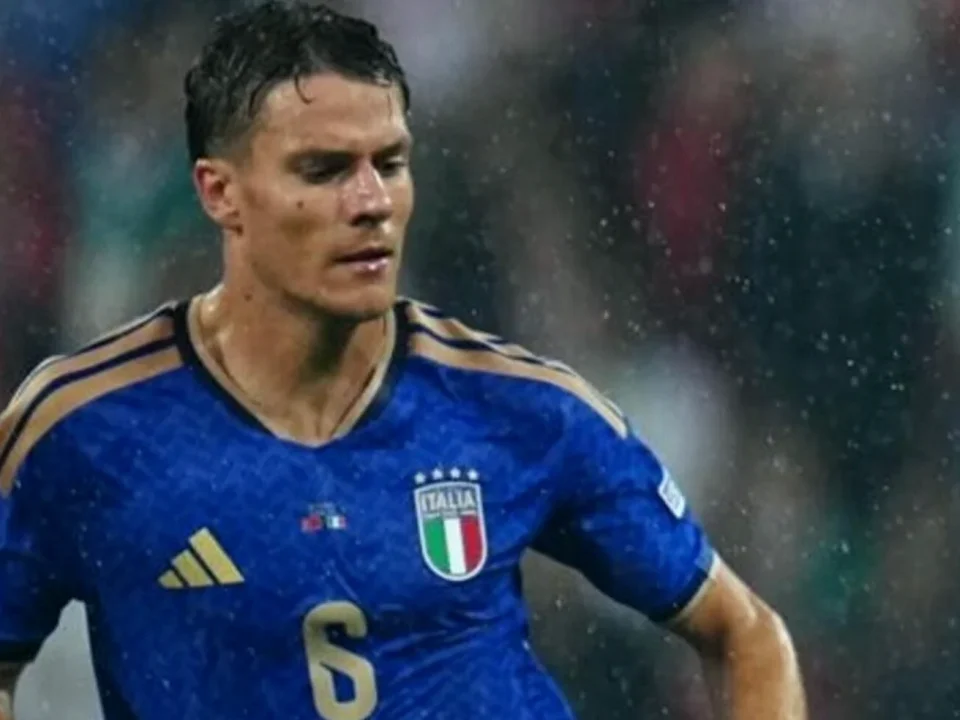
Italy’s response in Bursa carried the feel of a midfield rediscovering its own language. After the defeat by Belgium at the Olimpico, Roberto Mancini had looked for a different balance: not a nostalgic recreation of the Euro 2020 side at Wembley, but an arrangement capable of restoring control. In the rain in Turkey, Nicolò Fagioli gave that idea a convincing shape.
The coach and the club
Mancini’s choice placed Fagioli in a role between a conventional central midfielder and a second conductor of play. The Fiorentina man was asked to drift into the game, receive under pressure and link Italy’s midfield to its forwards. It was a deployment that recalled Marco Verratti’s ability to connect short passing sequences, while Fagioli’s starting position was closer to that of a creative mezzala.
Massimiliano Allegri had viewed him in similar terms during their time together at Juventus: a midfielder who builds play rather than simply finishes it. Fagioli’s admiration for Luka Modrić has long reflected that instinct, and the few metres between midfield roles matter less than the quality of the combinations around him.
Against Turkey, he became the quiet organiser of Italy’s attacking rhythm. He worked in tight spaces with Sebastiano Esposito, used Pio Esposito as a reference point, released Giacomo Raspadori when the opening appeared and recycled possession through Sandro Tonali when the move required patience. He was involved in the build-up to Italy’s second and third goals.
His numbers underlined the performance. Across 76 minutes, Fagioli had 50 touches and completed 40 passes at a 92 per cent success rate. More importantly, he gave the side greater technical security and imagination after the problems exposed against Belgium.
A midfield with distinct jobs
The improvement from the Olimpico to Bursa was rooted in the composition of the three-man midfield. Tonali offered a different profile from Jorginho: greater running power, defensive reliability and the capacity to cover the team’s transitions. Earlier in his career, Tonali had been regarded at Brescia as a possible heir to Andrea Pirlo because of his playmaking qualities.
Stefano Pioli later encouraged his forward running, turning him into a more attacking, box-to-box presence. For Italy, however, Tonali’s value was also in holding the department together while Fagioli found pockets of space to create.
Davide Frattesi completed the unit with acceleration and a scorer’s timing. His first Italy goal had come in the Netherlands on 18 June 2023, only months before Mancini resigned from the national job. He has now reached nine international goals after a difficult spell that had been revived at Lazio under Gennaro Gattuso.
Fagioli’s return to the centre
The Bursa match was only Fagioli’s eighth senior appearance for Italy, an unexpectedly small total for a 25-year-old of his ability. Mancini had handed him his debut in the November 2022 friendly against Albania in Tirana, played as the World Cup in Qatar was beginning.
His path has not been straightforward. Luciano Spalletti still included him, to some surprise, in the squad for the European Championship in Germany shortly after his ten-month betting ban had ended. But continuity remained elusive through an uneven period at Juventus before his renewed form at Fiorentina under Paolo Vanoli.
Italy’s shortage of domestic talent at the biggest clubs is frequently discussed, yet Fagioli and Tonali’s partnership in Turkey suggested that some of the required quality has been present all along. Mancini’s experiment did not solve every question left by the Belgium defeat, but it offered a credible route forward: Tonali’s authority, Frattesi’s runs and Fagioli’s ability to make the ball move with purpose.