
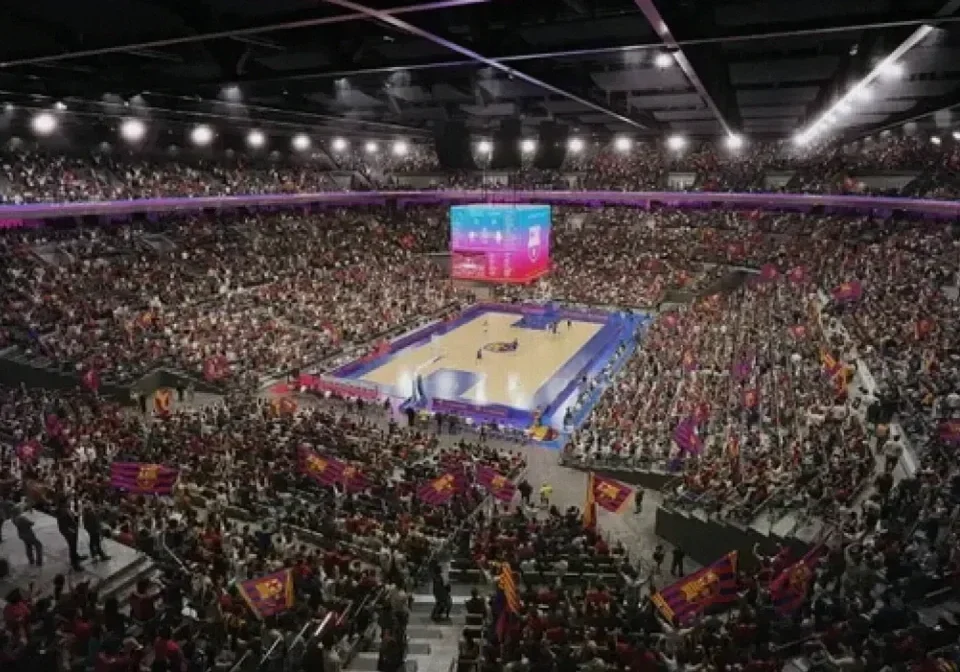
Barcelona’s rebuilding map extends beyond the Camp Nou district. At the site of the former Miniestadi, FC Barcelona are pursuing a new Palau Blaugrana designed to bring elite basketball, concerts and major indoor events back into the club’s long-term Espai Barça vision — but the board insists it will be financed without adding to the club’s debt.
Key takeaways
- Barcelona say the proposed Palau Blaugrana will sit outside the €300 million Espai Barça funding structure.
- The club is examining a model in which a private operator builds and runs the arena through events revenue.
- The planned capacity is at least 15,000 for sport and roughly 20,000 for concerts.
- A larger venue would meet EuroLeague requirements to stage a Final Four.
- Interest from prospective investors has grown, with the prospect of an NBA presence in Europe adding appeal.
A venue intended to pay for itself
Speaking at Barcelona’s Ordinary General Assembly, president Joan Laporta said the new Palau would not be included in the €300 million figure connected to the wider Espai Barça project. He said the club was looking at alternative solutions and stressed that the arena should neither create fresh debt nor affect the financing already assigned to the redevelopment.
Ferran Olivé, Barcelona’s economic vice-president, repeated that position while presenting the club’s financial plans for the 2025-26 and 2026-27 seasons. In the subsequent members’ questions, he outlined the type of structure under consideration.
Barcelona are looking at arrangements increasingly used for new multi-purpose arenas: a company would take responsibility for construction under a concession-style agreement, then operate the building through concerts and other events. The commercial income would be intended to cover the project’s costs, rather than placing repayments on Barcelona’s balance sheet or drawing on Espai Barça funds.
The club’s current board has a mandate running to 2031, and a replacement for the existing Palau Blaugrana is one of its principal outstanding infrastructure ambitions. A number of investors have shown interest in joining the development.
From Miniestadi plot to continental arena
The arena is planned for the former Miniestadi land and is expected to hold a minimum of 15,000 spectators for sporting fixtures, rising to around 20,000 for music shows. Earlier plans had envisaged 12,000 seats, but the expanded scale would allow Barcelona to satisfy EuroLeague standards for hosting a Final Four while making the building more commercially useful throughout the calendar.
The design retains Tac Arquitectes, the Catalan practice led by Eduard Gascón which won the original competition in 2016. The firm has been working with Artytech2, the company involved in the commercial operation of Madrid’s Movistar Arena.
Plans presented earlier this year included retractable seating and a second external skin, with a double-glazed façade intended to provide close control over sound for neighbouring residents. The aim is an arena that can shift between basketball and other indoor sport, then become a large concert hall without turning the surrounding district into an after-hours burden.
Another factor is the developing conversation around the NBA’s possible move into the European market. A significant meeting is scheduled for 5 October in Como, Italy, with Laporta expected to attend and Barcelona viewed as a club the NBA would want involved. For investors considering the Palau, the possibility of future NBA-linked competition on the continent strengthens the case for a modern, high-capacity arena in the city.