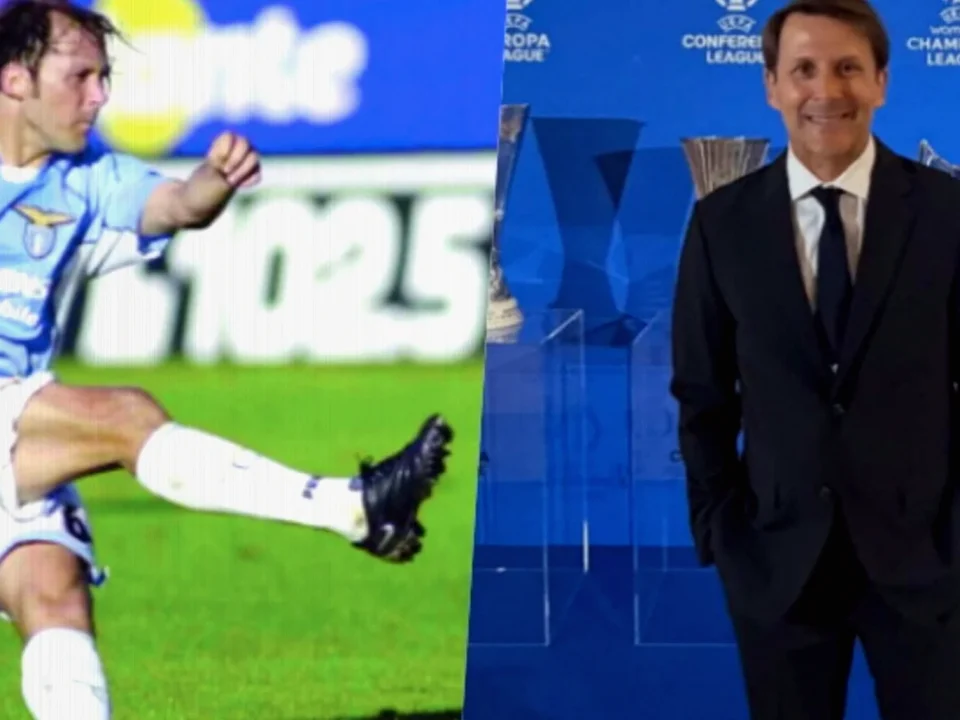
Gaizka Mendieta’s Italian chapter remains one of Serie A’s more curious turning points: a midfielder who arrived at Lazio in 2001 as a global prize, carrying a record-sized fee and the memory of two Champions League finals with Valencia, only to find a club changing too quickly to offer him the time he felt he needed. More than two decades later, the former Spain international looks back without bitterness, seeing football not as a debt but as the force that shaped the man he became.
A player built for every part of midfield
Mendieta belonged to a generation before the modern language of complete midfielders became routine. He pressed, defended, linked play, arrived in the area and took responsibility from the penalty spot. His range was reflected beyond football too: as a young man he ran middle-distance races, played basketball as a point guard, later worked as a DJ and entered the restaurant business.
He said his early sporting education made the demands of top-level football feel natural. Mendieta competed from 1,000 to 5,000 metres and held Spain’s national record over 2,000 metres for 15 years. Basketball also gave him a useful instinct for passing and movement.
- He was a capable point guard as a child.
- His running background covered distances from 1,000 to 5,000 metres.
- He said that passing the ball and running for 90 minutes had never been a difficulty.
- His DJ work began as an escape from football, encouraged by a friend who owned a record shop in Valencia.
For Mendieta, the connection between music and midfield play remains obvious. A DJ, he said, must watch whether the room is responding, alter the tempo, shift style, slow a track down or push it forward. In his view, that makes the person behind the decks “the midfielder of music”.
His ventures have generally followed personal interest rather than a business formula. While living in England, he brought Spanish ham into a market where he felt Spanish food was scarce. Not every project has succeeded, he acknowledged, but each began with enthusiasm.
The Lazio weight of 90 billion lire
Lazio secured Mendieta in the summer of 2001 amid intense international competition, paying around 90 billion lire for a player widely regarded as one of Europe’s leading midfielders. He arrived after consecutive Champions League final defeats with Valencia, having been named the competition’s best midfielder in both campaigns.
The second defeat, against Bayern Munich on penalties, still hurts him. Yet he believes that Valencia side under Hector Cuper retains a lasting place in the club’s story. “People still love us,” he said, describing that group as one that came close enough to greatness to remain in supporters’ memories.
At Lazio, however, the setting was unstable. Mendieta said the squad contained many new arrivals and had a new coach, but that he was not granted the adaptation period such a project required. Within a year, the club changed both coaches and presidents twice.
He rejected the idea that the transfer fee itself became a psychological burden. “My mind never focused on the 90 billion,” he said. “I had another obsession: winning the Champions League.”
- Mendieta said there was no contractual clause specifically blocking a move to Real Madrid.
- He understood that a transfer to Real was not possible because of his past.
- His subsequent loan to Barcelona brought another unsettled environment.
- He felt his football improved in Catalonia, but Barcelona chose to reset at the end of that season.
At Barcelona, Mendieta encountered young players who would define Spain’s next era: Andrés Iniesta, Carles Puyol and Xavi. He recognised their special quality, although he said nobody at the time could have known that they would become the core of a golden generation. He drew a similar parallel with the difficulty of predicting the future impact of Lamine Yamal, Pau Cubarsí, Pedri and their contemporaries.
His final departure from Lazio, for Middlesbrough, also left him with a different memory of the club’s support. Mendieta recalled Lazio ultras arriving at 7am at the team’s mountain training camp to say goodbye. He had expected insults, but felt supporters understood that he was not seeking an exit; Roberto Mancini, then coach, did not see a role for him.
He described his relationship with Lazio fans as “10 out of 10”, recalling consistent support despite their demanding nature. He also noted that Lazio supporters remain forceful in their convictions, referring to the current stadium protest as proof that some elements of the club’s culture have not changed.
Spain’s recovery and football’s wider lessons
Mendieta now sees himself as a retired player trying to give something back to a game that gave him a great deal. He does not consider his career a disappointment because it did not produce more trophies or goals. Football, he said, gave him the chance to play in Serie A, La Liga and the Premier League, as well as the ability to speak three languages in addition to Spanish.
Speaking about the value former players can bring outside football, he argued that elite sport teaches leadership, teamwork, resilience and the ability to treat mistakes as part of development. Not every former player has academic training, he noted, but the lessons of a dressing room and competitive pressure can be valuable to major companies.
He pointed to Michael Jordan and Roger Federer as examples of champions who regularly stress that their defeats outnumbered their victories.
Mendieta also believes Spain’s current success is the result of a long-term rebuilding process after the 2014 World Cup. In his assessment, Spanish football has recovered across the senior men’s side, women’s game and youth levels because of an approach based on enjoyment, individual technique and collective awareness.
- Spain spent eight years rebuilding a generation after the 2014 World Cup.
- Mendieta said young players are taught not only technical ability but also how to function within a team.
- He believes Spain’s strongest tradition is the desire to win with quality rather than treating victory as the only objective.
- His own Spain generation suffered from a mental barrier in quarter-finals and repeatedly lacked the final piece needed for major success.
He considers La Liga superior in technical, tactical and individual terms, even if he regards the Premier League as the more exciting competition. “If you want to see the real football, you have to watch La Liga,” he said.
From rivals to coaching and the Serie A he still watches
Although he mainly follows Lazio through results now, Mendieta retains an eye on the Italian game. He welcomed the sight of former players moving into coaching, mentioning Cristian Chivu, while describing Inter as a powerful side. His immediate answer when asked what he liked about Serie A was simple: Lazio being top of the table.
He also expressed regret at Italy’s absence from three World Cups, a striking decline for a nation with such a deep place in the game’s history.
Mendieta holds a coaching licence but has chosen the sporting-director route rather than the bench. He believes modern management has become far more complex, with a coach required to handle families, agents, social media, press obligations and events around a group of 25 players.
Asked about the opponent who caused him the most problems, he named Rui Costa first, while admitting that such an answer risks overlooking many exceptional players. The finest footballer he played alongside, however, was Diego Simeone.
His cultural footprint extended beyond the pitch. Los Planetas referenced Mendieta in their 2000 song “Un buen día”, after a remarkable goal had caught the imagination. Mendieta recalled the lyric’s pairing of Spider-Man and himself with amusement: “A comic-book character and a footballer. Some people said two superheroes.”