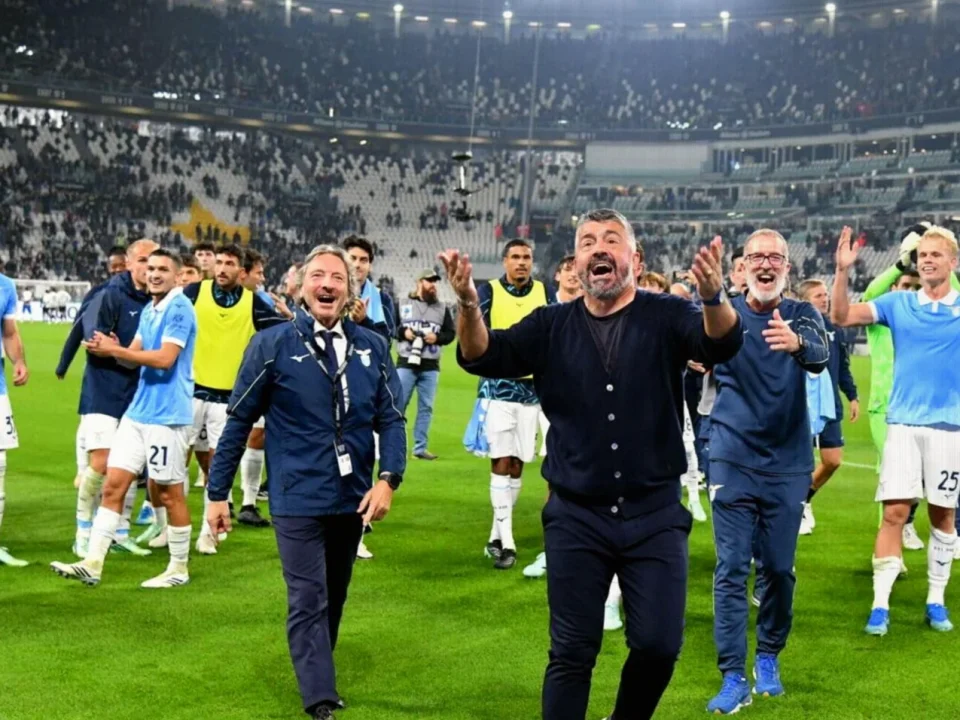
Lazio have moved from summer uncertainty to the centre of Serie A’s opening act in just 56 days. Rino Gattuso’s side left Turin with a 3-0 win over Juventus, level with Inter at the top on 19 points from seven matches and carrying the conviction of a team that has learned how to act together.
Gattuso has placed the collective at the heart of the project. “We are a family,” he said after the Juventus result, and the phrase has become more than a dressing-room slogan: Lazio’s players are sharing responsibility, accepting sacrifice and treating each contribution as part of the same construction.
Quick facts
- Lazio are joint Serie A leaders with Inter on 19 points after seven rounds.
- The 3-0 victory at Juventus was their fourth consecutive away win.
- Lazio have scored 14 league goals, supplied by eight different players.
- The goals in Turin came from a corner, an individual action and a counter-attack.
- Gattuso has built his side around a 4-3-3 marked by pressing, running and direct forward play.
The result at the Stadium was not merely a striking afternoon. Lazio unsettled Luciano Spalletti with different attacking answers and showed that their early-season form is supported by a developing identity. Gattuso wants his team to impose itself rather than wait for matches to be decided around it.
His 4-3-3 has brought intensity, a high tempo and vertical movement. Lazio press, cover distance and commit bodies forward, but the idea also depends on trust: players must believe that the risk taken by one teammate will be supported by another.
At the back, the new partnerships have made the absences of Alessio Romagnoli and Mario Gila less damaging. Victor Provstgaard has emerged as one of the division’s most convincing central defenders, combining athleticism with a maturity underlined by his goal against Juventus.
Josip Sutalo has added experience and authority to a line that often operates high up the pitch. Christos Mandas has taken on the weight of leadership, while Nuno Tavares changes the shape of a match when he accelerates, bringing disruption to areas opponents would prefer to control.
Floriani is another sign of Gattuso’s willingness to trust development from within. The defender is the latest Primavera player to establish himself, following the path previously taken by Danilo Cataldi, and Lazio have found value not only in the market but inside their own system.
The coach’s work has also challenged the old habit of describing him simply as a motivator. This Lazio have structure, rehearsed mechanisms and an understanding of roles. Not every player is expected to finish the decisive move; some are there to create the conditions for someone else to do so.
Midfield has become the clearest example. Davide Frattesi changes games with his runs into the box, Reda Belahyane brings vision alongside defensive substance, and Taylor offers control before increasing the pace. Fisayo Dele-Bashiru provides another dimension through power and carrying ability, as shown when he drove beyond Bremer in the move for Lazio’s third goal in Turin.
Patience with individuals has been another part of the club’s progress. Gustav Isaksen, signed from Midtjylland three years ago, has begun to turn obvious ability into regular influence after injuries and difficult spells. Goals against Monza and Juventus have marked his new confidence, which Denmark coach Brian Riemer has also noted.
Tijjani Noslin’s contribution is less easily reduced to numbers, but his hold-up play, combinations and willingness to open channels have helped the attacking unit. Mattia Zaccagni has supplied one goal and three assists while also working for Tavares and Taylor, echoing the broad influence once associated with Lazio’s former spine of Sergej Milinkovic-Savic, Luis Alberto and Ciro Immobile.
Gattuso’s Lazio are therefore not defined only by a formation. They are a side built on relationships, where substitutes are expected to feel as involved as starters and where individual freedom depends on collective discipline.
After being largely overlooked in the summer, Lazio have become an awkward presence for the established contenders. They have found a place among the protagonists by making discomfort a strength, and the first two months suggest that Gattuso’s team are ready to keep disturbing the championship’s expected order.