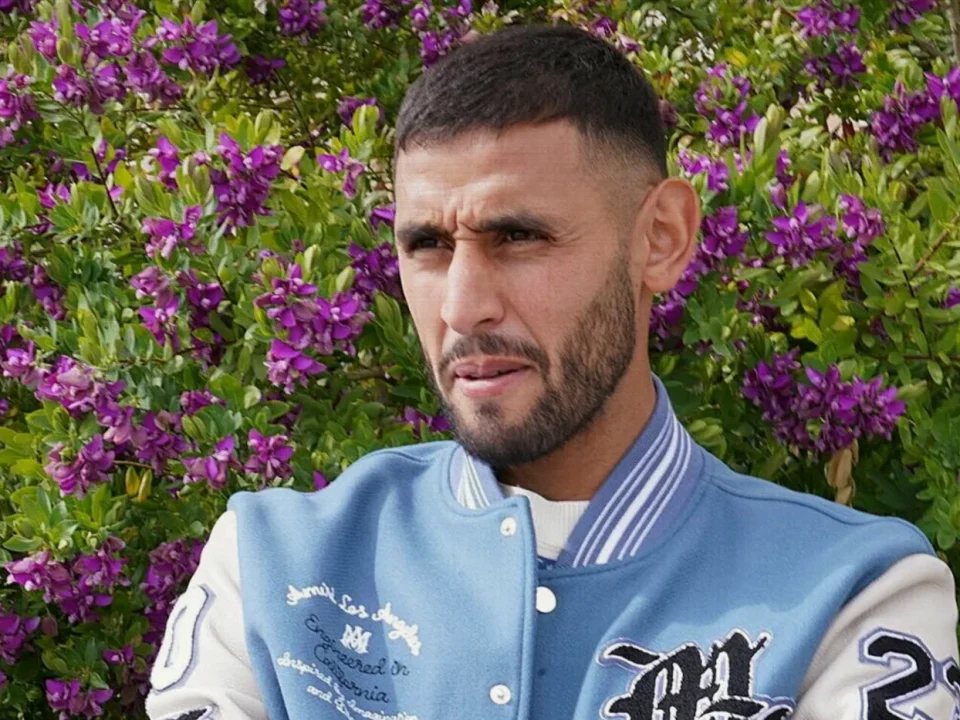
Faouzi Ghoulam’s Napoli story belongs to a period when the club was chasing more than results: it was testing the limits of its own game, its own belief and, often, the patience of opponents. Injuries eventually cut across the left-back’s finest years, but his connection with Naples has endured. Now studying at Coverciano as he prepares for a future in coaching and football management, Ghoulam looks back on a career shaped by Rafael Benitez, Maurizio Sarri, a special bond with Kalidou Koulibaly and the sense that Napoli had briefly assembled a side capable of troubling anyone.
The coach and the club
Ghoulam arrived in January 2014 after Benitez called him while he was on his way to discuss a new contract with Saint-Étienne. He had expected to join Roma the following summer and, by his own admission, knew little about Napoli beyond Diego Maradona. Then he searched for images of the city online, saw the bay and the sea, and felt the move had to happen.
The Algeria international told Benitez that a place at the World Cup was at stake. He did not demand to start, but wanted the chance to earn his place. Benitez gave him that assurance. Ghoulam bought his own flight from Lyon, changing in Frankfurt, and did not renew his Saint-Étienne deal.
There was still an obstacle on his first day in Italy. The training ground at Castel Volturno did not initially impress him after the facilities he had known in France, while a clause in his Saint-Étienne contract threatened to delay the signing. He had been entitled to a significant share of the transfer fee, a detail he said had not been explained by his former club. Rather than let the issue threaten the move, he gave up the money in order to become a Napoli player.
It became a long chapter: 216 appearances between 2014 and 2022, two Coppa Italia triumphs, an Italian Super Cup and a Scudetto challenge that came agonisingly close. Two serious knee injuries, however, changed the scale of what might have been.
The most painful interruption came in a Champions League meeting with Manchester City at the Stadio San Paolo, during the peak of Sarri’s Napoli. Ghoulam recalled that Napoli produced around half an hour of exceptional football before his knee gave way, leaving City unable to settle into their usual passing rhythm.
His favourite single performance came away at Manchester City, where he won a penalty. He remembered a difficult opening quarter-hour, with Napoli trapped close to their own penalty area and unable to play out. Once they began to retain possession and build attacks at Guardiola’s stadium, the group started to understand the level it had reached.
Sarri’s demanding freedom
For Ghoulam, Sarri’s Napoli was defined by an unusual contrast. The training week was exhausting, highly demanding and full of detail; matchdays brought the release. He said the players enjoyed the football most in the actual matches, when they watched opponents chase them and felt the work of the preceding days take effect.
Winning alone was not enough for Sarri. Ghoulam said the coach set additional standards, including the desire to make visiting supporters leave early. Around the 70th minute, Napoli’s players would look towards the away end. If the stands were still full, they knew the following Tuesday could bring even tougher work on the training field.
That mentality, he felt, explained why the team did not simply protect leads and why it continued to score. The squad contained outstanding players whose quality, in his view, was not always fully appreciated from outside.
One early Champions League trip to Kyiv captured Sarri’s intensity. Before the match had started, the coach entered the dressing room angry and warned his players that he did not want the opposition in Napoli’s box even once. Ghoulam said Sarri went as far as suggesting they should score an own goal rather than allow that to happen. When the opponents played long early in the contest, Sarri reacted immediately from the bench. Napoli pressed relentlessly, determined to prevent the long balls that had irritated their coach.
Ghoulam also credited Francesco Calzona, then part of Sarri’s staff, with helping several players develop. Calzona would speak individually with players, explain where they could improve and receive a willing response from those who were still fighting to establish themselves. Much of that work, Ghoulam said, took place during pre-season camps alongside the rest of the staff.
Koulibaly, Benitez and the men around Napoli
Koulibaly became much more than a team-mate. Ghoulam described him as a brother and praised both his character and his intelligence, saying that he had helped him become the player he was at Napoli. He recalled a match in Rome against Mohamed Salah as a defining moment in Koulibaly’s rise, particularly in open-field defending.
After that game, Ghoulam remembered seeing Raul Albiol on the team bus speaking with Barcelona’s sporting director about Koulibaly, evidence of how quickly the defender’s reputation had grown.
Looking back across his Napoli years, Ghoulam praised Aurelio De Laurentiis for his choices in the dugout. His own list of coaches at the club included Benitez, Sarri, Carlo Ancelotti, Gennaro Gattuso and Luciano Spalletti.
He believes Como currently play attractive football, but noted that Cesc Fabregas’s side changes significantly from season to season and that it remains unclear how long the Spanish coach will stay. The difference with Sarri’s Napoli, he suggested, was stability under one of the leading coaches of that era.
A view of the present championship
Ghoulam sees several sides in the Scudetto conversation. He considers Gian Piero Gasperini a transformative figure in Italian football, a coach whose proactive and attacking ideas have influenced others and whose approach demands considerable physical output.
He had long wondered what Gasperini could achieve with a squad containing 18 players of comparable level, allowing changes without a major loss of intensity. In his assessment, Roma are now showing that potential and should be considered contenders. He said Roma supporters may play down expectations for superstitious reasons, but believes there is genuine hope around the club.
Although he remains a Napoli supporter, Ghoulam said he would be pleased for his many Romanisti friends if Roma won the title, because he would like them to experience something comparable to the joy Napoli supporters have known.
He also included Inter and Como among the teams capable of challenging at the top. His reservation over Como concerns habit rather than talent: the expectation of having to win every Sunday is a pressure traditionally handled more often by Italy’s biggest clubs.
Napoli, in his view, are presently a small step behind their rivals only because of the change of coach.
Among individual players, he spoke positively about Favasuli, describing him as explosive, quick over distance and technically gifted. Ghoulam believes the youngster has already brought extra energy to his team and could become an important asset. He is interested to see whether Favasuli’s long-term role will be further forward or as a more orthodox wide player, while stressing that his best football may still be five or six years away.
Ghoulam was equally cautious about the language used around young prospects. Asked about Vergara, he insisted that the player should not be reduced to the label of “youngster”, because he already considers him a strong, high-level footballer. He made a similar broader point when names including Lulli, Liberali, Lontani, Mora and Robinson were raised: it is wrong, he argued, to suddenly discover players and declare them strong only at the point they become visible. Development is uneven, and a footballer at 16 cannot be judged as the finished version of the player he may be at 25. He regrets that many talented players never receive the opportunity to emerge.
The game beyond Naples
Asked about the most advanced coaches and teams, Ghoulam named Arsenal and Paris Saint-Germain among the sides he enjoys watching. He also remains an admirer of Antonio Conte’s teams, despite the reputation for demanding training. Given his own mentality, he said he would have enjoyed working under Conte.
He spoke without regret about the physical price of his Napoli years, saying he left two knees on the field in pursuit of success with the club. He also expressed appreciation for Spalletti’s Juventus.
On the Ballon d’Or, Ghoulam removed his friend Fabian Ruiz from consideration because he felt he could not be impartial. His own choice would be Lionel Messi. Maradona remains, in his eyes, the greatest footballer ever, but Ghoulam said Messi’s achievements were extraordinary, having witnessed them in the United States.
He also offered an account of Fabian Ruiz’s path after Napoli. Ancelotti, he said, had made clear how strongly Napoli wanted the Spanish midfielder when he arrived. Ghoulam claimed that Paris Saint-Germain moved for Fabian partly to deny Real Madrid a future opportunity, with Ancelotti having wanted to take him to Madrid when his contract was nearing its end. Real Madrid’s focus on Kylian Mbappé prevented that deal from progressing, allowing PSG to act first. He added that Fabian did not initially play regularly in Paris, despite his quality and the trophies he has since won there.
A new education at Coverciano
Ghoulam’s next football chapter is taking shape away from the touchline. He is attending the coaching course at Coverciano and plans to complete a master’s programme in Düsseldorf, where he hopes to exchange ideas not only with coaches but also sporting directors and federation presidents.
His playing career gives him one perspective, but he wants to understand the game from every side. The former Napoli full-back approaches that work, he said, with humility and passion. For a player whose years in Italy were marked by ambition, beauty and injury, it is a fitting continuation: not a departure from football, but another way of staying inside it.