There is a strange contradiction at the centre of Milan’s early season: Gonçalo Ramos has covered more ground than anyone in the squad, yet he has become increasingly distant from the opposition goal. His only strike came against Venezia on 28 August, in the second league round, and the following weeks have left a centre-forward working hard for the collective without receiving the chances expected of a scorer.
The coach and the club
Ruben Amorim has not questioned Ramos’s effort. After the Lecce match, he defended the Portuguese forward’s contribution: “Ramos works extremely hard. The goals will come; he gives a great deal to the team.”
That faith reflects the demands placed on the striker. Amorim wants his No. 9 to contribute when Milan are without possession, and Ramos has certainly carried out that part of the role. Across five matchdays he has run 57 kilometres, the highest total in the Milan group. Strahinja Pavlovic follows on 55 km, Koni De Winter on 50.6, Mario Gila on 49, Samuel Chukwueze on 45 and Yunus Musah on 42.6; every other player has remained below 42 kilometres.
Ramos is therefore averaging 11.5 km per game, an exceptional figure for a central striker. The question for Milan is whether such a workload, if not managed with rest, can leave him sufficiently sharp when the decisive choice arrives in the penalty area.
His intensity is evident in other measurements too. After four rounds, Gradient data placed Ramos first among Milan players for sprints, ahead of Pavlovic and De Winter. He was also second for accelerations, almost level with Pavlovic. Across Serie A, the leading sprint figures at Juventus, Inter and Roma belong respectively to Pierre Kalulu, Andy Diouf and Lulli, all defenders or wide players rather than centre-forwards.
Rasmus Hojlund at Napoli and Assane Diao at Como lead their own sides’ sprint charts among attacking players, but neither has reached Ramos’s numbers. Milan’s issue is not a striker standing still.
A forward too far from goal
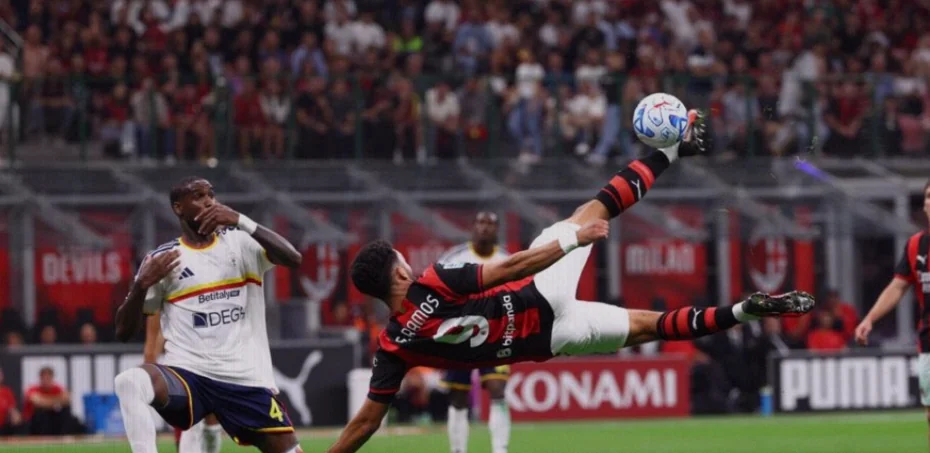
The shooting record tells a different story. Ramos took five attempts against Torino on the opening day: one on target, two off target and two blocked. He then registered eight shots against Venezia, but none against Juventus, one wide effort against Lazio, three attempts off target against Benfica and no shot at all against Lecce.
The Venezia game remains the clear exception. Ramos had opportunities that could have brought three or even four goals. In September, however, the supply has been thin. Against Lecce he did not shoot, though he made seven lay-offs, fashioned two chances for team-mates and provided an assist. It was the performance of a link player rather than a penalty-box No. 9.
Only 9% of Ramos’s touches have come in the opposition area. Lautaro Martinez reaches 20%, while Donyell Malen is at 29%. Those figures help explain why Milan’s striker has one goal from 14 attempts in six appearances: his finishing has not been precise enough, but he has also spent too little time where finishes are usually created.
Amorim saw a small improvement in the Lecce performance because the team offered its forward more support. “We stayed closer to him today, and that is why Gonçalo played better,” the coach said.
The next step is more practical. Ramos needs earlier through balls, deliveries from wide areas and passes pulled back from the byline. Milan must turn his pressing, running and combination play into regular service in the box.
The international break and the next league tests
Ramos has joined Portugal for matches against Wales, Norway, Denmark and Norway again. When he returns, he will be trying to recover the scoring rhythm he showed at Paris Saint-Germain, where over the previous three years he averaged a goal every 142 minutes.
That record came alongside players such as Khvicha Kvaratskhelia and Ousmane Dembele, and against opponents including Auxerre, Metz and Le Havre, circumstances that naturally provided more opportunities. Milan’s immediate Serie A schedule will offer a different setting, but not necessarily an unfavourable one.
Sassuolo, Atalanta and Udinese are next, and all three belong to the nine Serie A teams allowing the most shots. For Ramos, the chapter after the break is clear: Milan need their tireless striker nearer the goal, and he must make the next chance count.