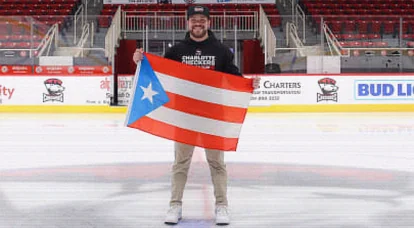
Gustavo Canals found hockey through “The Mighty Ducks,” and the Puerto Rican assistant athletic trainer is now building a career in the sport with the Charlotte Checkers, the Florida Panthers’ American Hockey League affiliate.
In his fourth season on Charlotte’s training staff, Canals handles much of the behind-the-scenes work that keeps players ready for the next practice or puck drop. That includes preparing the rink and bench areas, assisting with treatment, and overseeing rehabilitation work for injured players who are working their way back toward the lineup.
For Canals, the path started as a kid in a Puerto Rican household near Washington, D.C. The 1992 Disney film offered a first glimpse of a game that suddenly looked accessible.
“It was the movie that started everything,” Canals said. “Seeing kids from all kinds of backgrounds in it made an impression on me. It showed me that I could be part of it too.”
He soon became a Washington Capitals fan, following a club led by Alex Ovechkin and Nicklas Backstrom. Mathieu Perreault was another player who helped fuel his growing interest in the game.
A growing Hispanic presence behind the bench
Canals takes pride in both his Puerto Rican heritage and the increasing number of Hispanic athletic trainers working in professional hockey. He sees the sport’s expansion into markets with significant Hispanic communities as a key reason more people are considering careers around the game.
“Hockey has moved into places with large Hispanic populations,” Canals said. “It is becoming more visible in our culture, and that exposure has brought more people toward jobs in hockey.”
His colleagues include Charlotte head athletic trainer Thomas Alva, who arrived in September after 22 seasons with the Florida Panthers, Dallas Stars, Atlanta Thrashers and Philadelphia Flyers.
Elsewhere around the AHL, Jaime Garcia has served as head athletic trainer and sports medicine manager for San Jose’s affiliate since the 2024-25 season. Haley Cruz is in her third year as head trainer for the San Diego Gulls, Anaheim’s affiliate, while Jacqui Gutierrez joined the Hershey Bears, Washington’s farm club, as an assistant trainer in July.
Garcia, a Mexican American raised in Southeast Houston, entered hockey looking for a challenge outside the familiar Texas sports landscape. His first job in the game came with Fort Worth of the former Central Hockey League in 2012-13.
“It was not one of the traditional Texas sports like football, basketball or baseball,” Garcia said. “I barely knew hockey and had only watched some of it. But I wanted something more demanding. That first year had plenty of challenges, but I would not exchange it for an easy season.”
From street hockey to the training room
Canals began with street and inline hockey at about age 6, then moved to the ice during middle school. He later played forward for Christopher Newport University’s American Collegiate Hockey Association Division III club team in Newport News, Virginia, during the 2015-16 season.
The financial demands of club hockey, along with a heavier academic load, ultimately led him to stop playing. But his education opened a different route into the game. Canals earned an undergraduate degree in exercise science and kinesiology, then completed a master’s degree in athletic training at Shenandoah University in Winchester, Virginia.
“When I was younger, I thought I might become a veterinarian and work with animals rather than people,” he said. “Then I realized I could work in medicine and stay around hockey. At that point, I knew I wanted to chase a job in the sport.”
During college, he spent an immersion year largely assigned to Colgate University’s NCAA Division I women’s hockey program. The experience put him on team trips, introduced him to different athletic environments and gave him daily contact with players from varied backgrounds.
“I traveled everywhere with them,” Canals said. “I got to see what different schools had available and work with athletes from different places. It was an experience I will always remember.”
After receiving his graduate degree, Canals joined Lindenwood University’s NCAA Division I women’s hockey team as an assistant trainer in August 2022. Charlotte hired him in 2023.
Measuring progress one return at a time
Much of Canals’ work comes when the Checkers are either on the road or waiting for an injured player to clear the next stage of recovery. He often runs early rehabilitation skates, keeping players active and progressing while they are unable to rejoin full team sessions.
“I do many of the first rehab skates for players returning from injury,” he said. “If the club is traveling, I may remain behind and work with guys who are hurt, skate with them during rehab and make sure their conditioning is where it needs to be. Then they can keep progressing until they are ready to meet the team on the road or get back into practice when everyone returns.”
The payoff, he said, is watching a player return to game action after weeks away.
“One of the best parts is seeing an athlete score that first goal after coming back, or make a big play,” Canals said. “You know he was sidelined three weeks earlier, and now he is back at full speed.”
Canals is aiming for an NHL opportunity of his own. He has already worked at Florida Panthers development and rookie camps, and has assisted with the club’s Black Aces group of extra players assembled during the Stanley Cup Playoffs.
That exposure sharpened the target.
“It lit a fire in me to reach the NHL,” Canals said. “It makes me want to keep pushing until I get there.”