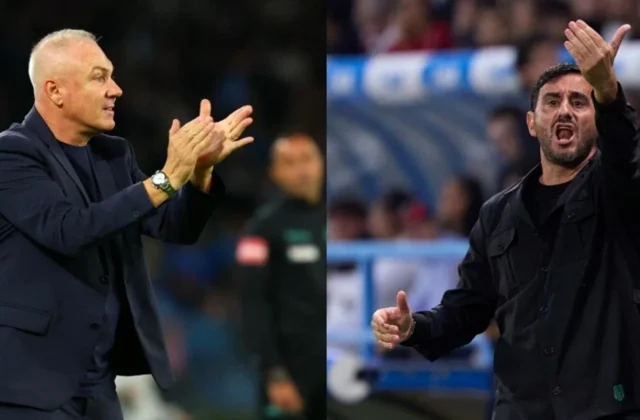

Napoli’s season has reached an early point of concern in the final third, with Rasmus Hojlund too often operating far from the penalty area that should define his work. The Danish striker has two goals in six official matches, but neither came from inside the box: both were created through his own efforts from distance.
That return has reflected a wider problem for Massimiliano Allegri’s side. Napoli have scored only seven times in six games, their lowest output at this stage of a campaign in the Aurelio De Laurentiis era apart from the final Serie C season. For a club with ambitions at the top of the table, the lack of chances around the opposition goal has become a central issue.
Hojlund is receiving too little service
Hojlund has had only 15 touches in the opposition penalty area across Napoli’s first six competitive fixtures. The comparison with leading forwards at other major clubs underlines the scale of the shortage.
| Player | Club | Touches in the penalty area |
|---|---|---|
| Rasmus Hojlund | Napoli | 15 |
| Lautaro Martinez | Inter | 48 |
| Donyell Malen | Roma | 47 |
| Anastasios Douvikas | Como | 31 |
| Randal Kolo Muani | Juventus | 31 |
Lautaro Martinez and Malen have each been involved inside the area more than three times as often as Hojlund. Douvikas and Kolo Muani, despite playing in very different attacking contexts, have both recorded more than double the Napoli forward’s total.
The figures do not place responsibility solely on Hojlund. Napoli have struggled to bring him into moves close to goal, and he has regularly been asked to work alone against organised defensive lines. It is a demanding role for a forward whose strongest trait is attacking space ahead of him with the goal in view.
A changing role at Napoli
Hojlund’s experience has already been shaped by contrasting demands from the bench. Under Antonio Conte, he began to take on a more physical centre-forward role, receiving with his back to goal and bringing team-mates into play through lay-offs.
Allegri initially appeared to offer him greater freedom, with more opportunities to run beyond the defence. Hojlund himself has spoken of that possibility. Yet Napoli’s current attacking decline has limited the value of that freedom, because the team are not consistently producing the final pass or placing their striker in scoring positions.
Allegri has identified decision-making in the last 25 metres as part of the problem. The work now concerns both the collective attacking structure and the quality of Napoli’s final ball.
The international break offers time for adjustment
The extended break gives Napoli an opportunity to reset an attack that has lost momentum. Hojlund must contribute to that improvement, but the greater task belongs to the side around him: moving the ball into dangerous areas more frequently and allowing their No. 19 to spend more of the match where a centre-forward can make the difference.
Napoli do not need their striker to manufacture every goal from outside the box. Their next step in the season is to put Hojlund back at the centre of the penalty area, where his runs can become a genuine route to points rather than an isolated option.