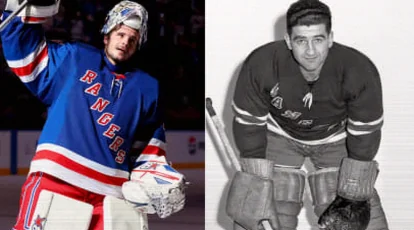
Igor Shesterkin’s empty-net strike for the New York Rangers has put a fresh spotlight on one of hockey’s rarest plays, but the trail of goaltender scoring runs much deeper than Ron Hextall’s celebrated breakthrough in 1987. Long before the Flyers netminder fired into an open Boston Bruins cage, Chuck Rayner had turned a wartime service game into a goaltending tale that still sounds impossible.
Shesterkin sealed a 5-1 Rangers win over the Tampa Bay Lightning at Madison Square Garden on Oct. 1 when he scored unassisted with 2:34 left in regulation. It was the first goal ever recorded by a Rangers goaltender. He became the 18th NHL goalie to score, with those netminders combining for 21 goals: 19 during the regular season and two in the Stanley Cup Playoffs.
Hextall had been the first to do it in the NHL, finishing Philadelphia’s 5-2 victory against Boston on Dec. 8, 1987. His shot went the length of the ice into an empty net, creating a moment that changed how the league viewed the possibility of a goalie goal. Hextall said he enjoys seeing other goaltenders join the club, calling it a special accomplishment.
Rayner’s wartime rush
Rayner’s goal came under far less familiar circumstances. Before becoming a Rangers star and Hockey Hall of Fame member, the Brooklyn-born goalie was serving with the Royal Canadian Navy in Victoria, British Columbia, during World War II. Known as “Bonnie Prince Charlie,” Rayner played on a Navy club stocked with NHL talent and faced a Royal Canadian Army side in a 1944 interservice game.
There was no modern restriction keeping a goalie from crossing center ice. Rayner had confidence in his skating and puckhandling, and he had already considered attempting an end-to-end rush if the right opening appeared.
That chance arrived during a 3-on-3 stretch after a series of fights crowded both penalty boxes. The Army had possession in the Navy zone when Bill Carse, formerly of the Chicago Black Hawks, drove a hard shot that struck Rayner high in the chest and kicked out into open ice.
Rayner saw no Army skater between himself and the far net. He collected the puck and charged down the rink, still in full goaltending gear, toward Army goalie Art Rice-Jones, a strong minor-league netminder before the war. Rice-Jones was caught off guard by the sight of a padded goalie barreling in alone, and Rayner beat him high on the stick side.
After the war, Rayner joined the Rangers as a free agent for the 1945-46 season. He nearly tried for another goalie goal on Feb. 1, 1947, with New York chasing a playoff spot against the Montreal Canadiens at the Montreal Forum.
The Rangers trailed 2-1 late in the third period when coach Frank Boucher sent Rayner out of his crease to work a power play. Rayner later said Boucher supported the idea of another rush. His large pads made him an unmistakable figure in the attacking zone, and Montreal columnist Dink Carroll described the closing minute as one of the season’s most dramatic, noting that Rayner continued battling Canadiens skaters for the puck despite the bulk of his equipment.
No second goal came that night in Montreal. Rayner’s lone coast-to-coast score for the Navy remained the one he treasured most, a wartime memory he said he would not exchange for any amount of money.