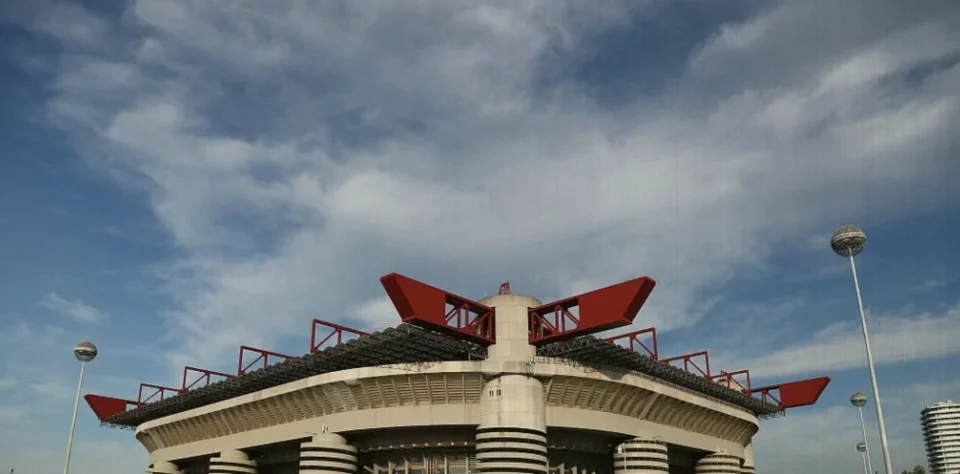
Inter and Milan have cleared an important administrative hurdle in the long route towards a new San Siro. Lombardy’s Administrative Court has rejected five challenges to the sale of the Meazza stadium and surrounding land to the two clubs, preserving the validity of the deed and allowing the project timetable to move forward.
The ruling matters beyond the stadium itself. For Inter under Oaktree, Milan under RedBird and the City of Milan, the redevelopment is a €2.3 billion undertaking that will shape the clubs’ home for the next generation and could place the city back on the major international football map.
Quick facts
- Five legal challenges against the San Siro sale have been decided by Lombardy’s Administrative Court.
- Four cases were ruled inadmissible on procedural grounds; one was rejected after examination of its substance.
- The planned development is valued at €2.3 billion.
- The proposed stadium would hold 71,500 spectators, including more than 13,000 premium seats.
- Inter and Milan are targeting completion in June 2031, ahead of the hoped-for Euro 2032 role.
The court published its decisions after a hearing on 23 June. In four cases, it did not assess the underlying objections because of procedural defects. That distinction is significant: those claims cannot simply be brought back before the same court in an effort to secure a full ruling on their merits.
Judges described an abuse of procedure in relation to several of the challenges, noting changes among claimants and the addition of new arguments as the cases progressed. One early appeal, first lodged in January 2022, grew from 54 individuals to 100 over three years.
Other, more recent cases were found to have challenged only isolated parts of the process without also contesting earlier connected acts. In the court’s view, that prevented a complete legal assessment of the procedures being attacked.
A council decision upheld
The sole case assessed on its substance came from Enrico Fedrighini, a Milan city councillor from the mixed group, who challenged the path taken through the city council in November 2025.
The court upheld the political and procedural steps taken by the council, including the so-called “kangaroo amendment”. That mechanism caused 214 other amendments to lapse during the decisive council sitting.
There was no breach, the judges concluded. Fedrighini had taken part in committee work, while the use of the amendment was permitted under the council’s rules.
The verdicts can still be challenged before the Council of State, with the standard deadline falling on 6 April. The project also remains under the shadow of a Milan court investigation concerning alleged bid-rigging, and further appeals could emerge during later approval stages.
From legal process to construction schedule
For now, however, the clubs can continue the preparatory work. The demolition of the south ticket office and interventions around the site perimeter have already begun, ahead of the main construction phase.
The next public step will be the unveiling of updated designs by Foster + Partners and Manica, expected between late October and early November. Attention will then turn to the Strategic Environmental Assessment, for which an opinion is expected by mid-December.
The environmental examination will be closely watched. The works are expected to require excavation of 1.5 million cubic metres of soil, removal of 126,000 cubic metres of rubble and tens of thousands of truck movements.
About €700 million of the overall budget is earmarked for the new stadium. A further €400 million is assigned to a hotel, shopping area and offices, while another €400 million is expected to cover financing costs under a project-finance structure.
Questions remain over the present stadium’s eventual footprint. Only part of the blue and orange sections is expected to remain standing, with the rest demolished and roughly 60,000 seats either sold or given to supporters. The surrounding land could contain new buildings or be developed as a wholly green area.
After the environmental process, the clubs must submit the updated feasibility plan. The implementation plan, filed last March, is due for approval by March 2027, alongside clearance from the Conference of Services.
The stated aim is to complete approvals by summer 2027 and begin full construction thereafter. June 2031 remains the intended finish line, leaving time for a complete season of Inter and Milan matches before the city seeks to welcome the European Championship in the summer of 2032.