Inter’s place at the top of Serie A, alongside Roma and Lazio, has kept the early-season mood calm at Appiano Gentile. Four victories and a draw from the opening five league rounds make for a convincing start on paper, and Cristian Chivu’s side have repeatedly found a way back into matches when the afternoon appeared to be turning against them. Yet the first weeks have also left a quieter concern: a defence that has not yet carried the certainty of last season.
The Nerazzurri have conceded eight Serie A goals in five matches, their poorest figure at this stage since 2022-23, when Simone Inzaghi’s team eventually finished third behind Napoli and Lazio. Including the Champions League trip to Real Madrid at the Bernabeu, the total has reached 10 in six competitive fixtures. The average currently stands at 1.66 goals allowed per match in all competitions, or 1.6 when measured only in the league, compared with 0.92 across last year’s 38-match Serie A campaign, in which Inter conceded 35 times on the way to the double.
There is another pattern Chivu will not overlook. Inter have let in at least two goals in three consecutive league games against Roma, Udinese and Napoli, something that had not happened since October 2024. This is not a crisis for a team whose attacking department remains highly productive, with the Lautaro Martinez-Marcus Thuram partnership continuing to provide decisive moments and a midfield still offering varied solutions. But the contrast between the front line’s fluency and the back line’s vulnerability has become difficult to ignore.
Chivu searches for the right balance
The issue has not been caused by a wholesale tactical change. Inter remain committed to their established 3-5-2, while most of the regular personnel have stayed in place. The defensive trio most often used by Chivu — Yann Bisseck, Manuel Akanji and Alessandro Bastoni — is the same one seen last season. Even so, with those three on the pitch against Roma, Napoli and Monza, Inter conceded five goals in three games.
Chivu has consequently adjusted both roles and selection according to the opponent and the physical condition of his players. At Cagliari in late August, Benjamin Pavard came in for Bisseck and Inter won 1-0, still their only clean sheet of the season. Bisseck returned against Napoli and delivered an impressive individual display, but Inter nevertheless allowed two goals before Lautaro drove the comeback.
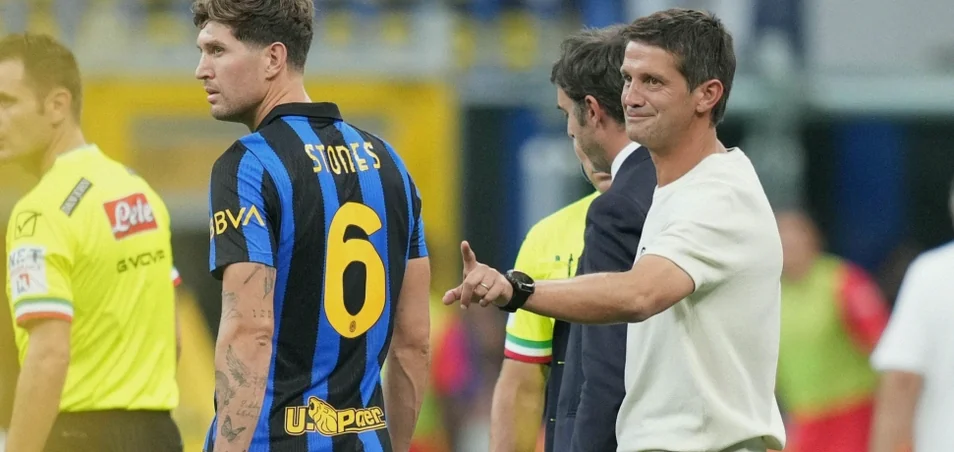
At the Bernabeu, Pavard started in Akanji’s place, with Bisseck moved centrally, without bringing the desired improvement. The experiment was less successful again when Stones played in the middle against Udinese at San Siro, where Inter won 5-3. Chivu then returned to the more familiar Bisseck-Akanji-Bastoni unit at the Olimpico against Roma.
The coach’s rotations suggest that the problem cannot simply be pinned on one defender or one combination. Akanji is still dealing with the residual effects of the Club World Cup, while Bastoni and others are described as short of peak physical sharpness. Inter’s attack has so far been able to cover many of those imperfections, often turning difficult matches into victories. For a side aiming to defend its domestic standing and progress further in Europe, however, the period after the international break must bring back the defensive polish that defined last season.