Inter have opened the season with a useful contradiction at the heart of their football: the division’s most prolific side is also its least inclined to beat opponents one against one. Cristian Chivu’s team have scored 15 times in five matches while completing only 14 dribbles, yet they sit on 13 points alongside Roma and Lazio. The early table suggests that possession, circulation and the timing of the final pass have mattered more than individual escapes.
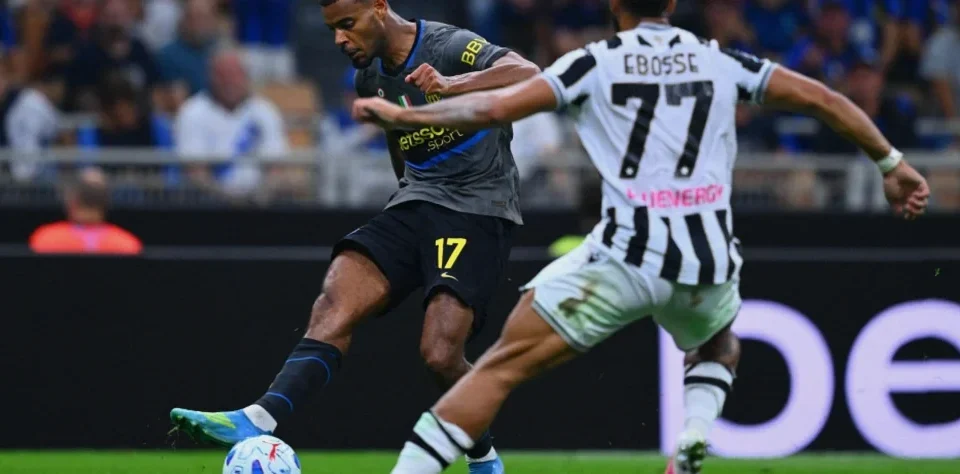
The goals have arrived in clusters: four against Monza, one at Cagliari, three versus Napoli, five against Udinese and two against Roma. It is a return that has put Inter clear at the top of the scoring charts, despite a statistical profile that runs against the usual idea of an attacking side built around wingers constantly taking on their full-backs.
Control rather than individual invention
Across the first five rounds, Inter have attempted 37 dribbles and succeeded with 14 of them. Venezia, bottom of the league’s ranking for successful one-on-ones, have still completed 17, while Bologna have managed four more than Inter. Roma and Como lead the competition in completed dribbles, but Inter have found another route towards decisive moments.
The contrast is even sharper when set beside Giorgi Kvernadze’s start at Frosinone. The young wide player has completed 24 successful dribbles by himself, almost twice the total recorded by the entire Inter squad. Frosinone’s conversion rate in those duels is around 37 per cent, narrowly below Inter’s 37.8 per cent, but Giovanni Stroppa’s side remain without a point.
Chivu’s group, meanwhile, have spent more time on the ball than any other team. Their players have held possession for 191 minutes in total, ahead of Milan on 185, Como on 182 and Roma on 171. Lazio have recorded the lowest figure, with 113 minutes. Inter’s match-by-match possession average has remained close to 60 per cent, continuing an approach associated with the club even before Chivu’s appointment.
Andy Diouf is Inter’s leading dribbler so far, offering the coach a more direct option down the flank. His career has already taken him through several roles: Zinedine Zidane saw him as a possible left-back, Lens used him in midfield, and Inter have deployed him as a wing-back. His unpredictability can change the rhythm on the outside, but it has not become the foundation of Inter’s attacking output.
For now, that is the wider lesson of Inter’s opening chapter. They do not need to turn every attack into an individual duel to score freely. With the ball for long stretches and with their collective patterns producing chances, Chivu’s side have made a fast start without relying on dribbles as their main source of progress.