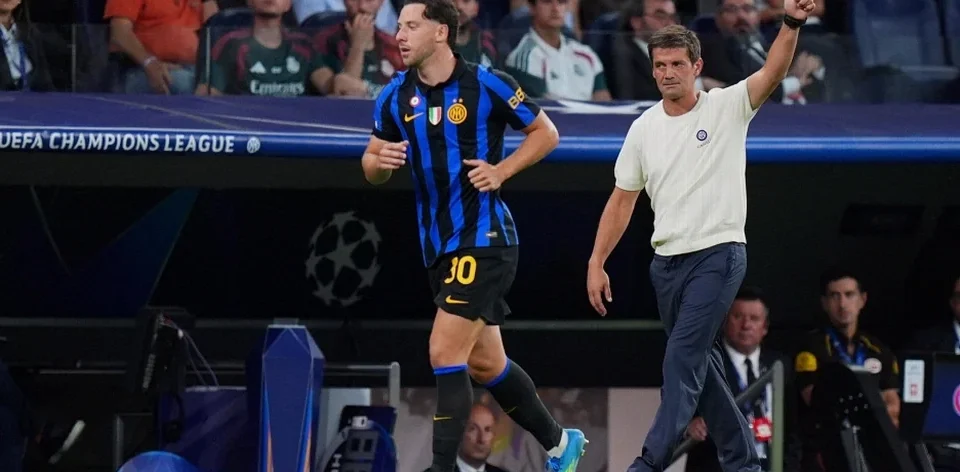
Inter’s European campaign has begun with two defeats, but the wider season is not yet written. Losses to Real Madrid and Club Brugge have left Cristian Chivu’s side without a point, yet the new Champions League format still offers a route back into contention.
Beppe Marotta has pointed to Paris Saint-Germain as the relevant example. The Inter president’s argument is simple: a poor start in the league phase does not prevent a club from reaching the latter stages, or even lifting the trophy.
Quick facts
- Inter have lost their opening two Champions League fixtures, against Real Madrid and Club Brugge.
- They host Shakhtar Donetsk on Wednesday before trips to Rotterdam, Dortmund and Bratislava.
- Stuttgart and Liverpool will visit San Siro during the remaining league-phase schedule.
- PSG recovered from major league-phase trouble in each of the past two campaigns before becoming European champions.
- Slovan Bratislava, Inter’s final opponent, sit bottom of the Champions League table on zero points after conceding nine goals in two matches.
PSG’s first European title, secured with a 5-0 final victory over Inter in Munich, was preceded by a campaign that had appeared close to collapse. After five league-phase matches, Luis Enrique’s team had collected only four points: a win over Girona, defeats to Arsenal, Atletico Madrid and Bayern Munich, plus a draw with PSV.
Qualification directly for the round of 16 had already become unrealistic. A 3-0 victory at Salzburg kept alive the possibility of reaching the play-offs, but the next match at the Parc des Princes against Manchester City seemed to end everything.
After a goalless first half, City struck through Jack Grealish in the 50th minute and Erling Haaland added another only 18 seconds later. PSG were effectively 127 minutes from elimination from a competition they would eventually win.
The response changed their season. Ousmane Dembélé, Bradley Barcola, Joao Neves and Gonçalo Ramos helped turn the match into a 4-2 win, keeping PSG alive with one final league-phase task: victory at Stuttgart.
They won there by four goals, then overwhelmed Brest 10-0 on aggregate in the play-off round. Liverpool were beaten on penalties, Aston Villa and Arsenal were eliminated, and Inter were swept aside in the final.
Marotta’s reference also reaches beyond that single comeback. In the following season, PSG opened with three wins and 13 goals across matches against Atalanta, Barcelona and Bayer Leverkusen, before their momentum disappeared.
Defeat to Bayern Munich followed, then a lift against Tottenham, before only two points were taken from fixtures with Athletic Bilbao, Sporting and Newcastle. PSG finished 14th in the league table and again had to enter the play-offs.
That second route ended with another continental title. Monaco were beaten in the play-offs, followed by Chelsea in the last 16, Liverpool in the quarter-finals, Bayern in the semi-finals and Arsenal in the final.
Inter’s remaining European road
For Inter, the immediate question is not whether they can mirror every stage of PSG’s journey, but whether they can put themselves back among the teams competing for the play-offs or the round of 16. The fixture list gives Chivu’s group enough opportunities, although the margin for further errors is already narrow.
Shakhtar arrive at San Siro on Wednesday. Inter then travel to Rotterdam, where they have recently won against Feyenoord, before returning home to face Stuttgart. Those three matches carry the weight of a recovery period.
There is then a trip to Borussia Dortmund, a ground where Inter won last season. Liverpool will follow at San Siro, giving the Nerazzurri a chance to settle a score from the previous campaign, before the final league-phase match away to Slovan Bratislava.
Bratislava may provide the last verdict, but Inter’s European direction will be shaped much earlier. Two matches have gone badly; the championship season, as PSG’s recent history shows, can still turn when a club finds its response.