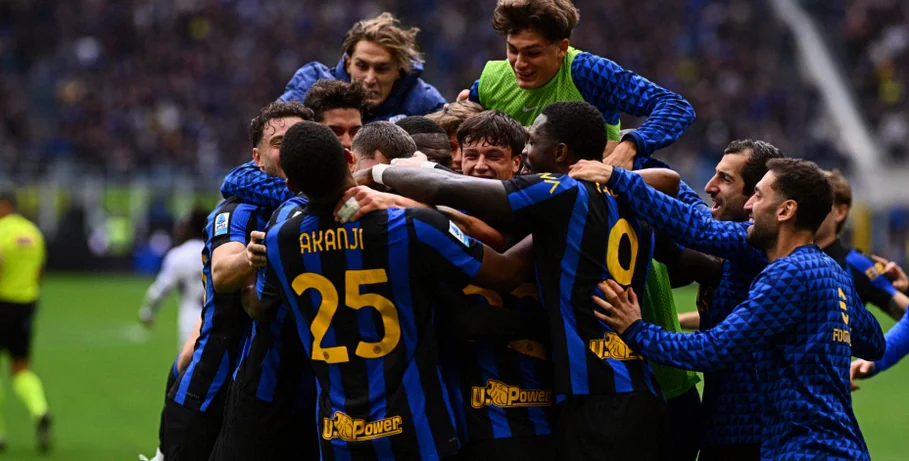
Inter’s season has acquired a familiar rhythm under Cristian Chivu: even when the match begins to tilt away from them, the afternoon is rarely settled. The latest recovery, against Fiorentina, took the Nerazzurri to five comebacks in eight Serie A fixtures and confirmed a quality that is becoming central to their campaign rather than a simple coincidence.
Having fallen behind first, Inter have collected 13 points, more than any other club across Europe’s five major leagues. Their response against Fiorentina brought three more, with Piotr Zielinski converting a penalty deep into added time before Marcus Thuram supplied the decisive touch with a precise finish.
The Fiorentina result followed earlier recoveries against Napoli, Udinese, Roma and Bologna. Across those five matches, Chivu’s side have recorded four victories and one draw after conceding the opening goal. No other team in the leading European leagues has matched that return: Werder Bremen, coached by Daniel Thioune, are next on nine points, followed by Villarreal on eight. Ipswich Town and Real Zaragoza have seven, while Arsenal, Crystal Palace, Barcelona and Strasbourg sit on six.
A squad built for late solutions
Inter’s capacity to change games owes much to the options available to Chivu. Lautaro Martinez and Thuram have each scored four goals in these comeback situations, while Carlos Augusto and Ange-Yoan Bonny have contributed two apiece. The figures underline both the importance of the attacking leaders and the value of players entering from the bench with a different task.
Against Fiorentina, Chivu introduced Zielinski, Bonny and Lavelli, the Under-23 player whose contribution helped create the crucial penalty. Lavelli extended the ball towards the far post with a flick, setting in motion the episode that led to the spot-kick. The coach explained that he had sent the youngster on to stretch Fiorentina’s defensive line.
Bonny’s role was equally specific. Chivu wanted an attacker who could move across the front line and offer fewer fixed reference points than Francesco Pio Esposito had done, with Esposito being closely handled by Marin Pongracic. It was a small adjustment, but one suited to a match in which Inter needed to disrupt a defence that had become increasingly compact.
The same instinct had been evident in Bologna. With the score at 1-1, Chivu brought on Carlos Augusto and Bonny. Carlos Augusto scored around 40 seconds after entering, and Bonny later made the result safe. Zielinski then provided the decisive intervention against Fiorentina.
Each recovery has had its own pattern, but the broader lesson is consistent. Inter possess a deep group, and Chivu has repeatedly found the right intervention as matches develop. Going behind has not become an advantage in itself, yet for this Inter side it has increasingly looked like the beginning of another contest rather than the end of one.