Italian football’s recurring question has returned with uncomfortable force: why do opponents so often appear to have another gear? A Champions League round that brought no points sharpened that impression, with Como, Napoli and Roma all unable to protect their momentum when matches turned against them.
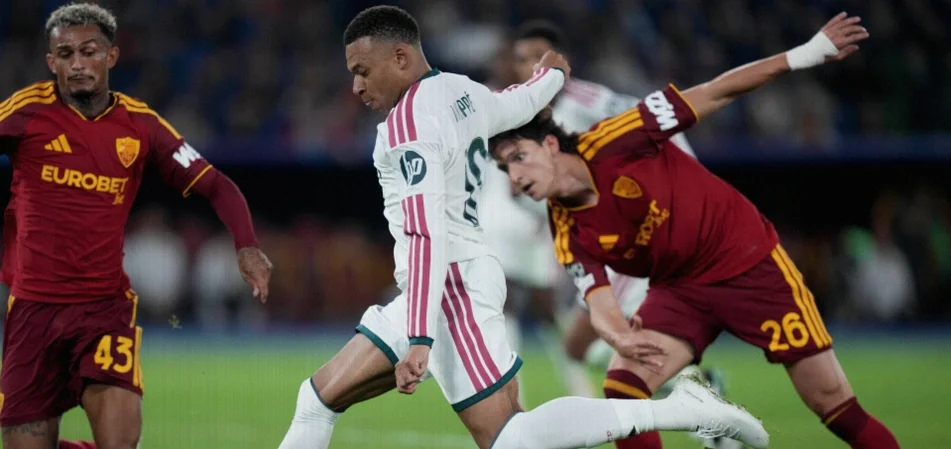
Roma’s defeat to Real Madrid offered the clearest contrast. The Giallorossi were competitive in both running and football for around 80 minutes, but then faded badly. A lack of options from the bench and the absence of the personality required in such a fixture left them exposed. Real Madrid, a side accustomed to decisive European nights, sensed the change in the contest and struck three times.
The difference is not simply one of talent. It is also a matter of experience and conviction. Established European sides tend to believe a goal is coming when a match enters its final stretch; less familiar teams can begin to fear the opposite outcome. That shift in mentality can quickly become visible in the legs.
A familiar physical gap
Italian clubs have repeatedly encountered players whose pace and energy seemed difficult to contain. Bruges’ Forbs gave Inter that impression, while Milan had previously been overwhelmed by Feyenoord’s Paixao. Italy’s national side has faced similar problems: Switzerland’s Vargas, Spain’s Lamine Yamal and Nico Williams at the European Championship, and Bosnia’s wide players in the World Cup play-off all highlighted the issue.
There is a further irony in the market. Italian clubs can be drawn towards players who hurt them in Europe, only to find that those same footballers settle into a slower rhythm after arriving in Serie A. Alajbegovic is presented as an example of that concern: a player admired for the qualities shown elsewhere, then potentially shaped by a different domestic environment.
Training is not only about volume
The discussion cannot be reduced to whether Italian teams work enough. Jamie Vardy, after his time at Cremonese, offered the opposite complaint, saying that he often reached matches exhausted and unable to run at his usual level.
That observation points towards the quality of preparation rather than the number of sessions. Luis Enrique, the European champion coach, granted more rest days than any other manager during the 2025-26 season. Recovery, intensity and the ability to reproduce speed over the course of a match may matter more than sheer workload.
For Italian football, the larger concern is whether young, fast and physically resilient profiles are being developed and trusted often enough. While rival leagues invest in players able to play at high tempo, Serie A is too frequently associated with experienced free transfers and older reference points. The challenge is not to run blindly, but to build squads and training programmes capable of sustaining modern football’s pace when Sunday afternoons give way to European pressure.