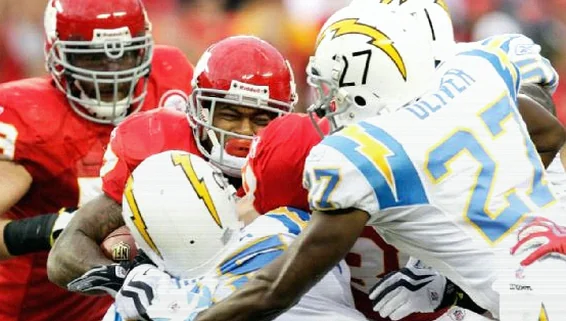
Former Kansas City Chiefs running back Larry Johnson says worsening memory lapses, confusion and difficulty regulating emotions have convinced him that he may be living with chronic traumatic encephalopathy, though he cannot know for certain while alive.
Johnson, 46, was a first-round pick in 2003 and played nine NFL seasons as a punishing, high-volume runner. He described losing track of his car after a short shopping trip and becoming disoriented while driving, unable to recall either his destination or location.
“My short-term memory got so bad that I could walk into a store and, 30 minutes later, have no idea where I parked,” Johnson said. “Sometimes I’m driving and suddenly don’t know where I’m headed or where I am.”
CTE is a progressive degenerative brain disease associated by researchers with repeated head impacts, including sub-concussive contact. At present, a definitive diagnosis requires examination of the brain after death, leaving players with symptoms and their families without a conclusive answer during life.
Research aims to identify CTE in living players
Scientists are pursuing a test that could identify CTE before death. Michael Alosco, a Boston University neuropsychologist involved in the second phase of the federally funded Diagnose CTE Research Project, said the field may be approaching that possibility.
The project has followed more than 300 former football players since its first phase began in 2015, alongside Alzheimer’s patients who did not play football. Researchers are examining testing patterns to separate CTE from other neurological and medical conditions, although there is no firm timetable for a validated live-patient diagnosis.
Participants in Alosco’s current research are at least 50 years old, an age at which CTE is generally believed to be more detectable through testing.
A reliable diagnosis could significantly affect medical care. Several conditions can produce cognitive symptoms that resemble CTE but can be treated, including sleep apnea, hypertension, low testosterone and depression.
Rachel Grashow, a Harvard researcher who has studied retired NFL player health, warned that assuming every cognitive problem is CTE can carry serious consequences. Players experiencing such symptoms can become more likely to believe they have CTE and may face an elevated risk of repeated thoughts of self-harm.
A 2024 study found that nearly one-third of former NFL players reporting general health issues believed they had CTE. That group was five times more likely to report suicidal thoughts than players who did not connect their symptoms to CTE.
Players differ on whether they would seek an answer
Current and retired NFL players offered sharply different views when asked whether they would take a noninvasive CTE test if one became available.
- Washington Commanders quarterback Marcus Mariota said he would participate, believing the results could provide useful information for NFL players as well as younger athletes entering football.
- Jacksonville Jaguars wide receiver CJ Williams said he would likely wait until his career ends. He said a diagnosis would not make him walk away from a game he loves, but it could influence his lifestyle after football.
- Minnesota Vikings safety Joshua Metellus said he would hesitate to be tested while still in the league because the knowledge could alter how he plays. He said some players might become more cautious or decide not to continue.
- Pittsburgh Steelers safety DeShon Elliott said he would want the test so he could better understand his condition and explore ways to reduce further risk.
- Indianapolis Colts tight end Mo Alie-Cox said he would not want to know absent symptoms, partly because of how others might treat him. If symptoms emerged, however, he said testing could be necessary to protect himself and those around him.
- Carolina Panthers long snapper JJ Jansen said players would likely consider a noninvasive health measure, comparing it to the extensive blood, urine and physical testing already conducted around the league.
- New York Giants linebacker Micah McFadden said he would be interested in taking the test.
- Vikings guard Will Fries said he did not have an immediate answer, adding that he focuses on using available brain-health and prevention resources while continuing his career.
- Jaguars center Robert Hainsey gave an unqualified yes.
- Dallas Cowboys safety Malik Hooker said he would take the test for himself and for his family, citing the sacrifices they have made to support his NFL career.
A positive result could force career decisions
The question of continuing to play after a positive result produced just as much uncertainty.
Green Bay Packers safety Xavier McKinney said he probably would not remain on the field if testing established that he had CTE. Hainsey said any decision would depend on confidence in the test itself, especially if active players were among the first people evaluated. Still, he acknowledged that a confirmed result would demand serious consideration because life after football lasts far longer than most careers.
Jansen said information showing that a player was particularly vulnerable or already experiencing brain-related problems would naturally change the decision-making process. He added that players are making more informed choices as research develops.
Hooker said he would consult his family and medical professionals before deciding whether to keep playing.
Several unnamed players echoed that uncertainty. One NFC linebacker said insufficient data would keep him from changing course. An NFC offensive lineman initially leaned toward retirement but said he would need time and conversations with teammates before reaching a conclusion.
An AFC linebacker said his love of the game might keep him playing if he felt healthy, but he would reconsider if testing showed a more serious condition than expected. An AFC defensive back said his competitive instinct would push him to continue, though he acknowledged the issue would require a family discussion. Another AFC offensive lineman said he would need more long-term research before making a decision.
For Johnson and other former players already dealing with troubling symptoms, the pursuit of a live-patient CTE test is not merely scientific. It could determine whether they are facing an untreatable disease, another condition that can be addressed, or years of uncertainty without a definitive diagnosis.