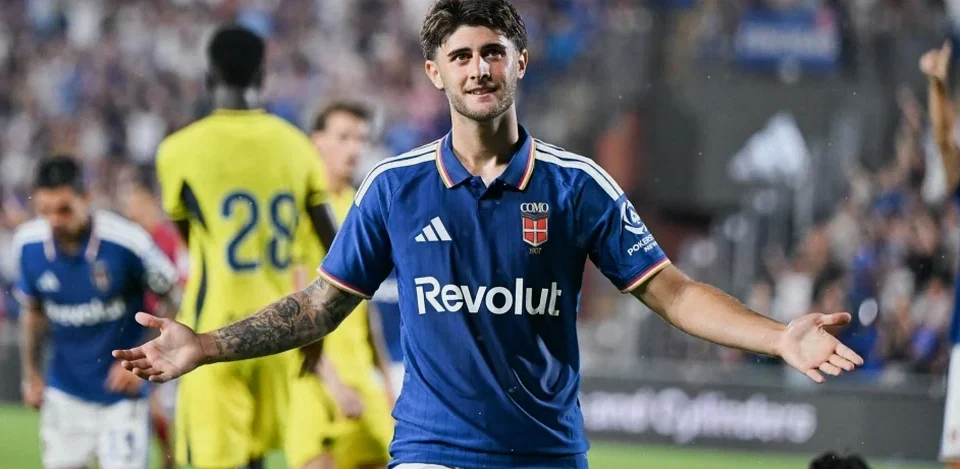
Mattia Liberali’s first Italy Under-21 appearance brought a late win in Armenia, but the 18-year-old’s thoughts already stretch beyond one qualifying night. The Como player sees work, patience and adaptability as the steps between a promising debut and the larger ambitions that wait ahead, including the 2030 World Cup.
A first Under-21 night in Armenia
Italy left Armenia with a 1-0 victory after Cisse struck in the 95th minute, and Liberali made his debut for the Under-21 side with the sort of attacking instinct that has marked his early development: dribbling, forward passes and a left foot capable of finding unusual solutions.
He admitted that Italy had expected to settle the contest earlier, but valued the group’s response when the match remained level.
“I hoped it would be easier in terms of the result and that we could open it sooner,” Liberali said. “But we did well to keep going right until the final move.”
Once he checked his phone after the final whistle, his parents were the first people he contacted. He also credited his grandfather, saying he owed them a great deal. His younger brother Daniele, an Under-16 player at Leon Vimercate, has become another regular sounding board.
- Liberali trained with the Under-21 squad at Tirrenia under coach Silvio Baldini.
- He described training standards as central to his progress, arguing that the week’s work must carry into the weekend.
- He said he arrived with considerable hunger to work and prove himself.
- Italy’s forthcoming match against Poland will be significant in the qualification race.
He expects Poland to provide a demanding test, describing them as a robust side with high intensity and quality players. “They cannot be underestimated,” he said.
Finding his place between the lines
Liberali came on in Armenia as a midfielder and later operated wider, reflecting a flexibility he considers increasingly necessary. His natural role, developed from childhood, is behind the striker, although he is also comfortable starting on the flank and moving inside.
That latter role was one he performed on the right as an attacking midfielder under Alberto Aquilani at Catanzaro. Liberali thanked Aquilani for waiting for him, calling that patience important for a young footballer.
He was reunited in the Italy set-up with Favasuli and Cisse, two players with whom he says he shared an excellent year and still speaks every week. He has also linked up again with Francesco Camarda, whom he has known since they were children.
Italy’s Under-17 European Championship triumph in 2024 brought Liberali, Camarda and Mosconi into focus. At the time, Maurizio Viscidi warned that it would represent a failure of development if such players, capable of beating opponents, were reduced to receiving with their backs to goal and playing only in two touches.
Liberali met that observation with humour, saying he had reached “four touches”, before explaining the more serious point behind it: a player must recognise when to carry the ball and when to release it quickly.
- He believes the rise in quality leaves players with less time to think and act.
- He says modern teams often play with remarkable intensity.
- For him, preparation before receiving the ball is essential.
- He identified attacking space in behind and defensive intensity as areas still requiring improvement.
- His strongest quality, he feels, is seeing the next action before the ball arrives.
Francesco Totti was one of his childhood idols, along with Paulo Dybala during his Juventus years. At Como, he now points to Nico Paz and Martin Baturina as examples close at hand.
Asked whether he and Paz can play together, Liberali left the decision to Cesc Fabregas. He said they understand one another well in training, while adding that the wider Como group enjoys playing together.
Como, growth and the road ahead
Como has also widened Liberali’s horizons away from the pitch. He has begun learning Spanish and English, partly out of necessity in a squad with different backgrounds, but also because he enjoys getting to know teammates and their cultures.
His view of the club’s season is rooted in identity rather than grand declarations. Liberali said a team that keeps faith with its own idea of football will eventually find results. While recognising that other sides are candidates for the Scudetto, he framed success more simply: win enough individual matches and the chance of something greater can follow.
Before the international break, defeat against Frosinone had brought a lighter moment when Liberali met Palmisani in the Italy camp. He joked to the goalkeeper: “Who were you, Buffon?”
His move away from Milan remains part of the same developmental logic. Liberali spoke warmly of the club that had raised him from childhood and said he remains grateful, but accepted that footballing paths can split. At that point, he felt the right choice was to take a step back, potentially into a lower division, in order to play.
He also refused to measure himself against Lamine Yamal, despite being only two months older. Liberali said there was no meaningful comparison and that every player needs his own time, adding that he still has a long road in front of him.
The Italy dream beyond qualification
Born a year after Italy’s 2006 World Cup triumph in Berlin, Liberali is too young to remember the national side’s disappointments in South Africa and Brazil. By 2030 he will be 23, an age at which he hopes to be ready for football’s biggest international stage.
The World Cup is a dream he wants to fulfil, though he is conscious of the smaller major steps that must come first. For now, he described wearing the Italy shirt as an honour every time, even if the Champions League anthem remains another sound he has imagined hearing on the pitch since childhood.