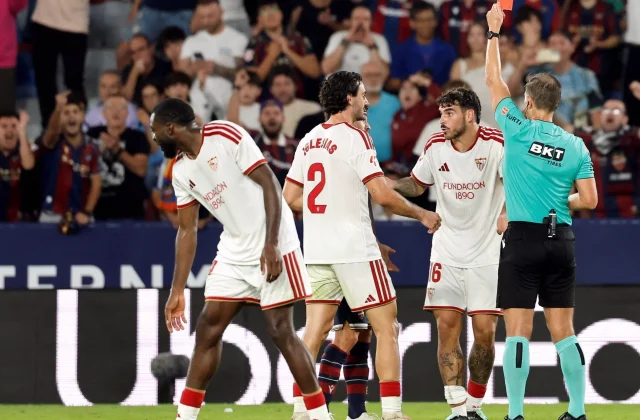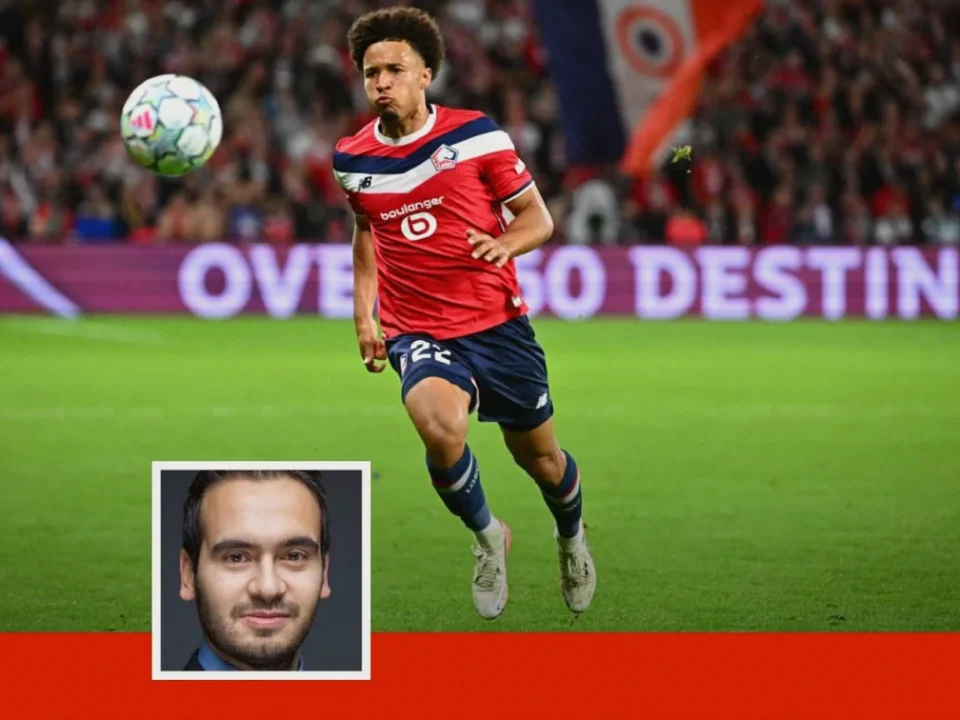
There was no card in the moment, but Lille’s 1-0 win over Le Havre on Saturday has left a far deeper mark. Tiago Santos, injured early in the match after Amir Richardson’s challenge, has suffered a complete tear of the anterior cruciate ligament in his right knee.
The Portuguese right-back faces a long absence, depriving Lille of their established starter in the position. LOSC have questioned the lack of punishment for Richardson and intend to take the matter to both the French Football Federation and the Ligue de Football Professionnel.
Quick facts
- Tiago Santos sustained a complete rupture of the ACL in his right knee.
- The injury occurred early in Lille’s 1-0 home victory over Le Havre.
- Amir Richardson was not even booked after the challenge.
- Lille may seek disciplinary action, action against the referee, and potentially civil compensation.
- A successful damages claim would depend on proving a serious breach of football’s rules, rather than simple clumsiness.
The central issue is whether Richardson’s tackle can be judged a “characterised fault”: a serious infringement of the laws rather than an unfortunate incident within the usual risks of a football match. The scale of Santos’ injury alone would not automatically establish liability.
In legal terms, a challenge from behind, a late tackle made with excessive force or brutality, or an act considered disloyal and creating an abnormal danger could meet that threshold. A mistimed but merely careless challenge, even one with grave consequences, would normally remain part of the inherent risk accepted in the sport.
A judge, rather than the match official, would ultimately decide that question if Lille brought a civil case. Bastien Dechepy’s decision not to caution Richardson does not prevent a court from reviewing video and other evidence and reaching a different conclusion.
Disciplinary route remains open
Lille’s options through the competition regulations are limited. A technical protest against a refereeing decision must be made by the captain at the first stoppage and confirmed within 48 hours, but it cannot challenge a referee’s simple interpretation of an incident such as an uncalled foul.
Even if such a protest were admissible, its possible outcome would be a replay. Having won the match, Lille have no sporting reason to pursue that route.
The disciplinary process is more relevant. LOSC cannot directly refer Richardson to the LFP disciplinary commission, but can ask the LFP president to do so. The president can open proceedings over potentially serious misconduct, with footage of the incident likely to form part of the file.
Following an investigation and hearing, the commission could punish a serious offence that went unpunished during the game. Any such disciplinary finding could also become important if Lille later seek damages through the courts.
The FFF could separately examine Dechepy’s handling of the incident. Under the federation’s refereeing framework, an internal sanction for a technical error or manifest weakness could range from a warning to months without appointments, or even demotion.
Le Havre could face a compensation claim
If Lille pursue financial redress, the claim would be aimed at Le Havre rather than Richardson personally. As the player’s employer, HAC can be held liable for wrongful acts committed by an employee in the course of his work under Article 1242, paragraph five, of the French Civil Code.
There are past cases in French football that set the relevant principle. Marseille were pursued after Patrick Blondeau fractured Nantes player Yves Deroff’s tibia in May 1999, while Paris Saint-Germain faced action after Paul Le Guen broke Guingamp midfielder Charles-Edouard Coridon’s fibula in October 1997.
Those cases established that compensation can follow only where a clear violation of the game’s rules is proven. They also underline why the employer club, rather than the footballer responsible for the tackle, is the usual defendant.
Lille could seek to recover the wages and social-security contributions it must continue to pay while Santos is unavailable. Any court procedure would likely take a long time, however, and its outcome would rest on the evidence, the legal preparation and any earlier disciplinary ruling.
The French primary health insurance fund, CPAM, could also seek reimbursement for benefits paid if court action establishes liability.
Santos retains his own legal options
The player himself may bring a personal claim through either civil or criminal proceedings. French criminal law treats unintentional injury resulting in more than three months of total incapacity for work as an offence under Article 222-19 of the Penal Code.
If Santos chooses to join criminal proceedings as a civil party, he could seek compensation for his own physical and personal damage. For Lille, the immediate battle is likely to be over whether a tackle that passed without a booking can now be judged severe enough to carry consequences far beyond Saturday night.