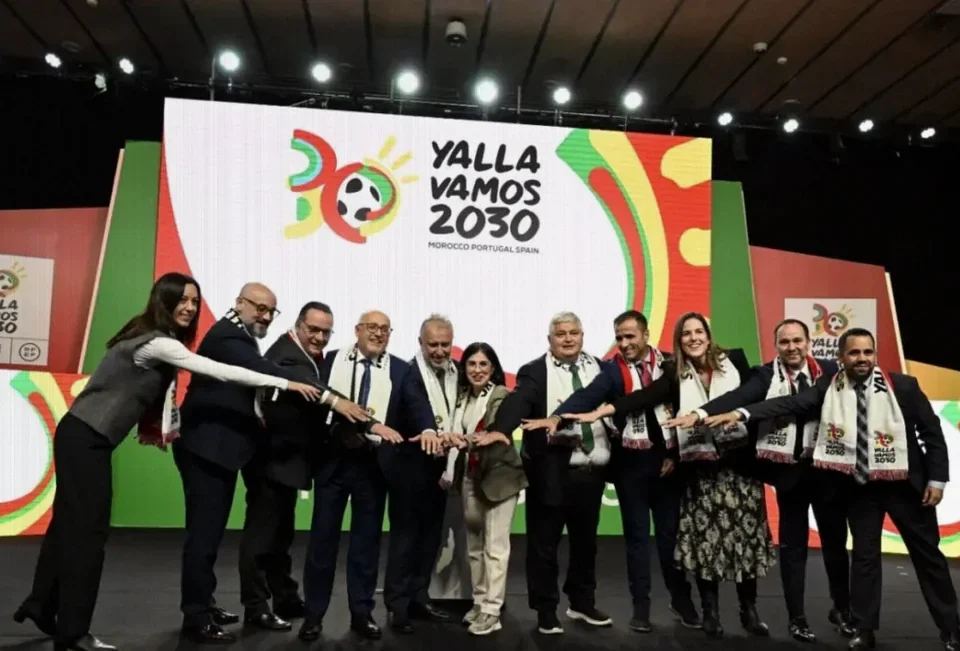
Madrid is preparing to press its case at the centre of Spain’s 2030 World Cup plans, with FIFA president Gianni Infantino expected to visit as the country steps up work on the tournament it will co-host with Portugal and Morocco.
Headline
Spain strengthens 2030 World Cup plan as Infantino visit approaches
SEO Title
Spain pushes 2030 World Cup hosting plan ahead of Infantino visit
SEO Description
Spain is intensifying its 2030 World Cup preparations, defending 11 proposed venues and backing Madrid’s Santiago Bernabéu to host the final.
A Spanish-led tournament project
RFEF president Rafael Louzán announced on Wednesday that Infantino will travel to Spain. The visit could coincide with the arrival of a FIFA delegation continuing its work on the 2030 finals project.
Spanish football’s preparations are set to accelerate after the Spanish Super Cup is presented in Istanbul. The federation’s position is that Spain carries 55% of the organisational responsibility for the joint bid, compared with Portugal’s 30% and Morocco’s 15%.
- FIFA specialists in stadium infrastructure are expected to form part of the visiting group.
- Those officials have recently completed inspections connected with the World Cup staged in the United States, Mexico and Canada.
- Spain wants to retain the original proposal of 11 host venues.
Valencia and Vigo in the venue picture
The Spanish plan includes replacing A Coruña and Málaga with Valencia and Vigo. Valencia is being presented as a major city with the capacity to stage an event of this scale, while Vigo has begun redevelopment work at Balaídos.
The country’s strongest stadium arguments remain concentrated in Madrid and Barcelona. Santiago Bernabéu, Camp Nou and Atlético Madrid’s Metropolitano are among the principal grounds in Spain’s proposed tournament network.
Madrid’s final ambition
The Bernabéu is in contention with Casablanca to stage the World Cup final. Madrid’s argument extends beyond the stadium itself: the capital is emphasising its ability to accommodate major sporting occasions, with the MADRING Formula One race cited as a recent example of the city’s event infrastructure.
Barcelona also offers a compelling venue through Camp Nou, which is expected to return to the world’s largest stadium bracket with a capacity above 100,000. The Metropolitano is widely expected to host matches during the tournament, with the semi-finals seen as its most likely assignment because its capacity is not considered sufficient for the final.
- Santiago Bernabéu is Spain’s leading candidate for the final.
- Camp Nou’s planned capacity exceeds 100,000 spectators.
- The Metropolitano is expected to be a World Cup venue and is viewed as a possible semi-final stadium.
Club compensation and stadium control
No difficulty is anticipated over FIFA’s requirement for exclusive control of selected stadiums. The usual arrangement is for host clubs to receive financial compensation for surrendering commercial use of their grounds and for accepting restrictions that can begin months before the competition.
That model was used for the most recent World Cup, and Spain expects similar agreements to be reached with the clubs whose stadiums are ultimately chosen for 2030.