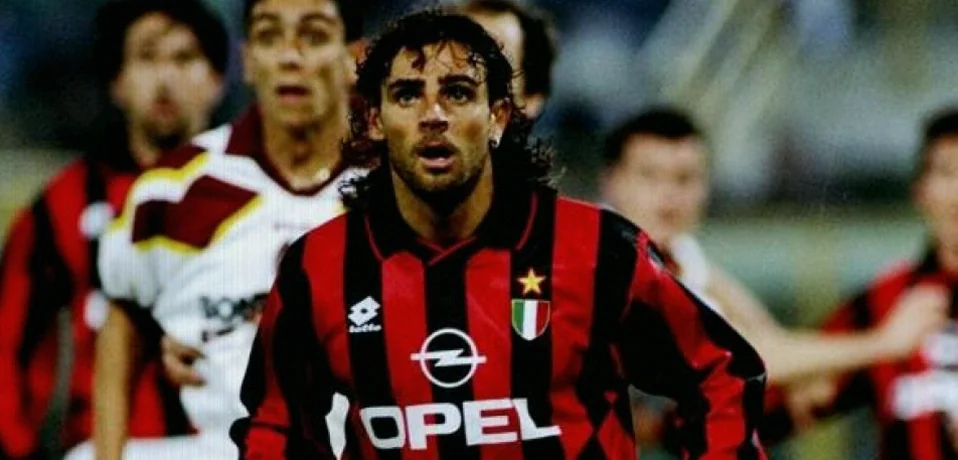
Marco Simone sees Milan’s present through the standards of a side that once made Europe feel familiar. The former Rossoneri forward, speaking ahead of the Europa League meeting with Salzburg, has urged patience with the club’s new cycle while insisting that a club of Milan’s weight cannot reduce its ambition to a place in the Champions League.
The decision
For Simone, the central issue is continuity. Milan have changed considerably from last season, including the move from Massimiliano Allegri to Amorim, and the former striker believes such a change must be given time to settle.
“They are two different ideas of football,” Simone said. “There is no single way to win, so I would not say which coach is right. But the team has to be allowed time to adapt.”
He argued that frequent changes make success harder. In the Milan teams of his own era, newcomers entered an established structure, which made it easier to find their level quickly even when competition for places was fierce.
Simone recalled an exceptional group of Italian players alongside leading foreign figures such as Ruud Gullit, Zvonimir Boban and Marcel Desailly. Franco Baresi, Mauro Tassotti, Paolo Maldini, Demetrio Albertini, Alessandro Costacurta, Sebastiano Rossi and Christian Panucci were among the core he named from that period.
His memories include Milan’s 3-0 Champions League victory over Casino Salzburg, now Salzburg, at San Siro on 28 September 1994. Simone scored Milan’s second with a low shot from outside the area and added the third after cutting onto his right foot from a Boban pass. Baresi’s Milan, he said, felt like “the strongest team in the world” that night.
Simone has no regrets over his time in red and black, only pride in a squad he considers extraordinary. He also believes modern forwards receive more opportunities than attackers did in the 1990s, when defences gave away little. Changes in rules and the greater readiness to issue cards, he suggested, would have had a major effect on a player such as Diego Maradona.
The current Milan remains his great footballing attachment, but he is concerned by the scale of annual change. He agrees with Boban’s recent view, expressed at the Festival dello Sport in Trento, that Milan should not treat a top-four finish and Champions League qualification as the limit of their aspirations.
“As a supporter, I worry if Milan do not aim to win the Scudetto,” Simone said.
He also called for perspective over Gonçalo Ramos, whose difficult start does not alter Simone’s assessment of his ability. The Portuguese forward played in a different environment at Paris Saint-Germain, and Simone believes he will improve if Milan develop a more productive attacking game and create more chances.
Simone would also have welcomed Luka Modric into the Milan side of his era. In his view, the midfielder would have been a starter even in that squad: a universal player who makes a team function rather than needing everything around him to work first, and one capable of fitting into any generation at the age of 41.
Sunday’s picture
Milan’s early league form has reflected the unsettled nature of the project. Simone saw encouraging signs in the performance against Lecce before the international break, but a less convincing display followed on Sunday in Reggio Emilia against Sassuolo.
He places Inter at the head of the Scudetto race because of the depth and quality of their squad. Milan, in his assessment, belong in the chasing group with Roma, Como, Juventus, Napoli and Lazio.
To place real pressure on Inter, Milan must improve both their goals output and the quality of their football, Simone said. Roma and Como have started strongly, while he considers Lazio the outstanding surprise relative to the resources available to them.
He reserved praise for Lazio coach Gennaro Gattuso, a former Milan teammate and fellow participant on the Coverciano Master course. Simone described Gattuso as a highly capable coach who can draw the best from his players.
Living in Monaco, Simone still follows Italian football reasonably closely, though with less affection than before. He misses the days when more Italian players were central figures and feels the modern game contains too many unfamiliar foreign names.
Europe remains a defining part of Milan’s identity in his eyes. During his own spell at the club, he said, the Rossoneri entered continental matches with a winning mentality, limited pressure and belief that any opponent could be beaten. Conditions have changed, but he believes Milan can go deep in the Europa League.
A positive result against Salzburg, he added, could provide the momentum needed for a stronger return to Serie A.
Simone’s reflections also returned to the leadership of Silvio Berlusconi and Adriano Galliani. He retains deep affection for that Milan and described Berlusconi as an exceptional president who never made players feel he was influencing team selection. With Arrigo Sacchi and Fabio Capello in charge, he said, it would have been difficult in any case to interfere with a team so strong that almost anyone selected could thrive.