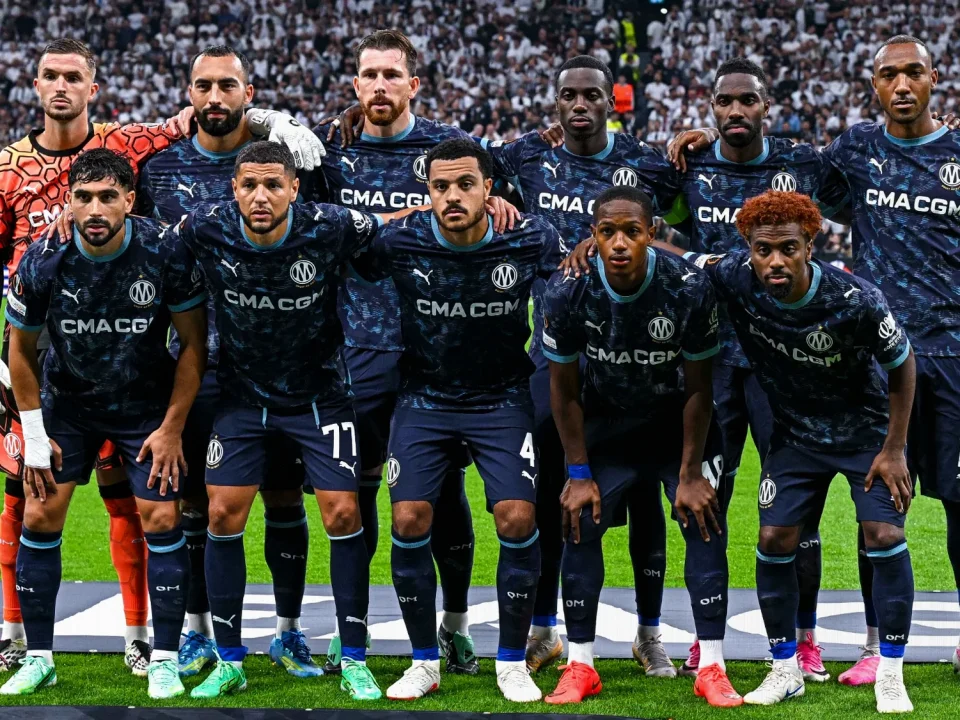
Four defeats in a row have left Marseille walking into a storm. Thursday’s 4-1 Europa League loss at Besiktas exposed the lack of options behind an otherwise credible first-choice side, and the next assignment is the visit of Paris Saint-Germain. For Bruno Genesio, the prospect of repeating a season such as 2012-13 would be accepted without hesitation: second place, however unconvincing it might look.
The move
Marseille began the campaign without a single new signing, a decision that has quickly caught up with a squad short on depth. The preferred XI, altered for the trip to Turkey, still contains players of a level expected near the top of French football. Beyond it, however, the team have looked vulnerable.
Besiktas punished Marseille heavily in Istanbul. The defeat was their fourth straight loss, with the side criticised for its lack of confidence, collective frailty and recurring naivety. Daniel Riolo described the display as utterly hopeless, saying he could find no encouraging element in a team that appeared unable to respond as Besiktas overwhelmed them.
The timing could scarcely be harsher. PSG are due at the Vélodrome next, with Marseille attempting to stop a losing run before it becomes a wider crisis.
The French season around it
Marseille have survived bleak stretches before, often with instability on the bench or a squad weakened by departures.
In 2000-01, after finishing 15th the previous year, the club rebuilt following the exits of Robert Pirès, Peter Luccin and Stéphane Dalmat. George Weah, the 1995 Ballon d’Or winner, arrived, but the campaign unravelled. Abel Braga, Christophe Galtier in a short caretaker spell, Javier Clemente and Tomislav Ivić each took charge during a season marked by supporter opposition to shareholder Robert Louis-Dreyfus and internal boardroom conflict. Bernard Tapie had returned as sporting director, yet Marseille again ended 15th and only narrowly avoided relegation.
The 2004-05 season brought another difficult transition. Didier Drogba, whose form had driven Marseille to a Europa League final, was sold to Chelsea. The club used the proceeds on Péguy Luyindula, Eduardo Costa, Benoît Pedretti, Fabrice Fiorèse and Habib Bamogo, while Bixente Lizarazu joined Fabien Barthez as another member of France’s 1998 World Cup-winning squad. But the Vélodrome struggled to move on from Drogba and the football failed to excite.
José Anigo, Albert Emon and Philippe Troussier all managed the team that season, while former boxer Louis Acariès conducted an audit. Marseille remained in contention for the podium before a nine-match winless run dropped them into an unremarkable fifth place.
Baup’s narrow-margin runners-up
Didier Deschamps left in the summer of 2012, after three seasons and six trophies, amid underlying tension with José Anigo before taking the France job. Élie Baup inherited a restricted recruitment situation under DNCG limits and a group depleted by the departures of Alou Diarra, César Azpilicueta and Stéphane Mbia.
Against those limits, Baup took Marseille to second behind PSG in 2012-13. It was an extraordinary result rather than an expansive one. The side won 18 of their 21 league games by a one-goal margin, including 12 1-0 victories. They finished with Ligue 1’s 14th-best attack and a goal difference of only +6, remarkable figures for runners-up.
That brand of football earned Baup the “Mr 1-0” label, but the outcome is the kind of finish Marseille would now welcome. Genesio would surely accept the same destination, even if the route was equally tight and unattractive.
The Bielsa collapse and a disrupted squad
Expectations were high in 2015-16 despite André-Pierre Gignac’s exit, following Marcelo Bielsa’s attacking first season that ended in fourth place. Those hopes disappeared on the opening weekend, when Bielsa resigned after a 1-0 home defeat to Caen. He objected to the club’s attempt to reduce the terms of his contract extension.
Michel’s subsequent spell proved unsuccessful, and Franck Passi took over on an interim basis until the end of a season Marseille finished 13th. Steven Fletcher missed a penalty in the final 1-1 draw at Troyes; scoring it would have lifted the club to ninth.
- Notable departures included André Ayew, Rod Fanni and Dimitri Payet, while Florian Thauvin left and later returned.
- Karim Rekik, Georges-Kévin N’Koudou, Mauricio Isla, Lucas Silva and Paolo De Ceglie were among the arrivals.
- Lassana Diarra was the major success story in an otherwise troubled campaign.
Second place, then another split
Marseille’s 2019-20 team also found a way to finish second without consistently convincing. With no European football to distract them, André Villas-Boas worked with a limited group supplemented by Álvaro González, Darío Benedetto and Valentin Rongier.
A slow opening, including one defeat and one draw, was followed by a 4-0 loss to PSG in Le Classique and tension between Dimitri Payet and Florian Thauvin. Yet Villas-Boas guided the club into second place, a finish confirmed when the season was halted by the coronavirus pandemic.
His spell later ended in conflict. Around six weeks after the campaign was stopped, Villas-Boas resigned amid disagreement with Pablo Longoria, then sporting director, over transfer business carried out without his approval.
That history does not lessen the scale of Marseille’s present problem. But it shows the club have known seasons in which thin squads, managerial upheaval and poor starts have produced either rescue acts or deeper damage. The PSG match will offer an immediate indication of which direction this one is taking.