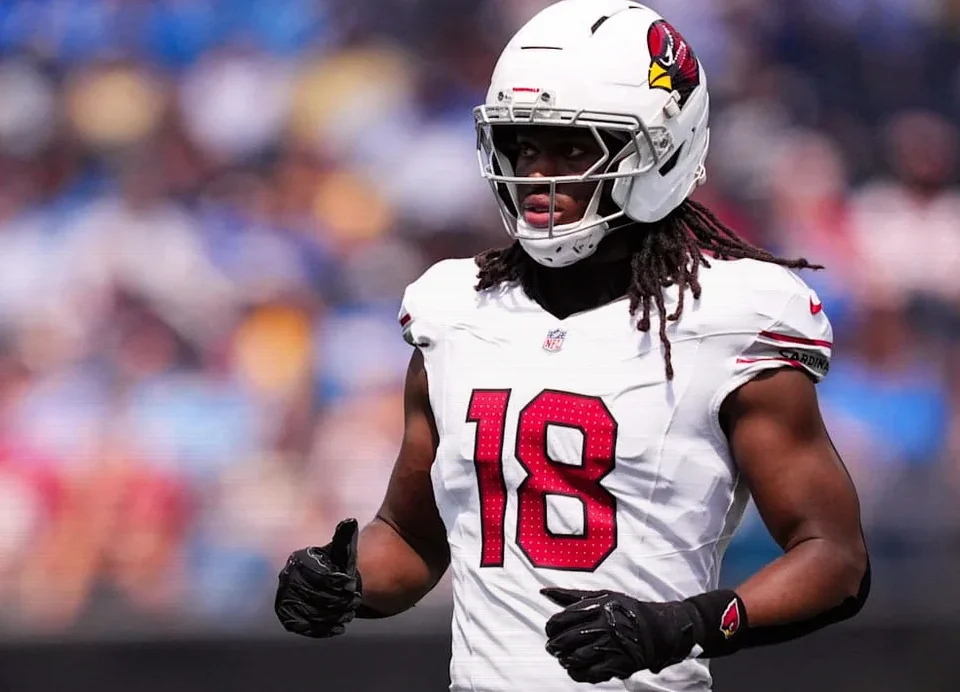
Marvin Harrison Jr.’s third NFL season has opened with another quiet stat line, and the Arizona Cardinals wide receiver understands why the scrutiny has returned. The 2024 No. 4 overall pick has only four targets through two games, with one catch for 33 yards, as Arizona searches for ways to turn its top perimeter threat into a larger part of the offense.
Harrison’s limited role through two weeks
Harrison’s only reception came on a difficult sideline catch in the Week 1 win over the Los Angeles Chargers. He received just one target in Arizona’s 31-7 Week 2 defeat against Seattle, leaving his early production far below the expectations attached to a receiver drafted near the top of the first round.
- Targets: 4
- Receptions: 1
- Receiving yards: 33
- Week 1 highlight: a sideline reception against the Chargers
- Week 2 result: Arizona lost 31-7 to Seattle
Harrison said the lack of production cannot be pinned on one player or one decision. His downfield routes, he explained, require several parts of a play to work in tandem.
“It’s a combination of a lot of things,” Harrison said. “For my routes downfield, you need the right coverage, the protection has to hold up, I have to run a good route, and Jacoby has to make the right read and throw. It is never just one person responsible for success or a lack of it.”
Los Angeles rarely left Harrison alone in Week 1. Of his 33 routes against the Chargers, he saw single coverage on only seven. He won his lone press-man opportunity, using the size and route-running ability that made him a premier prospect to produce his 33-yard sideline grab.
McBride has become Brissett’s preferred option
Quarterback Jacoby Brissett has instead leaned heavily on tight end Trey McBride, who has repeatedly found favorable matchups underneath and in the middle of the field.
- Against the Chargers, McBride caught nine passes for 95 yards and a touchdown.
- Against Seattle, he led Arizona with 10 targets and eight receptions.
- McBride totaled 41 yards in the Seattle game and scored his second touchdown of the season.
That usage has made McBride the centerpiece of Arizona’s passing attack in the opening two games, while Harrison has remained a largely untapped big-play option. Harrison credited Seattle’s defense for helping limit the Cardinals, calling the reigning champions one of the league’s strongest units on that side of the ball.
“Seattle is a really good defense,” Harrison said. “You do not want to give a division opponent too much credit, but when you look around the league, they are ahead of everybody defensively. Things like that can happen.”
Expectations remain high in Arizona
The concern around Harrison extends beyond this two-game stretch. His first two NFL seasons also fell short of the production expected from a player with his draft pedigree.
Arizona’s previous quarterback instability, including Kyler Murray’s health issues and the difficulty of developing continuity, had been part of the explanation for Harrison’s uneven results. The defensive background of former coach Jonathan Gannon also gave the franchise an understandable reason for its offensive shortcomings.
But Mike LaFleur’s offensive expertise was expected to bring a different outcome. Instead, Harrison has begun 2026 facing many of the same questions.
Brissett pushed back against the criticism, noting that attention has centered disproportionately on Harrison despite other Cardinals also having modest numbers.
“Is some of the noise justified? I do not think so,” Brissett said. “We just signed Mike Wilson for $25 million, and nobody is talking about him having two catches. People want to make something out of nothing. We have to keep improving, both as teammates and individually, and that is what we are doing.”
Harrison is accustomed to the spotlight
Harrison arrived in the NFL with major expectations after entering Ohio State as an elite recruit and following receivers Garrett Wilson, Chris Olave and Jaxon Smith-Njigba in Columbus. Smith-Njigba was named the 2025 NFL Offensive Player of the Year, while Harrison entered the 2024 draft widely expected to become a top selection.
He said the public response to his slow start is not surprising given the attention that followed him to Arizona.
“No,” Harrison said when asked whether he was caught off guard by the reaction. “I know who I am, what was expected when I was drafted here and the expectations that came with it. People want to see certain production, and when it is not there, they are going to ask why. I am not surprised by what is said about me.”
Arizona has 15 regular-season games remaining for Harrison and the offense to change that narrative.