At Milanello, the next step from promise to first-team possibility is never taken in a single afternoon. Francesco Camarda and Davide Bartesaghi have already shown that the route exists, while Milan Futuro continues to give others a competitive setting in which to make their case. Ruben Amorim has asked for patience with the club’s younger defenders, and October’s demanding run of seven Serie A and Europa League fixtures in 20 days may yet create an opening for those waiting below the senior squad.
“We have young defenders who need minutes,” Amorim said at the end of August. “The answers will not all arrive in my first transfer window at Milan. Some players may surprise you. Everyone wants everything immediately, but I come from the old school and I can wait.” It is a line that frames Milan’s work with a group of players at very different points in their development: some fresh from the summer tour, others rebuilding, and others steadily accumulating responsibility with Milan Futuro.
A waiting game with purpose
Vladimirov is among the young defenders Amorim has observed closely. The 2008-born Bulgarian centre-back stands 190cm tall and has been included in the first-team group, though he has not yet received a senior match call-up. He travelled with the side during the summer tour and has made four appearances for Milan Futuro, where he has become an important figure in the defensive unit. The crowded October programme could offer a first chance, but his immediate task remains to keep growing through regular football.
Silvano Vos represents a different kind of story. When Milan Futuro drew 1-1 with Carpi a couple of seasons ago, then-Carpi coach Christian Serpini identified Vos and Jimenez as players operating above that level. Their paths have since separated. Jimenez has enjoyed notable spells with Bournemouth and Fiorentina, while Vos has had to negotiate fitness problems, language issues, questions over temperament and the broader adjustment from Ajax’s academy environment to Italian football.
Milan Futuro have nevertheless handed the Dutchman another opportunity, and the early response has been strong: two goals and one assist across the first three Serie D matches. Sergio Navarro has worked particularly closely with the 21-year-old, with frequent discussions aimed at strengthening his confidence as well as his football. Vos combines technical quality with physical presence, standing close to 190cm, and can operate either as an attacking midfielder or as a mezzala. The ability was never the question; this season is about turning it into continuity.
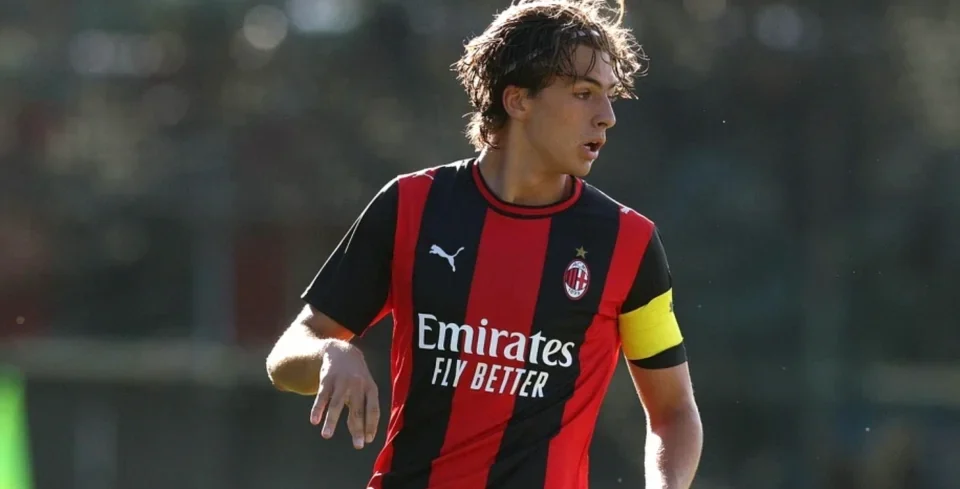
Lorenzo Ossola has been shaped by Milan for much longer. The left-footed 2007-born attacking midfielder joined the academy at seven and was one of Milan Futuro’s captains this season. He has scored twice in his opening four league appearances after also taking part in the senior team’s summer tour. Former youth-sector head Mauro Bianchessi once compared the youngster’s style to Fernando Redondo, a player Ossola grew up admiring despite the Argentine’s injury-hit period in Milan.
Ossola’s production last season underlined why he remains one of the academy’s leading prospects. Across 43 appearances, split between 20 Primavera outings and 23 matches for Milan Futuro, he produced seven goals and 11 assists. He can be used as a mezzala or from wider areas, giving Navarro and Amorim a player whose development is not tied to one narrow role.
Pandolfi, meanwhile, is another local product moving through the ranks. The 18-year-old midfielder from Treviglio entered Milan’s youth system at the age of four and has progressed through every stage, from the Under-17 side to Primavera and now Milan Futuro. He has recorded a goal and an assist in four appearances this term, and wore the captain’s armband in the recent victory over Villa Valle.
His reference points say much about his game: Andrea Pirlo, Luka Modric and Samuele Ricci. Pandolfi is a deep-lying midfielder who values possession and rhythm rather than goals, but his technical base and long association with the club give him room to grow into a more complete organiser.
Marco Sala completes a group that has already acquired meaningful Serie D experience. Also born in 2007, he can cover several midfield duties, including mezzala, holding midfield and an advanced central role. His stature is striking — he is over 190cm — but his inspirations are more delicate: Andres Iniesta is his principal idol, while Sandro Tonali is his Italian reference.
Sala featured in a Youth League final during Ignazio Abate’s time with Primavera and has already completed a full Serie D campaign, registering 27 matches, four goals and three assists. This season he has started three of Milan Futuro’s first four games across league and cup, becoming a central figure for Navarro. In a season that will test Milan’s depth, the academy’s next chapter is being written not through promises, but through these weekly demands.