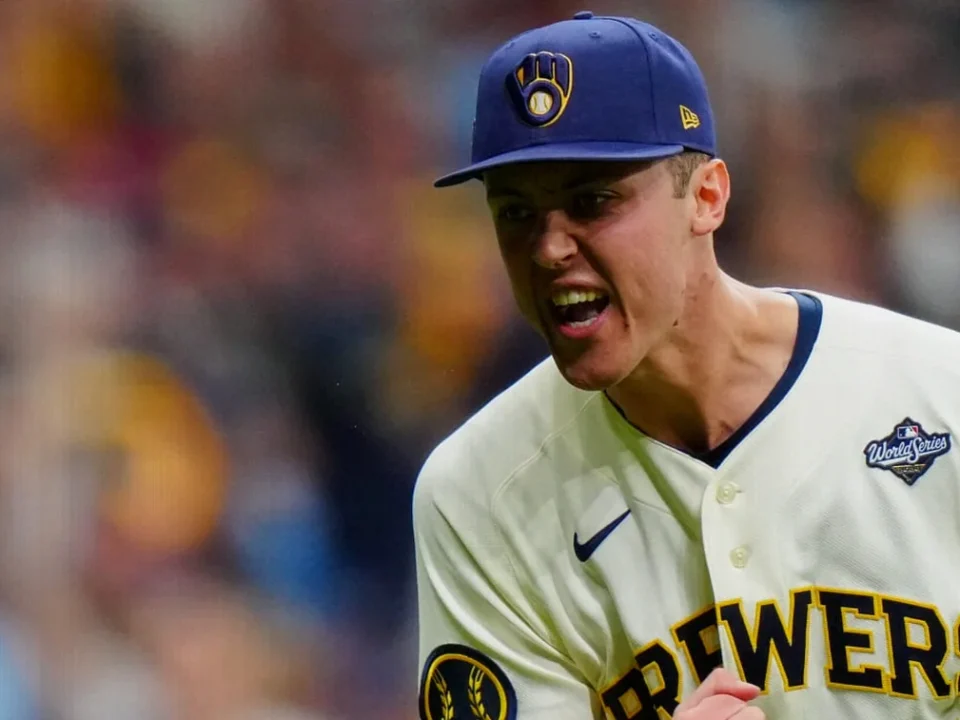
Jacob Misiorowski’s first World Series pitch missed high, but it still landed in the record book. The Milwaukee right-hander opened Friday’s Game 1 at American Family Field by firing a 103.5 mph four-seam fastball to Tampa Bay’s Yandy Díaz, the fastest pitch tracked in World Series history, then worked through five innings to help the Brewers take a 3-2 victory over the Rays.
| Game | Rays | Brewers | Result |
|---|---|---|---|
| World Series Game 1 | 2 | 3 | Milwaukee leads series 1-0 |
Misiorowski finds a different way to win
The night was not the usual strikeout parade from Milwaukee’s young fireballer. Misiorowski gave up one run on four hits and one walk over five innings, striking out three while throwing 78 pitches. He drew 17 swings and misses, a modest total for a pitcher who paced the Majors with 252 strikeouts and a 1.80 ERA during the regular season.
Still, he did the most important job a postseason starter can do: he handed over a lead. It was Misiorowski’s first playoff win and the first victory by a Brewers starter this October. He has now given Milwaukee a chance to win in each of his three postseason series openers.
“Not perfect, but good enough to get a win,” Misiorowski said.
Manager Pat Murphy saw a pitcher making adjustments instead of simply overwhelming hitters.
“I thought Miz was great tonight,” Murphy said. “In the regular season, we’re accustomed to him mowing people down and getting two strikeouts an inning. That’s unrealistic.”
Triple-digit history, but a tight fourth inning
Misiorowski broke the previous World Series pitch-speed mark of 103.2 mph, set by Aroldis Chapman with the Cubs in Game 2 of the 2016 World Series. The record covers the pitch-tracking era, which began in 2008.
| Misiorowski, Game 1 | Figure |
|---|---|
| Opening fastball | 103.5 mph |
| Pitches at 100 mph or higher | 40 |
| Innings pitched | 5 |
| Runs allowed | 1 |
| Strikeouts | 3 |
His 40 pitches at 100 mph or above were the most ever in one World Series game in the tracking era. All four postseason starts with at least 30 triple-digit pitches belong to Misiorowski.
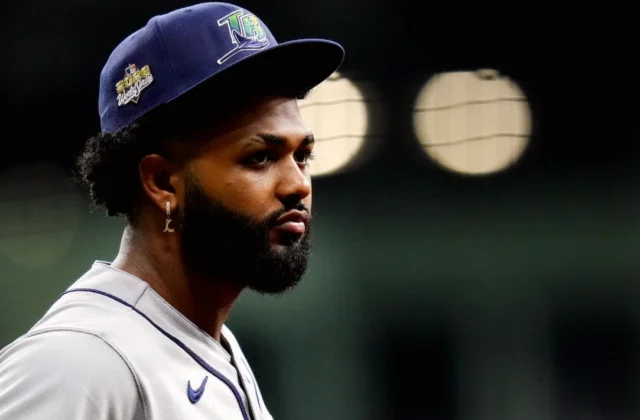
But Tampa Bay showed why October lineups can narrow even the widest margins. In the first inning, Jonathan Aranda and Chandler Simpson reached on singles before Junior Caminero lined into an inning-ending 5-4 double play.
Caminero got another crack in the fourth. With Aranda aboard and one out, Misiorowski fell behind 2-0 and came in with a 101.5 mph fastball. The 22-year-old drove it at 112.7 mph with a 13-degree launch angle, a low laser that kept carrying over Garrett Mitchell’s head in center for a double. Liam Hicks followed with an RBI groundout, trimming Milwaukee’s advantage to 2-1.
“You don’t see many people hit a baseball like that,” Mitchell said. “It’s low on a line, and it just stays up and continues to carry. It was a great swing. It was crazy.”
Murphy goes to the bullpen with the lead
With Tampa Bay’s lineup coming around for a third time in the sixth, and Caminero potentially due for another look, Murphy decided five innings and 78 pitches were enough. Misiorowski’s fastball had made the headlines, but his ability to navigate trouble was the difference in the Brewers’ Game 1 win.
“The biggest thing I learned was October baseball,” Misiorowski said. “It doesn’t matter how you get outs. You just have to get them.”
That lesson was already clear in the Milwaukee clubhouse afterward. During Murphy’s postgame appearance, his children joined him at the podium, as they often do. Asked who played well, his son Jaxon named Christian Yelich, then brought up Caminero. Murphy slapped the podium and protested that his son was always talking about the other club.
It was a fitting close to an opener that belonged to two young stars in different ways. Caminero produced Tampa Bay’s loudest swing. Misiorowski brought the game’s biggest arm, made World Series velocity history, and, more importantly for Milwaukee, left with a lead in hand.