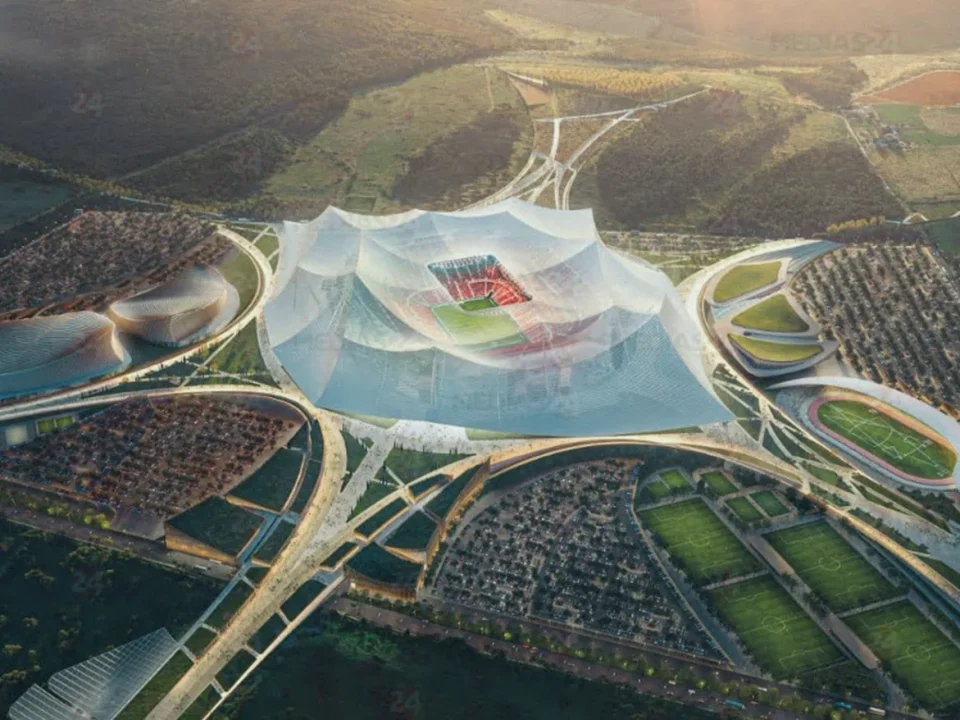
In Benslimane, between Morocco’s commercial hub of Casablanca and the capital Rabat, a vast construction site has become central to the country’s 2030 World Cup ambition. The Grand Stade Hassan II is planned as a 115,000-seat arena, a scale that would make it the world’s largest football stadium if completed as proposed.
Morocco, Spain and Portugal will jointly host the 2030 finals, but FIFA has not selected the venue for the final. Morocco is pressing the case for its new national showpiece, while Madrid’s Santiago Bernabéu stands as the principal Spanish alternative.
Quick facts
- The Grand Stade Hassan II is being built in Benslimane and is planned to hold 115,000 spectators.
- The project was announced in 2023, with completion initially targeted for the end of 2027.
- Ground preparation began around a year after public funding was approved in October 2023 and ended in May 2025.
- Work is reported to be 40% complete, with about 10,000 workers on site and a larger workforce expected for the roof phase.
- The 2030 World Cup runs from 13 June to 21 July, hosted principally by Morocco, Spain and Portugal.
The stadium’s projected capacity is 38,000 above that of the Maracanã, and each of its four sides is intended to accommodate up to 29,500 people. It has been conceived not only as a tournament venue but as the centrepiece of a wider urban district with training facilities, aquatic complexes, hotels, shops and leisure areas.
Early estimates placed the cost at MAD 5 billion, roughly R$2.4 billion at the exchange rate used at the time. More recent Moroccan estimates have put the likely final bill above MAD 11 billion, or more than R$5 billion.
The arena is named after Hassan II, Morocco’s monarch from 1961 until his death in 1999. His son, Mohammed VI, has ruled the kingdom since then. The investment forms part of a broader effort to meet FIFA requirements ahead of the World Cup.
Stadiums in Tangier, Casablanca, Rabat, Agadir, Marrakech and Fez are also due for renovation, at an estimated cost of around R$2.9 billion. The programme follows Morocco’s hosting of the Africa Cup of Nations at the beginning of 2026, when the country rebuilt stadium infrastructure extensively.
A tent-shaped landmark
Oualalou+Choi and Populous designed the Grand Stade Hassan II with Moroccan cultural gatherings, known as moussems, in mind. The principal form draws on the image of a festival tent: 32 stair structures will support a vast aluminium roof frame.
The plan covers 119,000 square metres of built area. Gardens are intended to sit both at ground level and on raised platforms 28 metres above the pitch, giving the building a landscape element unusual for a stadium of this size.
The design received an Architizer award in June in the unbuilt sports and recreation facilities category. For Morocco, the project has become a symbol of a World Cup campaign that had been pursued for four decades before the successful 2030 bid.
Amine El Amri, deputy editor-in-chief of SKWAD at 2M TV, described the stadium as the “cherry on the cake” of Morocco’s infrastructure push. He said hosting ambitions now appeared realistic in a way they did not during the country’s bids in the 1990s.
El Hajjam said the arena has become a frequent subject of conversation in cafés, workplaces and online. “Knowing that Benslimane will host the biggest stadium in the world makes all of us feel part of history,” he said.
Construction timetable under scrutiny
A consortium led by SGTM, Société Générale des Travaux du Maroc, is overseeing the build alongside partner companies. The initial phase focused on marking out and preparing the site; the construction programme then moved into its main structural stage.
The official target remains the end of 2027, although a completion in mid-2028 has also been presented as manageable should the schedule slip by several months. El Amri said he did not expect a major delay and considered the delivery target achievable.
The scale of the roof makes the next phase particularly demanding. Local reports have indicated that the workforce of roughly 10,000 could double once work on the covering begins.
El Hajjam said the project was already feeding improvements to local roads, transport and economic activity. “People expect everything to go to plan, but in general everyone is confident,” he said, adding that Morocco was ready to stage a major tournament.
The final remains open
The contest for the 2030 final has added a political edge to an already ambitious building programme. Morocco’s argument rests on capacity, new infrastructure and the prospect of presenting FIFA with the biggest stadium in the game.
Spain’s principal candidate is the renovated Bernabéu, home of Real Madrid. Florentino Pérez was re-elected as the club’s president in June for another four-year term, and his relationship with FIFA has been viewed in Spain as an advantage for Madrid’s bid.
One scenario discussed around the tournament would place the final in Madrid while giving the Grand Stade Hassan II a semi-final. Another possibility raised has been Morocco hosting the 2029 Club World Cup as a compensating event.
The issue has become intertwined with debate around Gianni Infantino’s future as FIFA president, particularly after the proposed FIFA Forward Enterprise project failed. The plan had envisaged a company controlling FIFA competitions and selling shares in the operation.
Claims published in August suggested that Morocco might have been offered the final in return for support for Infantino’s re-election. The matter has sharpened the public rivalry between the Moroccan and Spanish camps.
El Amri said Spanish media and public opinion had shown a lack of confidence in Morocco’s candidacy, arguing that Spain had turned the competition into a confrontation of greater importance than Morocco expected. “Moroccans love challenges,” he said.
Fouzi Lekjaa, president of the Royal Moroccan Football Federation, said at an event in early September that the final would be held in Morocco. FIFA subsequently stated that no final venue had yet been chosen.
A six-country anniversary tournament
The 2030 World Cup will be played across 20 proposed stadiums. Eight are expected to have more than 60,000 seats and three are planned to exceed 80,000, with Hassan II far beyond that threshold.
Spain’s proposed host cities are Barcelona, Bilbao, A Coruña, Las Palmas, Madrid, Málaga, San Sebastián, Seville and Zaragoza. Morocco has put forward Tangier, Fez, Rabat, Casablanca, Marrakech and Agadir, while Portugal’s matches are set for Lisbon and Porto.
To mark the centenary of the first World Cup, opening matches will also be staged in Argentina, Paraguay and Uruguay. Yet the tournament’s defining night remains undecided, and the unfinished stadium rising outside Casablanca is being built with that single possibility in mind.