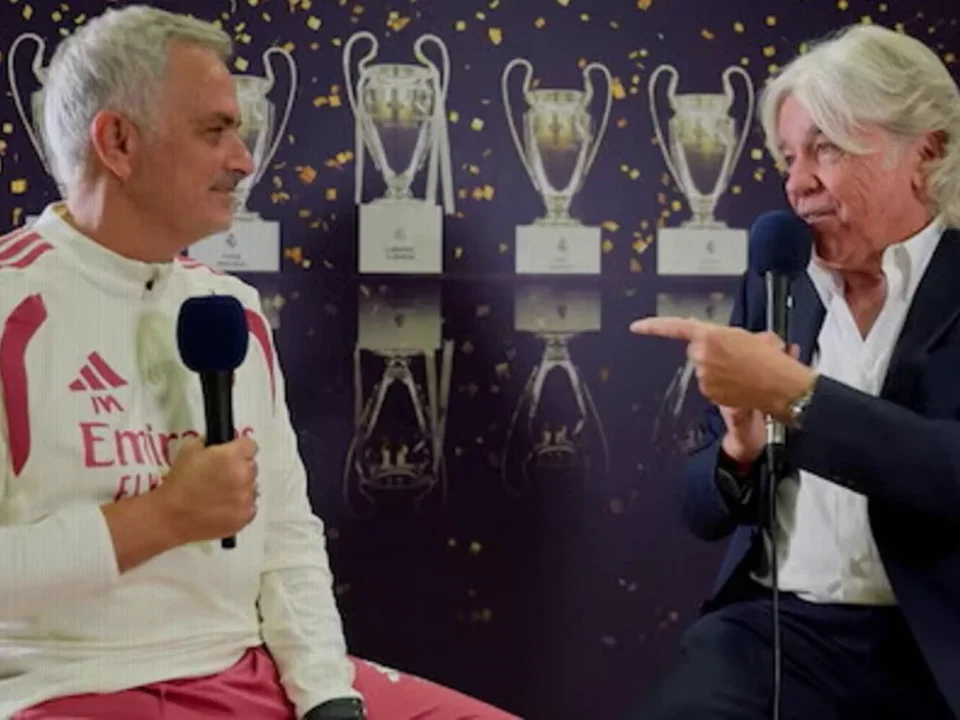
José Mourinho will return to the Stadio Olimpico on the 14th as Real Madrid coach, but he insists the occasion must be handled with the discipline of an opponent rather than the sentiment of a former Roma manager. The Portuguese says he has not yet begun preparing either the match or his own emotional return, aware that Rome remains one of the strongest bonds of his career.
“When I sit on the bench, it will be a different story,” Mourinho said. “At that point I will be representing only Real Madrid.”
The meeting brings Mourinho back to a city where he won the Europa Conference League, reached the Europa League final in Budapest and forged an unusually deep relationship with supporters. He expects respect rather than banners or elaborate tributes, but knows that the approach to the Olimpico, the tunnel and the first sight of the pitch will not feel routine.
A return shaped by Roma
Mourinho said Roma supporters understood that, during his spell at the club, he put their team above personal image, internal politics and his relationship with the ownership. He recalled arriving in the capital to find around 1,000 people waiting at the airport before he had even taken charge of a game.
He believes that welcome captured something distinctive about the club and the city. In his view, the Conference League triumph in Tirana carried particular weight because Roma had not regularly won trophies, even if the competition itself may be judged differently by clubs with a longer record of European success.
“For a club accustomed to winning, that trophy may mean less,” he said. “For one that is not used to it, it has enormous value.” He noted that the cup remains displayed at Trigoria.
Mourinho accepted that defeats and mistakes were part of his time in charge, while maintaining that he never held anything back. He described the Budapest final as the peak of his connection with Roma’s support, even more than the victory in Tirana.
He also addressed the difficult final stretch of his Roman tenure. Mourinho said he had effectively been “finished” long before his January departure, pointing to the UEFA punishment that followed the Europa League final and the aftermath of an airport incident. He argued that he should have been sanctioned only for insulting referee Anthony Taylor in the car park, rather than for events for which he did not believe he was responsible.
The former Roma coach confirmed that there had been a long period without contact with the Friedkin ownership after Budapest, saying their approach to the club differed from his. Yet he stressed that he has never publicly attacked the owners and would greet them normally should they meet around the match.
“I do not know how to carry resentment,” he said. “I keep the good parts of an experience and leave the negative ones behind.”
Real Madrid reunion after Benfica
Mourinho’s move back to Madrid came after a period at Benfica in which he had expected to see out his three-year contract. He said he was happy at the Lisbon club, close to home for the first time in two decades, and believed Benfica needed time to build towards a higher level.
He said speculation about a Real return began before any direct approach. At the time, Real Madrid had changed coach midway through the season, with Álvaro Arbeloa taking over, but Mourinho considered the reports no more than rumours because nobody from the club had contacted him.
The link between Mourinho and Real Madrid had never completely disappeared after his first spell ended 13 years ago. He said his relationship with Florentino Pérez had remained close and friendly, while stressing that Carlo Ancelotti had never had reason to suspect any manoeuvring behind his back.
“Carlo knew I was his friend, and he knew about my connection with Florentino,” Mourinho said. “There was nothing for him to worry about.”
Before his appointment, Benfica faced Real Madrid three times in two weeks. Mourinho highlighted the match that sent Benfica through from a seemingly impossible position: after taking no points from their first four games, they qualified on the final second of their eighth match, helped by a goalkeeper’s goal.
He described it as an extraordinary recovery, one no team had previously managed from that start.
The Vinicius and Prestianni episode
Mourinho also reflected on the dispute involving Vinicius Junior and Benfica player Gianluca Prestianni, which he called deeply difficult for everyone involved. Having experienced the matter first from the Benfica side and now from within Real Madrid, he said he had gained a fuller understanding of its complexities.
Prestianni was suspended, Mourinho noted, but not for racism. He said the issue became impossible to navigate cleanly because the player denied making the alleged remarks and there was no proof that he had said them.
Mourinho felt he was heavily criticised in public, particularly by people he regarded as opportunistic, for refusing to take a simplistic position on an uncontrollable situation. He nevertheless took one positive from it: he had worked with “a fantastic boy” at Benfica and had come to know “a golden boy” at Real Madrid.
Preparing Real Madrid for the Olimpico
Mourinho said the immediate priority is to protect himself from the emotion of the return and prepare Real Madrid properly. He wants his players to understand the intensity with which Roma supporters experience a major night at the Olimpico.
His squad contains players familiar with World Cup semi-finals and finals, as well as Champions League finals, but Mourinho believes the Roman setting has its own force.
“I want them to understand the extraordinary beauty of playing at the Olimpico,” he said. “This time, they will experience it as opponents.”
He expects to arrive from a hotel rather than from Trigoria and said he does not yet know where the team will stay. Still, he acknowledged there will be no disguising what the night represents once he walks through the stadium and towards the field.
The fixture also reconnects Mourinho with Ancelotti, another figure with strong ties to both Roma and Madrid. Mourinho recalled Ancelotti asking permission to visit Real Madrid’s training centre to speak with players and check on Vinicius, Rodrygo, Éder Militão and the injured Endrick.
Mourinho responded with humour, telling Ancelotti that the club’s corridors were already full of reminders of him. He described the Italian as “a great man” and a coach who remains close to players.
Respect for former clubs and Roma’s history
Mourinho said he has felt at home at almost all of his former clubs, naming Inter, Roma, Chelsea, Manchester United and Benfica. He separated Tottenham from that experience because his time there was dominated by the Covid period, with empty grounds and little opportunity to build a relationship with supporters. He described Fenerbahçe as a unique club and culture, but noted that his stay lasted only around 13 or 14 months.
He said none of his dismissals had been followed by public hostility from him, adding that leaving Roma had caused him real pain.
Asked about his standing among Roma supporters, Mourinho rejected comparisons with Francesco Totti and questioned why the club legend does not have a role at Roma. He also mentioned Bruno Conti with affection, while noting the importance of recognising historical figures without assuming every former great can automatically be accommodated within a club structure.
In Mourinho’s view, Real Madrid has distinguished itself in preserving its technical and human heritage through its president, directors and ambassadors, while still making choices about which former figures return in official capacities.
For Roma, however, the chapter is less about administration than memory. Mourinho arrives as the coach of Real Madrid, charged with delivering a major result for his new club. Yet the club he left behind remains, by his own admission, a place he still regards as home.