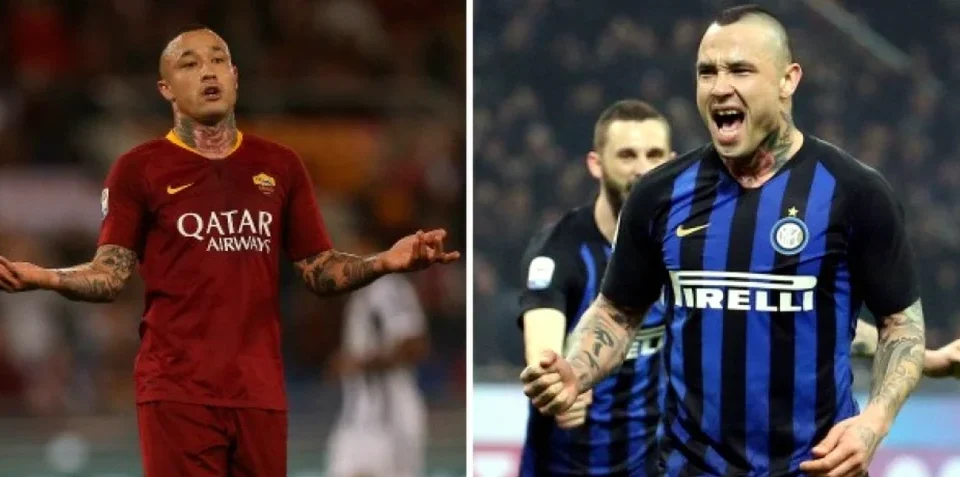
Radja Nainggolan will watch Roma-Inter from Belgium with the feeling that the Olimpico is still, in some way, part of his footballing home. Now 38 and playing in the Belgian second division for Patro Eisden, the former Roma and Inter midfielder sees the meeting as more than a fixture from his past: it recalls the club where he believes he expressed himself best, and an Inter spell that began under Luciano Spalletti before changing course under Antonio Conte.
An old Roma hand looks towards the Olimpico
Nainggolan is due to play away to league leaders Hekelgem the day after Roma face Inter, a short drive from his native Antwerp. Yet the Italian match remains firmly in his thoughts after four and a half seasons in Rome and 18 months with Inter.
He said he still feels capable of appearing in an occasion of that scale. Having attended Roma’s match against Fiorentina at the Olimpico, he admitted that being in the stadium made him want to put his boots on again. In his view, the modern game has become easier both through its regulations and its general standard, and he believes his former self would find room in either of the current sides, either behind the forwards or as a central midfielder.
- Inter remain his pick as the stronger side, with the deepest squad in Italian football.
- He considers Roma more settled under Gian Piero Gasperini, with a clearer identity and greater stability.
- He expects an intense match between two teams willing to take the initiative.
- Paulo Dybala, he said, could decide the balance of the evening.
Nainggolan hopes Roma can handle the pressure of a difficult night, while recognising that a match of this kind can turn in several directions.
Roma, the club he did not want to leave
His allegiance is uncomplicated. Nainggolan said he left his heart in Rome and described the capital as the place where he was able to give his best. He maintains that he would never have chosen to depart.
His 2018 move to Inter, he argued, was driven by Roma sporting director Monchi’s desire to dismantle the group assembled under Walter Sabatini and build a side of his own. Nainggolan claimed that, while seeking his opinions on transfer matters, Monchi was simultaneously negotiating his sale.
He compared the situation to Edin Dzeko’s proposed move to Chelsea, which did not ultimately happen. From Nainggolan’s perspective, the timing was particularly damaging: Roma had just reached the Champions League semi-finals against Liverpool and the squad felt it could improve further. Instead, the club repeatedly had to sell its most sought-after players to address its finances.
That period remains his principal sporting regret. He has few regrets overall, he said, but regrets that the Roma side did not win a trophy, believing it repeatedly ran into a Juventus team that was too strong for the rest of the division.
Inter’s changing plan
Spalletti’s call helped take Nainggolan to Milan, and the Belgian remains grateful to the coach, saying their work together produced the most compelling chapters of his career. His Inter experience, however, faded after the first season.
- Nainggolan accepted that he may have arrived in Milan somewhat drained after his years in Rome.
- More importantly, he identified Spalletti’s departure as the decisive change.
- Conte told him immediately that he did not feature in the new project, a direct approach Nainggolan said he respected.
- He noted that Conte had previously tried to bring him to Chelsea, an offer he rejected in order to stay at Roma.
- Nainggolan also turned down a major offer from China during his Roma years.
Asked whether Conte’s earlier failed attempt to sign him might have affected the later decision, Nainggolan could not say, joking that the coach may have still been annoyed by the refusal.
Still playing, still unconcerned with the next chapter
Nainggolan rejected the suggestion that his lifestyle had damaged his standing with leading coaches. He said he has always been the same person, whether at 20, 30 or approaching 40, and sees no reason to apologise for his private life because he gave everything on the pitch. He added that he often played through injuries.
He also dismissed claims that he caused disorder in dressing rooms, insisting that former team-mates and coaches would confirm he never had a problem with anyone.
Belgium has offered him a different role. He enjoys matchdays with Patro Eisden, says he can still outrun many younger players, and values serving as an experienced figure for the squad. Training, by contrast, holds little attraction for him.
He continues to believe he could perform at a higher level, but has no firm plan for the day when he can no longer chase full-backs. “I do not think about it,” he said. “I am enjoying the present.”
Nainggolan also addressed his past association with a drug-trafficking investigation, saying he had done nothing wrong and that the matter had already been closed. Asked how football should remember him, he chose a simple description: a genuine man in a game he feels contains too many false ones, someone who can always look himself in the mirror.