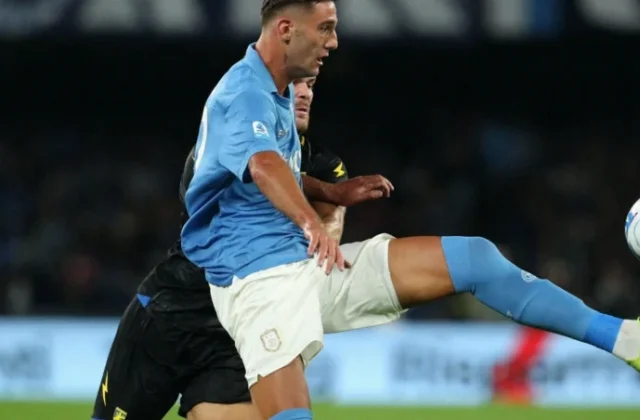

Napoli are still waiting for Rasmus Hojlund to become the reference point their attack was built to find. The Danish forward has supplied two moments of individual quality, but neither has changed Napoli’s position in the standings: his long-range goals against Como and Inter came on the second and third matchdays, and both matches ended without points for his side.
A promising start without a decisive return
- Hojlund has made six appearances across Serie A and the Champions League, accumulating 439 minutes.
- He has scored twice and has yet to register an assist.
- Both goals were struck from outside the penalty area, underlining his ability to create a finish for himself rather than a steady supply of chances in front of goal.
- He has started all six matches, but Allegri has replaced him on every occasion as Napoli manage his physical workload.
The central concern is not simply missed chances. Napoli have too rarely put Hojlund in the positions from which a centre-forward can decide matches. He has recorded only 15 touches in the opposition box so far, a low figure for a striker expected to make the difference close to goal.
His average of 0.8 shots on target per game points in the same direction. Allegri recognises that the collective approach carries responsibility: if the delivery is not clean, finishing becomes difficult. Yet the coach also wants greater output from his No. 9, with more regular presence in the middle of the area and a higher volume of attempts.
Space remains Hojlund’s natural territory
Hojlund’s clearest strength is his ability to run beyond a defensive line. Few Serie A forwards can combine his acceleration with his physical power when there is room to attack. With open grass ahead of him, the 2003-born striker can be difficult to contain.
That quality is less useful when Napoli face a deep, compact defence. In those matches, there is little space to exploit and Hojlund must offer more in shorter movements: linking the lines, combining with team-mates and repeatedly arriving in the area rather than waiting for a direct ball into the channel.
His minutes are being handled more carefully than last season, when he had barely any respite from January onwards amid a crowded schedule and limited alternatives at centre-forward. Napoli now have a more balanced way of managing him, but the added freshness has not yet become consistent influence in the final third.
A shared task for Napoli and their striker
The next stage depends on the connection between Hojlund and the players around him. Napoli must serve him with better timing and greater precision. Hojlund, meanwhile, must become sharper in tight spaces, more forceful in his runs and more alert to the decisive ball.
The finishes against Como and Inter showed that his talent is not in question. They were goals he largely constructed himself. But after a 50 million investment, Napoli and Allegri need more than isolated flashes: they are waiting for Hojlund to provide the steady presence and scoring rhythm of a true central striker.