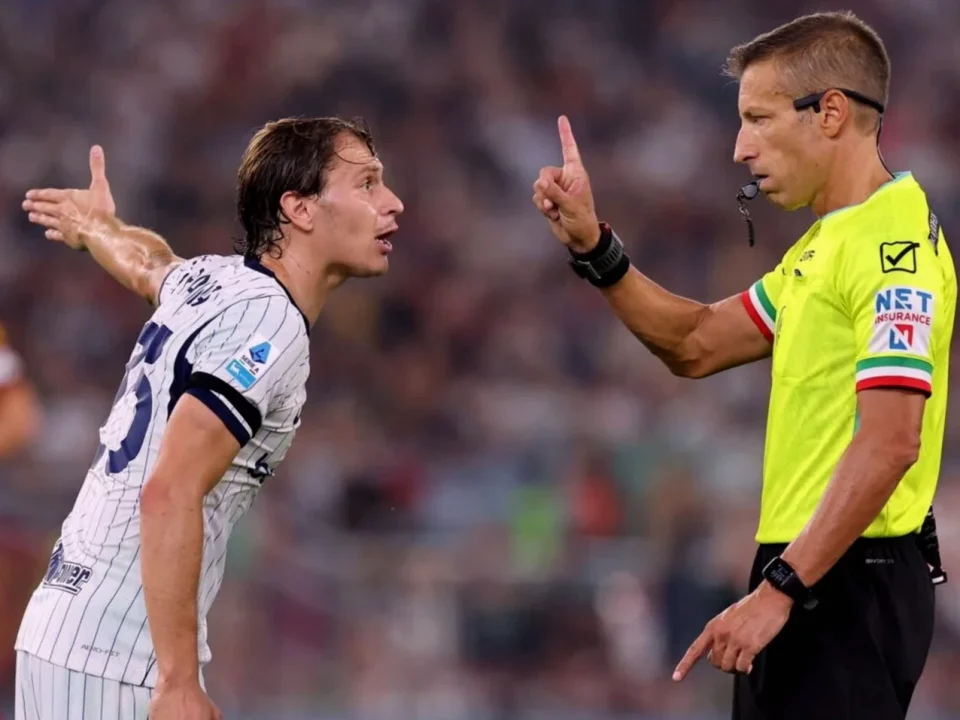
Daniele Orsato’s first weeks as Serie A’s refereeing chief have shifted the centre of gravity back towards the pitch. The VAR room is no longer expected to re-referee every disputed contact, with intervention reserved for mistakes judged clear and obvious. That reading of the protocol has made Orsato one of the most discussed figures in Italian football as the season begins to gather pace.
The change has been visible in the volume of decisions left with the match referee. Serie A had to wait until the fourth matchday for the first official to be sent to the monitor for an on-field review, a striking contrast with recent seasons in which video checks often appeared to dominate the rhythm and argument of a match.
For supporters of the new direction, there are immediate benefits. Players are spending less time on the grass after minimal contact, simulations have become less profitable, and matches have found a more continuous flow. A number of coaches have welcomed the approach, with Italy coach Mancini also backing the greater authority granted to referees.
A debate as old as VAR itself
The resistance is just as strong. Critics believe the correction has gone too far, creating an environment in which fouls are no longer punished consistently, particularly in penalty areas. Italian football has moved, in their view, from an era of soft penalties and theatrical falls towards one in which even substantial incidents may be waved away.
Juventus’ match against Atalanta on Sunday became the latest reference point. Kalulu was seen holding Rowe’s shirt in the box, yet neither the referee nor VAR took action. The episode renewed the question facing Orsato: when does a decision fall below the threshold for video intervention, and when does non-intervention become a mistake of its own?
Maurizio Sarri used the occasion to question the purpose of the system if it is not called upon in such cases. He argued that VAR should be removed if decisions are simply left to the referee’s feeling in the moment, while also admitting that he is content with a return to a game in which the referee has the final word.
From 2017 to the present argument
The current dispute closely resembles the one that accompanied VAR’s arrival in Serie A on 19 August 2017. Within a week, Genoa’s match against Juventus produced an early controversy when a penalty was awarded for a foul on Galabinov, while the Bulgarian forward’s offside position was not detected in the review process.
Gianluigi Buffon responded after that game with concerns that would echo through the following years. He said VAR was being used excessively and incorrectly, arguing that referees had to accept responsibility for what they perceived on the field. His wider point was that football contact cannot automatically be treated as penalty-box offence.
Nearly a decade later, the argument has not changed as much as the tools around it. For one side, the previous system had turned too many ordinary contacts into decisive interventions. For the other, the present standard risks allowing shirt-pulling, elbows and other fouls to escape sanction under the broad protection of the “clear and obvious” test.
Orsato’s next task
Orsato’s challenge is therefore not simply to reduce VAR’s role, but to establish a stable line that players, coaches and supporters can recognise. The league’s early weeks can absorb debate more easily; later, when points carry greater consequences for title races, European places and survival, every uncorrected incident will be examined more closely.
Italian football has long complained that matches were being decided from a television screen rather than by the officials on the field. Orsato has responded by restoring the referee’s primacy. The next stage is finding the balance between that authority and the protection offered by technology, before the championship’s defining Sundays turn every decision into a test of the new order.