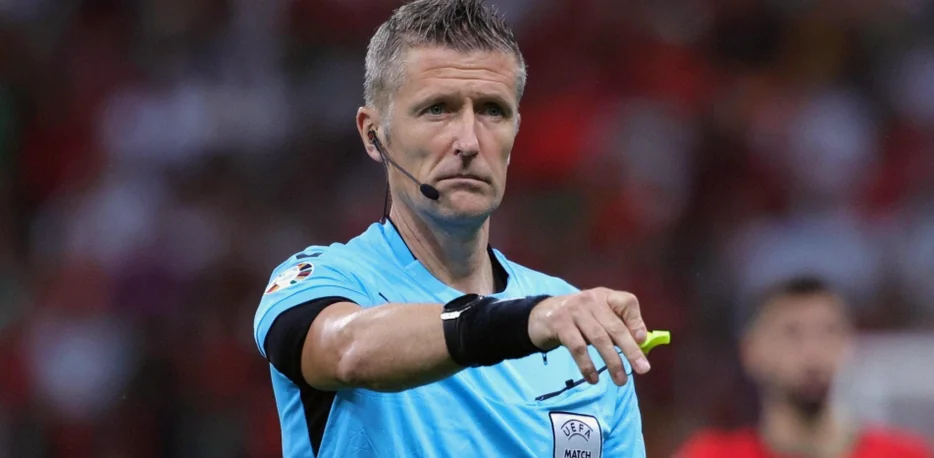
Daniele Orsato has set out the terms of a different refereeing season in Serie A: fewer interruptions, fewer marginal penalties and a VAR room that supports decisions rather than repeatedly remaking them. At the Lissone centre that houses Italy’s video operation, the refereeing chief made clear that this is intended as a lasting direction, not a weekly adjustment.
A season built around rhythm
Joined by AIA technical director Domenico Messina and CAN representative Gabriele Gava, Orsato addressed journalists, television commentators and former officials at the Serie A media hub. League chief executive Luigi De Siervo and FIGC general secretary Marco Brunelli also underlined the broader aim: to bring Italian football closer to international standards of intensity and continuity.
The early numbers point to a significant change. Referees have made very few trips to the pitch-side monitor, penalties have become rarer, and fewer fouls are being called. The amount of effective playing time has risen by almost six minutes compared with last season, helped by IFAB measures against time-wasting.
There has also not yet been a goalless draw in the opening part of the Serie A campaign, a detail presented as evidence of a competition being encouraged to play with greater freedom.
VAR remains central to the system, but not as a mechanism for microscopic intervention. Orsato’s message was that it has not been abandoned; rather, its use must remain tied to clear and serious mistakes.
Orsato asks referees to take responsibility
The former international referee said he wants his officials to recover the authority to decide on the field. He accepted that mistakes will happen, but insisted that the group will keep the same approach through to the end of the season.
“I may surprise you: we want to be on the same team as you,” Orsato said. “I am not the Gospel and errors exist, but I want my referees to go back to making decisions on the pitch. I will carry this through to the end of the season; I will not change my mind from one week to the next.”
He recognised that the current group has yet to develop the personality associated with past leading officials such as Graziano Cesari, who was among those present. The task, he said, is to pass on the confidence and courage built during his own career.
Orsato wants referees to deal with coaches and players without treating a yellow or red card as a defensive tool. He also placed major importance on conditioning, arguing that poor physical preparation is a leading cause of errors.
“Today, referees are finished on the field if they are not fit,” he said. “Anyone who cannot run stays at home.”
VAR boundaries and a harder threshold for penalties
The revised interpretation is especially visible in contact situations. Small touches and incidental foot-to-foot clashes are not automatically to become fouls or penalties. For a stepped-on foot to merit punishment, Orsato said, it must be a forceful and meaningful stamp rather than a slight brush.
- The decisions not to punish the Gila-Kolo Muani contact in Juventus-Milan and the Alajbegovic-Keita incident in Juventus-Parma were considered correct.
- The De Winter-Kalulu contact before Cisse’s goal in Juventus-Milan was not deemed sufficient for a foul.
- On the De Bruyne-Vasquez incident from the opening round, which prompted considerable debate, Orsato accepted that a foul could be argued but said it did not meet the VAR threshold of a clear and obvious error.
“You can discuss whether it was a foul or not,” Orsato said of De Bruyne-Vasquez. “But it was not a clear and obvious error, so VAR was right not to step in. The essential thing is to keep the same line until the end of the season. That is what coaches ask of us.”
The same logic applies to handball. No offence should be called if the available images do not establish that the ball made contact with the player. Serie A is also expected shortly to introduce a ball chip, as used at the World Cup, to assist in identifying touches. The IFAB direction, in Orsato’s view, is against soft penalties.
Errors admitted in the video room
Greater restraint does not mean tolerating obvious failures. Orsato openly identified several incidents in which referees or VAR officials fell below the required standard.
- In the latest round, Kalulu’s holding of Rowe during Juventus-Atalanta should have been recognised. Orsato described it as so apparent that even his 82-year-old father would have seen it.
- Dragusin’s challenge on Monterisi in Frosinone-Fiorentina should have resulted in a penalty. Orsato called it a kick rather than a normal contact and said such an oversight cannot survive VAR review.
- In the Coppa Italia meeting between Fiorentina and Pisa, the prolonged holding by Caracciolo on Pellegrino continued into the area. The Lissone assessment that the player had gone down too easily was judged wrong.
- Torino-Milan also brought a missed handball decision involving Vlasic. Although the arm was close to the body, it was moving upwards rather than downwards.
- VAR should have intervened over the lack of a direct red card for Caqueret’s serious foul on Britschgi in Como-Parma.
- Likewise, Jimenez should have been sent off for violent conduct against Bracaglia in Fiorentina-Frosinone.
The distinction is therefore sharp: borderline football contacts should not be over-analysed, but major fouls, clear holding and violent conduct must still be corrected without hesitation.
Consistency, geography and the next test
Orsato also addressed appointments and territorial links. The preference is to avoid assigning an official from the same city section as a club, although the question is not treated mechanically. Napoli, for example, would not be assigned Fabio Maresca, while Marco Guida of nearby Torre Annunziata remains a possible appointment.
The larger challenge now belongs to the officials in Lissone. Serie A has chosen a more flowing game and has accepted that referees must make decisions in real time. But for that policy to retain credibility, VAR must still speak decisively when a mistake is unmistakable. The balance Orsato is seeking is not silence from technology, but discipline: fewer interventions for minor details, and no uncertainty when the decisive evidence is there.