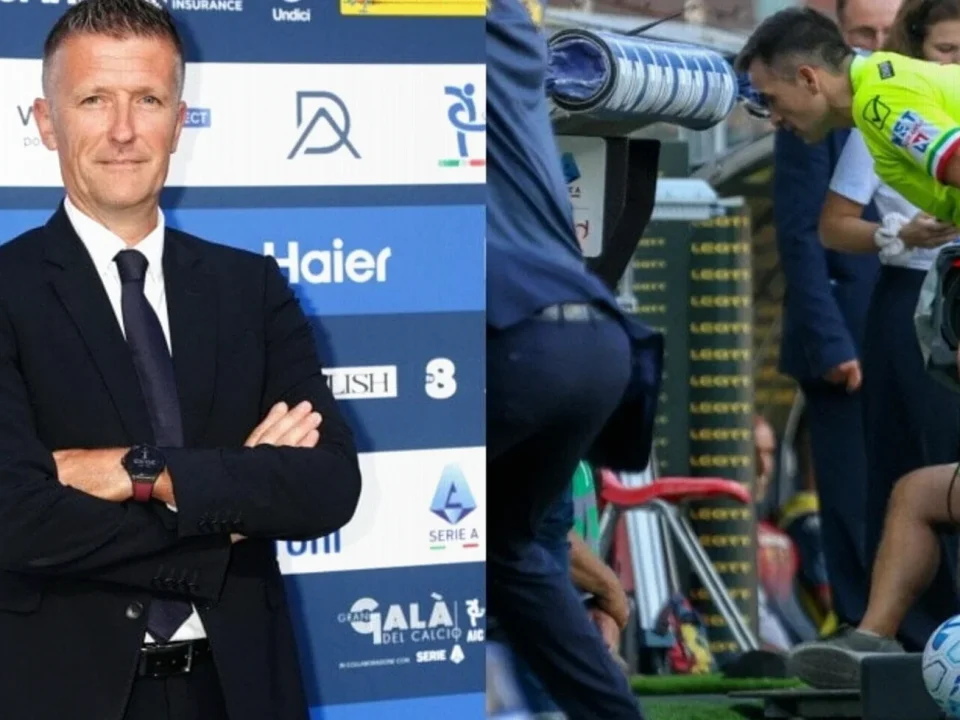
Serie A returns from the break with a familiar issue back at the centre of the championship: not the existence of VAR, but the uncertainty surrounding when it will be used. Recent incidents in Bologna and Turin, where major decisions were not reviewed, have revived the sense that Italian football has moved abruptly from constant video involvement to a more restrained model without fully explaining the change.
Key takeaways
- Controversial episodes in Bologna and Turin have prompted renewed criticism over the lack of VAR intervention.
- Daniele Orsato is being urged to set out the refereeing principles now governing Serie A matches.
- The debate concerns the line between an ordinary mistake and a “clear and obvious” error requiring review.
- Former refereeing chief Gianluca Rocchi has been cleared of both criminal and sporting offences after an investigation that damaged his reputation.
- The central demand is not for VAR to control every match, but for consistent and publicly understood criteria.
A new refereeing line needs clear boundaries
The concern is not simply that referees can make mistakes. That has always been part of football, and it remains reasonable for the on-field official’s interpretation to carry weight. VAR was introduced as support, not as a remote control room taking over the direction of every Sunday afternoon.
But support becomes difficult to accept when nobody outside the refereeing structure can establish the criteria for intervention. After nine years of video assistance, the current hesitation risks creating the impression that technology is being deliberately neutralised rather than used selectively.
Italy has experienced the opposite extreme: matches in which the remote review centre appeared to dominate too many decisions. That model was rightly criticised. Yet an answer cannot be a retreat into ambiguity, particularly when serious errors appear to pass without a review.
Orsato, now the key figure expected to define the refereeing approach, is the person who must explain where the boundaries lie. Supporters, clubs and journalists do not need a defence of the refereeing category or a return to a televised VAR format. They need to know how the current framework is meant to work.
The questions Serie A cannot leave unanswered
Before the league resumes, the refereeing leadership should provide a clear account of the standards being applied. Several practical issues go directly to the credibility of the competition.
- When does a foul merit a yellow card, and when should it lead to a straight red?
- What separates a routine incorrect decision from the “clear and obvious” mistake that requires VAR involvement?
- Which contacts and holding offences in the penalty area are punishable, and which are tolerated?
- In what circumstances must VAR step in without waiting for the referee’s initiative?
- How much pressure does an on-field review place on the official who made the original call?
- When should handball be penalised?
- Will a referee who makes an exceptionally serious error face suspension?
These are not theoretical questions. They shape league positions, club planning and the atmosphere around fixtures. When standards are not visible, every disputed decision becomes a separate political argument, with each side interpreting silence as evidence of unequal treatment.
The discussion also comes after a difficult period for Rocchi, whose image suffered through an investigation that has now ended with no finding of either criminal or sporting wrongdoing. The absence of wrongdoing does not erase the damage already caused, but it should at least bring greater care to a debate too often driven by accusation rather than explanation.
Football will not reach a point where it can be played without referees, however attractive that old idea may sound after another disputed weekend. Serie A must instead find a more workable balance: trust the referee on the pitch, use technology when a decisive error demands correction, and explain the standard well enough that the championship does not spend every Monday arguing over rules nobody has properly defined.