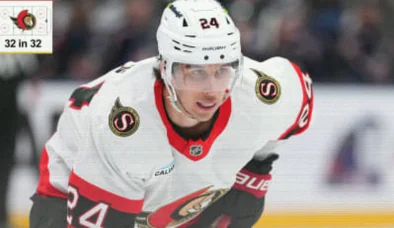
Ottawa’s 2026-27 outlook begins with a simple strength: the Senators spent more time attacking than almost anyone in the League last season, and their core players backed that territorial edge with speed, pressure around the crease and a blue line that can keep plays alive.
Senators carry a top-end possession profile into 2026-27
The Senators posted a 43.4 percent offensive-zone time share last season, second in the NHL and up from 41.8 percent, which ranked seventh in 2024-25. That advantage held across situations: Ottawa was second at even strength at 43.0 percent, tied for fourth on the power play at 60.6 percent and third while shorthanded at 29.0 percent.
Drake Batherson was a major driver of that work. He finished fifth overall in offensive-zone time at 48.3 percent, fourth among forwards, while his 46.0 percent offensive-zone starts rate placed him in the 98th percentile at his position. Dylan Cozens was tied for eighth League-wide at 48.0 percent.
Tim Stutzle continued to tilt the ice in Ottawa’s favor, recording a 46.5 percent offensive-zone time share, good for the 95th percentile among forwards. His 48.0 percent offensive-zone starts figure landed in the 99th percentile.
William Eklund, acquired from the San Jose Sharks during the offseason, could get a look alongside Stutzle on Ottawa’s top unit. Eklund posted a 45.9 percent offensive-zone time share last season, ranking in the 93rd percentile among forwards.
The Senators’ defense contributed heavily to the club’s puck-possession game. Jordan Spence was tied for third among NHL defensemen with a 47.6 percent offensive-zone time share, while Thomas Chabot ranked sixth at 47.0 percent. Jake Sanderson was in the 90th percentile among defensemen at 44.8 percent.
Chabot also finished seventh among defensemen in power-play offensive-zone time at 61.7 percent. On the penalty kill, Michael Amadio ranked seventh among forwards by spending 37.0 percent of his shorthanded ice time in the offensive zone.
Traffic at the net and shooting from the blue line
Ottawa was fifth in the NHL in both high-danger shots on goal, with 715, and high-danger goals, with 143. The Senators also ranked seventh in mid-range shots on goal with 699, while their 21 long-range goals were tied for eighth.
Batherson scored 24 high-danger goals, tied for fifth in the NHL. He added 70 high-danger shots, placing in the 91st percentile among forwards, plus seven mid-range goals and 49 mid-range shots, ranking in the 84th and 82nd percentiles respectively.
Stutzle was equally dangerous in close. His 20 high-danger goals were in the 97th percentile among forwards, and he generated 81 high-danger shots, a 95th-percentile mark. He also produced 11 goals from mid-range and 68 shots from that area, both top-tier positional results.
Cozens brought a varied shooting profile, finishing tied for 10th among forwards with 15 mid-range goals. He recorded 86 mid-range shots and 83 high-danger shots, both in the 96th percentile, and scored twice from long range, a 93rd-percentile result.
Fabian Zetterlund could be positioned for more work this season after finishing tied for third among forwards with four long-range goals. His hardest shot was measured at 94.30 mph, placing him in the 95th percentile among forwards.
Shane Pinto set NHL career highs with 23 goals and 46 points last season. His underlying shot production supported the breakout: Pinto ranked at least in the 80th percentile among forwards in five categories, including seven mid-range goals, 12 high-danger goals, 19 long-range shots, 55 mid-range shots and 59 high-danger shots.
Sanderson supplied offense from the back end while remaining one of the club’s most dynamic defenders. He was tied for third among defensemen with five high-danger goals and added five long-range goals, four from mid-range, 12 high-danger shots, 33 mid-range shots and 74 long-range shots. Those figures placed him near the top of his position across each shooting distance.
His shot also carried serious velocity, with a season-best 99.72 mph and a 72.28 mph average shot speed. Those marks ranked in the 96th and 91st percentiles among defensemen.
Tyler Kleven registered the NHL’s hardest shot attempt last season at 103.51 mph. He scored two high-danger goals, which put him in the 83rd percentile among defensemen.
Stutzle and Sanderson set the pace
Ottawa generated 1,953 skating bursts of at least 20 mph last season, ninth-most in the NHL, and its 126 bursts at 22 mph or faster ranked fifth. Stutzle and Sanderson were at the center of that pace.
Stutzle recorded 364 bursts above 20 mph, fifth in the League, and his 46 bursts over 22 mph ranked third overall. His top skating speed reached 23.54 mph, a 96th-percentile result among forwards, while his 43.05 miles skated on the power play ranked sixth at the position.
The 24-year-old forward has now finished in the 90th percentile or better among forwards in maximum speed and 20-plus mph bursts in each of the past four seasons.
Sanderson, also 24, led NHL defensemen and ranked fifth overall with a maximum skating speed of 24.37 mph. He was second among defensemen with 31 bursts above 22 mph and third with 204 bursts over 20 mph.
Across all four of his NHL seasons, Sanderson has remained in at least the 95th percentile among defensemen in top speed, 20-plus mph bursts and 22-plus mph bursts. With Stutzle pushing the attack up front and Sanderson driving play from the blue line, Ottawa enters the new season with two of the League’s most consistently explosive skaters.
SEO Title
Ottawa Senators 2026-27 Notebook: Stutzle, Sanderson Drive NHL EDGE Strengths
SEO Description
The Ottawa Senators enter 2026-27 after ranking among the NHL’s best in offensive-zone time and high-danger production, led by Tim Stutzle, Jake Sanderson and Drake Batherson.