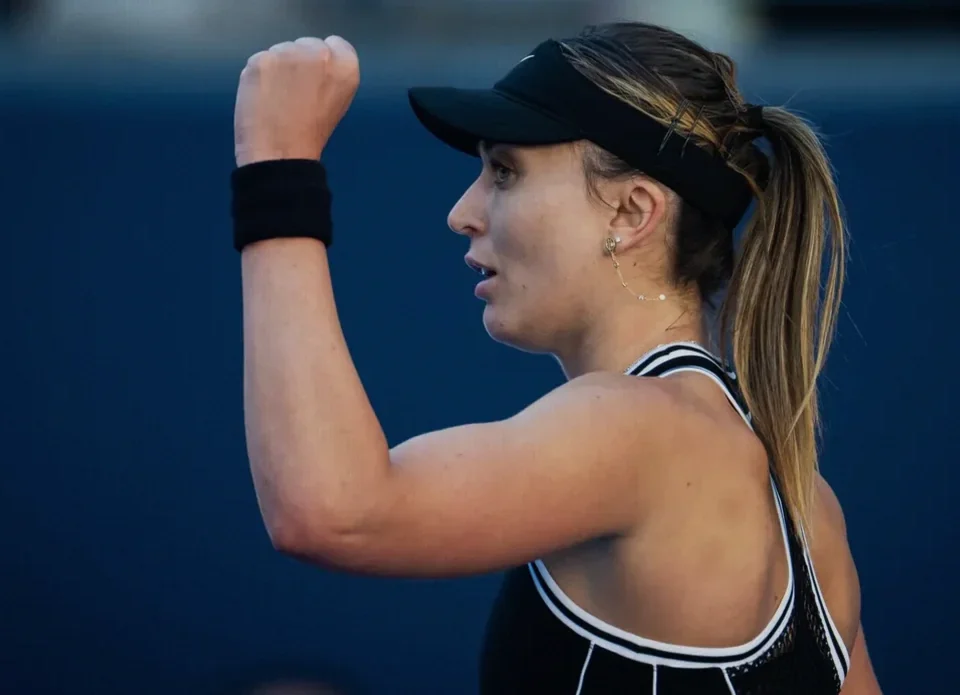
Paula Badosa turned a two-point escape into another significant step in her revival at the China Open, fighting past Daria Kasatkina 4-6, 7-6(7), 6-4 in Beijing to reach the second round.
The Spaniard had been close to defeat against Kasatkina, who was within two points of sealing the first-round contest, but Badosa held firm through a tense second-set tiebreak before taking control late in the decider. It was her second victory over the Australian in two months, following their US Open opener, which was split across two days and required Badosa to convert her ninth match point.
Badosa had anticipated a demanding assignment from the moment the draw placed Kasatkina in front of her. The pair even shared Badosa’s first practice session in Beijing, underlining how familiar the challenge would be. “We both wanted it so much, so the match had a lot of emotion,” Badosa said. “I knew it would be physical and tactical. Near the end, I could see she was having some trouble, and I told myself that it was the time to go for it. Mentally, it was a big battle.”
The result carries particular weight after Badosa’s difficult recent history in the Chinese capital. A year ago, she arrived after a two-month injury absence following Wimbledon, only to retire with a thigh problem in the second round before another extended layoff brought her 2025 campaign to an early end.
Her ranking and form have since begun moving in the right direction. Since losing in the first round at Wimbledon while ranked No. 141, Badosa has collected 16 of her 27 wins this season over the last two and a half months. A WTA 125 trophy in Bastad has been followed by a final in Iasi, a semifinal in Hamburg and a quarterfinal in Sao Paulo.
The climb has come after a steep fall from the positions she occupied in 2025, when she entered Wimbledon at No. 9 and Beijing at No. 18. Missed events at the end of last season, together with semifinal points she could not retain in Melbourne in January, sent her down as far as No. 142 earlier this year.
“The year has been very hard, particularly in my head,” Badosa said. “At the beginning, I did not feel like myself on court. Now I am gradually seeing the player I want to be again. I believe I am among the best in the world.”
Beijing offers an important opportunity in the ranking race. Aside from her third-round showing here last season, Badosa did not play again during that stretch of the calendar, leaving her with limited points to defend and a chance to add to her total with every deep run. Her plan is to enter four or five more tournaments in the 2026 season and build match volume before a full preseason, something her injuries prevented her from completing last year.
“Because I did not win much early in the year, there is not much pressure from points to protect,” she said. “If I keep winning, the picture can become very good. I am proud that I was able to compete and win a lot during the summer, and I am excited about what comes next.”
Badosa also wants to avoid another US Open draw like the one that put her against world No. 4 Coco Gauff in the second round while she was ranked No. 87. She could laugh about that experience after her run in New York, but the objective is clear: raise her position enough to meet the very top seeds later in tournaments, rather than immediately.
“Playing Coco was positive, but I would rather see her in the later rounds,” Badosa said with a smile.