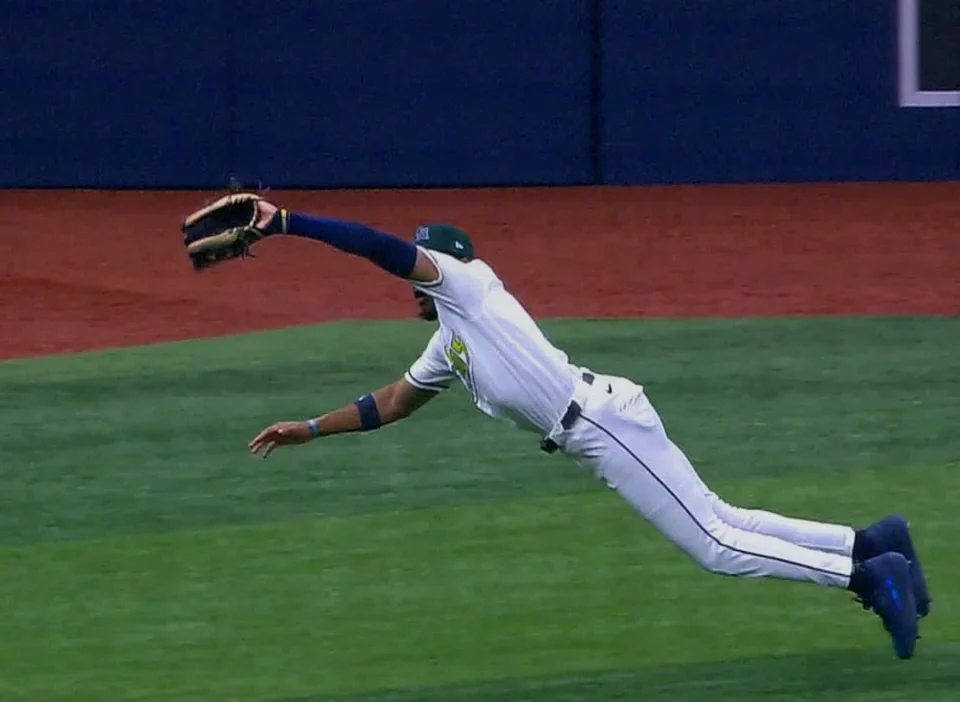
The Rays reached October with pitching, contact and a rebuilt outfield that has turned deep flies and line drives into a nightly trap. Tampa Bay’s defenders on the grass have been better than any Statcast-era club at converting airborne balls into outs, a striking turnaround from the group that helped sink the club during its 77-85 finish in 2025.
That club missed the postseason and carried an outfield defense near the bottom of the Major League leaderboard: minus-6 Defensive Runs Saved, minus-9 Outs Above Average and minus-12 Fielding Run Value. The response was not subtle. Tampa Bay changed personnel, brought in new instructors and made cleaner first reads a priority from the first days of camp.
Quick facts
- On non-home-run airborne balls traveling at least 220 feet, Rays opponents hit .256 in 2026, the best mark among more than 300 Statcast team-seasons.
- The comparable 2025 Rays figure was .301, ranking 21st in the Majors.
- Jonny DeLuca posted +13 Outs Above Average, Victor Mesa Jr. added +8, Cedric Mullins reached +11 and Chandler Simpson finished at +8.
- Rays center fielders positioned an average of 330 feet from home plate on the road, six feet deeper than the previous season.
- Tampa Bay faces the Yankees in the Division Series, with Game 2 scheduled for Monday at 8 p.m. ET.
The work began with the staff. Former outfielder Corey Dickerson joined as first-base coach and outfield instructor, while longtime Rays center fielder Kevin Kiermaier lent his expertise during spring training. Manager Kevin Cash called the outfield defense camp’s brightest development as early as March 16.
The roster was reshaped as well. Christopher Morel, who finished 2025 at minus-6 Fielding Runs, and Josh Lowe, at minus-5, departed. Veteran center fielder Cedric Mullins arrived after defensive slippage with Baltimore and the Mets, while DeLuca returned healthy after being limited to 20 games by injury in 2025.
Mesa, acquired in February, became another major piece. Of the 12 outfielders who logged a plate appearance for Tampa Bay last season, only three remained in 2026; Chandler Simpson and DeLuca account for virtually all of that returning continuity. Richie Palacios had only four plate appearances, while Tristan Peters, who appeared in four games, was sent to the White Sox for cash and later emerged as a top defender himself.
More range, less grass
The Rays were not the overall top defensive outfield by Fielding Run Value. That distinction belongs to the Cubs, whose +13 throwing-arm value led baseball. Tampa Bay’s outfield arms rated minus-3, 20th in the sport, leaving the Rays short of Chicago’s complete defensive profile.
But in the central task of tracking down batted balls, nobody did it better. Tampa Bay’s outfield had been among baseball’s top six in Outs Above Average in three of four seasons before falling into a tie for ninth from the bottom in 2025.
The temporary move to George Steinbrenner Field may have contributed to last year’s trouble. The Minor League-style setting played differently from Tropicana Field, long a friendlier backdrop for fly-ball defense. Still, the new season’s leap came from far more than a ballpark correction.
DeLuca’s +13 OAA put him among the game’s finest. Mesa recorded +8 despite not playing enough to qualify for some league leaderboards. Mullins jumped from +1 in 2025 to +11, restoring the level that once made him one of baseball’s premier outfield defenders.
Simpson made perhaps the sharpest individual adjustment. His speed did not translate into value a year ago, when he rated minus-5, but he rose to +8 in 2026. Aside from utilityman Ryan Vilade, at minus-2, each of Tampa Bay’s four principal outfielders landed among the top 15 in the Majors.
The first step tells the story
Positioning mattered. On road games, where the home-field switch does not affect the calculation, Rays center fielders played at an average depth of 330 feet. That was the deepest average placement by any club over the last three seasons, six feet farther back than Tampa Bay’s roughly average 324-foot depth in 2025.
The larger change was the instruction behind the first move. Simpson described Dickerson’s message in June as anticipation and aggression: “playing offense on defense,” while studying the ball, the hitter’s swing and the game situation. DeLuca said the jump data confirming his improvement had been encouraging and credited Dickerson with playing a significant role.
Statcast measures a good jump by the ground covered in the proper direction during the first three seconds after contact. Kiermaier excelled in that area, leading the Majors as recently as 2023, and Dickerson ranked third during his 2018 Gold Glove campaign. Pete Crow-Armstrong and Ceddanne Rafaela currently sit atop that skill set.
Three of Tampa Bay’s four regular outfielders ranked in the top 15 in jump performance. Mesa did not qualify because of his smaller workload, but his +6.3 feet above average would have led the Majors.
His catches showed why. In July, Mesa robbed Rafaela on a play driven by a jump nine feet better than average, rather than elite running speed. In June against Detroit, he caught Dillon Dingler’s liner toward left without needing a dive; Statcast credited him with a +13-foot jump.
The established big leaguers all improved in that opening burst. Mullins rose from minus-0.6 feet to +1.9, Simpson from +0.3 to +2.4, and DeLuca from +1.6 in 2024 to +2.6 this season.
That collective early read has made the Rays the best team in Statcast tracking, which began in 2015, at getting productive first steps. It also gives Tampa Bay another October advantage beyond its pitching and its ability to avoid strikeouts.
When Yankees hitters such as Cody Bellinger and Ben Rice drive balls beyond the infield in this Division Series, the Rays will trust the work done long before the glove closes. The catch often starts in the first second, and this Tampa Bay outfield has made that second count.