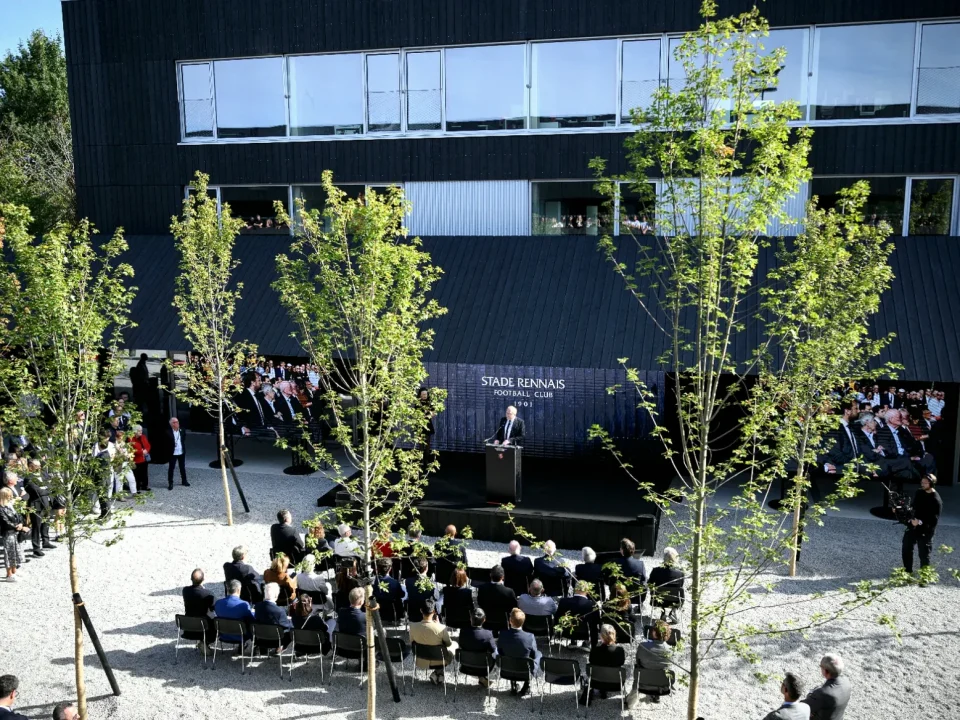
At La Piverdière, the red ribbon fell before a gathering that stretched across three generations of the Pinault family. Around 400 guests attended the opening of Stade Rennais’ expanded training headquarters, with former internationals Sylvain Wiltord and Steve Mandanda among them, alongside French Football Federation president Philippe Diallo.
François Pinault, the club owner, formally opened the new complex, described by Rennes as its “centre de life”. The 15-hectare site now brings the first-team squad, academy, administrative staff and education facilities together in one location, completing a project intended to reshape the club’s daily operation.
François-Henri Pinault said Rennes had long considered how it needed to change to meet the demands of modern football. He called the development a major commitment to the senior side, the academy and the future players who will wear the club’s red and black colours.
The Pinault family have funded the €40 million redevelopment in full. Work began in 2023 and has produced three main buildings containing changing rooms, treatment areas, hydrotherapy facilities, gym and rehabilitation spaces, offices, and areas for players and staff to relax.
Aiming for European standards
Pierre Juhel, Rennes’ stadium manager and the project supervisor, believes the new base places the club among the strongest-equipped sides in France. He pointed to the quality of the pitches and buildings, saying the infrastructure is now at the level expected of a Champions League club.
Juhel said only Paris Saint-Germain operate in a different category nationally, while insisting Rennes have little to envy from the rest of Ligue 1. The academy, now situated only a short distance from the professional squad, has also received facilities that match those of many top-flight clubs.
“The players now have to make the place their own,” Juhel said.
Midfielder Valentin Rongier welcomed the setting, highlighting the natural surroundings, advanced gym equipment and communal areas. He said the squad must recognise its good fortune and repay the investment through its work.
Diallo attended the inauguration before travelling to the Stade de France for France’s match against Italy on Friday evening. He described the new La Piverdière as a potential model for future academies in French football, praising the combination of senior football, player development and schooling on the same campus.
The FFF president said Rennes remain a benchmark for youth development in France, noting that eight players either developed at the club or currently represent it were involved around the France team.
Rennes are fifth in Ligue 1 and back in Europe this season, but the opening also sharpened the expectations around the club. President Arnaud Pouille expressed his gratitude to the Pinault family for improving conditions for every department and bringing the academy and first team closer together.
He said Rennes now rank at least among the top three French clubs for training infrastructure, perhaps close to first place. Yet he also identified the next question for a club with higher ambitions: the stadium.
“To become a major club, you need a major owner, a major training centre and a stadium that reflects what you want to be,” Pouille said. “That will certainly be the next stage.”