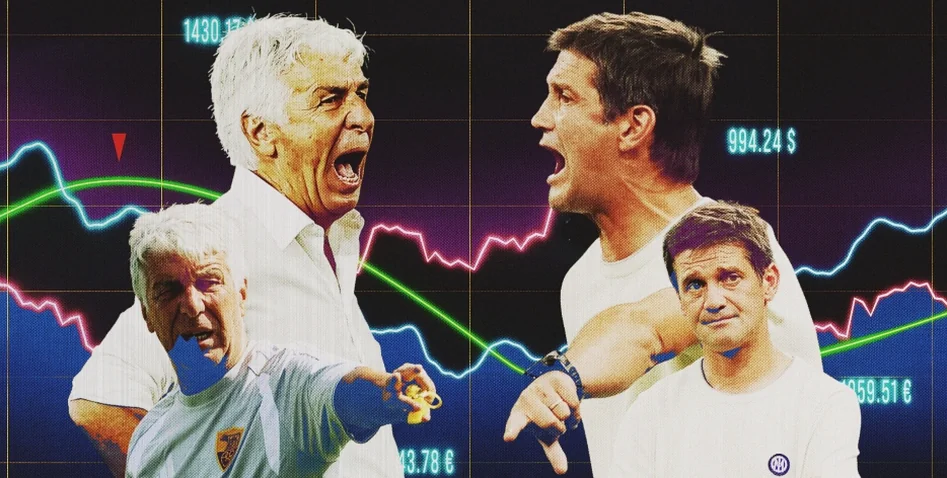
Roma and Inter have travelled parallel coaching paths since the summer of 2025, but the financial room behind Gian Piero Gasperini and Cristian Chivu has not been identical. Two seasons into their respective projects, Roma have committed more to rebuilding the squad, while Inter have combined selected spending with a tighter control of the overall payroll bill.
Roma outspend Inter in the Gasperini and Chivu era
Roma have spent €211 million on fixed transfer fees and loan costs since Gasperini took charge, compared with €186 million for Inter under Chivu. The calculation excludes add-ons and focuses on the guaranteed cost of registrations and temporary deals.
The €25 million difference reflects contrasting ownership approaches. The Friedkin group have continued to finance Roma’s ambitions despite Financial Fair Play restrictions, while Oaktree’s stated priority at Inter has been operational and financial stability.
Quick facts
- Roma’s transfer spending under Gasperini: €211 million.
- Inter’s transfer spending under Chivu: €186 million.
- Roma spent €86.5 million in 2025-26 and €124.5 million in 2026-27.
- Inter spent €84 million in 2025-26 and €102 million in 2026-27.
- Roma’s squad costs have risen by about €15 million since summer 2025.
- Inter’s squad costs have fallen by about €10 million over the same period.
Gasperini’s first Roma window brought immediate backing. Wesley arrived for €25 million and El Aynaoui for €23 million, before the winter additions of Robinio Vaz at €20 million and Donyell Malen on a €2 million loan.
Roma also paid €6.5 million for Ziolkowski, while Bailey and Ferguson each joined on loans costing €3 million. Ghilardi and Zaragoza each cost €2 million on loan, taking the 2025-26 acquisition total to €86.5 million.
The following summer was more expensive still. Malen was signed permanently for €25 million, while Castro cost €35 million and Rodrigo Mora €25 million. Koulierakis arrived for €16.5 million, Molina for €13 million and De Roon for €1 million.
Ghilardi was bought outright for €8 million and Balerdi joined on a €1 million loan. That produced a €124.5 million outlay for 2026-27, even with Roma operating under financial restrictions.
The commitment to Mora may yet become larger. Roma’s agreement with Porto includes either a further €25 million payment next year or a clause giving Porto 50 per cent of a future resale.
Inter’s first summer with Chivu was built around younger players, consistent with Oaktree’s preference for developing assets. Luis Henrique cost €24.5 million, Bonny €23 million, Diouf €20 million and Sucic €15.5 million.
With Manuel Akanji arriving initially on a €1 million loan, Inter’s total for 2025-26 reached €84 million. The club then adopted a more forceful approach in the following campaign, particularly in the Premier League market.
Spence joined for €31 million and Jones for €30 million, while Stones arrived without a transfer fee. Inter also made Akanji’s move permanent for €15 million, brought Stankovic back through a €23 million buy-back clause and signed Provedel for €3 million.
Stankovic had been sold to Club Brugge for around €10 million a year earlier. Those deals took Inter’s 2026-27 spending to €102 million, and the combined total during Chivu’s time in charge to €186 million.
The figures need the wider sporting context. Chivu inherited the stronger starting group, as shown by the results achieved by the clubs before the two coaches arrived. The Romanian won the Scudetto in his first season, while Gasperini returned Roma to the Champions League after a seven-year absence.
Yet the economic direction is clear. Since the summer of 2025, Roma’s annual squad cost — including wages, amortisation and loan expenses, adjusted for arrivals and departures — has increased by roughly €15 million. Inter’s equivalent cost has instead been reduced by approximately €10 million.
That is the measure club executives watch most closely because it determines the resources available each season. Friedkin have repeatedly covered Roma’s losses through equity injections since taking over in 2020, and the 2025-26 accounts are also expected to close in the red.
Inter, by contrast, recorded a €35 million profit in Oaktree’s first season in charge. Another positive result is anticipated when the board approves the accounts to 30 June 2026, underlining how two leading Serie A projects can pursue success with markedly different financial foundations.
SEO title: Roma spend €211m under Gasperini as Inter reach €186m with Chivu
SEO description: Roma have invested €211 million in transfer fees and loans during Gian Piero Gasperini’s tenure, €25 million more than Inter under Cristian Chivu, as ownership strategies shape two Serie A projects.