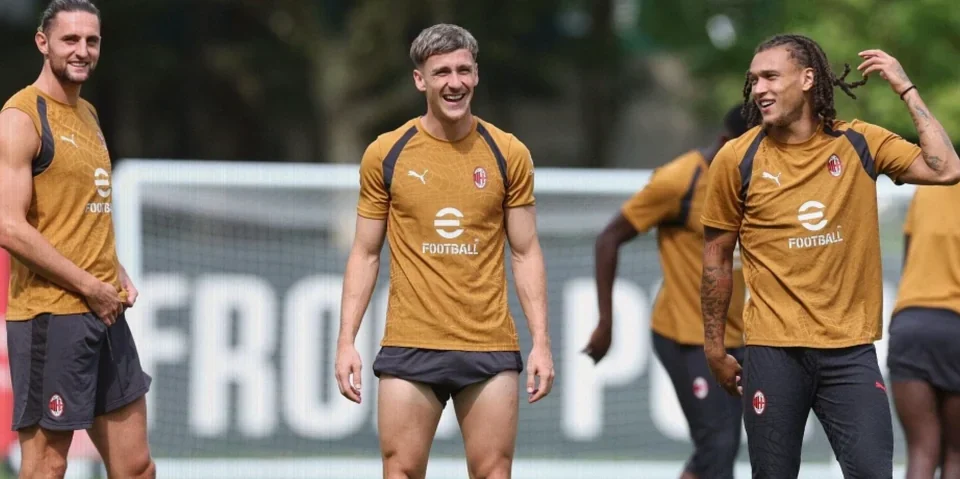
Ruben Amorim’s Milan is beginning to show the manager’s wider idea of squad building: players are being asked to understand more than one job, rather than being fixed permanently to a single position.
The Portuguese coach has used the early part of the season to spread minutes and tactical responsibility across his group. It is not simply a way to keep the dressing room satisfied; Amorim wants as many players as possible to share the same tactical reference points, with versatility becoming an asset over the course of a long Serie A campaign.
Quick facts
- Amorim has moved several Milan players between wide, central and attacking roles.
- Davide has been considered both for the left side of defence and, if needed, midfield.
- Diego has played on both flanks and could also become an option behind the striker.
- Adrien Rabiot has featured in the attacking line but appears most effective in central midfield.
- Alexis has mainly played as an attacking midfielder, although his natural wide role remains relevant.
Davide has faced a more complicated tactical adjustment than he did last season. He is not an obvious fit for the wide role associated with Amorim’s system, but the coach considers him capable of operating as the left-sided defender in the back line.
There have also been moments when the English player has been used further forward, behind the attack. His profile does not naturally resemble the kind of attacking midfielder Amorim usually prefers, yet the coach has kept that solution available. Davide may even be considered for a midfield role when circumstances demand it.
Diego has supplied one of Milan’s more immediate bursts of energy in recent matches, arriving at a time when the side needed fresh momentum. Last season he was largely deployed on the left, but Amorim sees him as Samuel Chukwueze’s counterpart on the right in his preferred pairing structure.
So far, Diego has worked on each wing. In the closing stages of one match, after replacing Alexis Saelemaekers, he also moved into central areas as Milan’s original 3-4-2-1 shape became less defined.
That late shift does not make him a regular attacking midfielder, but it leaves the door open. For Amorim, the value lies in having an additional answer available during matches rather than protecting strict positional labels.
Rabiot remains the clearest illustration of the coach’s approach. Under Massimiliano Allegri last season, he played as the left-sided midfielder in a 3-5-2, and the expectation was that he would continue in the centre under Amorim.
Instead, the Frenchman was initially placed in the line behind the forward. Rabiot has said that he discussed the change with Amorim and accepted it because the role was not unfamiliar to him. His performances there have been positive, underlining both his quality and his willingness to adapt.
The past two matches, however, have reinforced the impression that Rabiot is most influential in the middle of the pitch. A two-man midfield, similar to the role he has known with France, appears to bring out his strongest qualities.
It is therefore reasonable to expect him to spend more time in midfield as the season develops. The advanced option remains part of Milan’s planning, particularly when the match situation or available personnel require it.
Alexis has spent much of the campaign in the attacking line, with displays ranging from convincing to untidy. Playing in a two-man unit behind the striker is still relatively new territory for the Belgian, although his close control and ability to find passes through the lines give him useful qualities for the role.
Amorim has made clear that he does not primarily view Alexis as a touchline winger tasked with repeated one-against-one situations on the right. Yet that remains the position most closely connected to the player’s established game, while the coach had also considered using him on the left on his stronger inverted side at the start of the season.
For Milan, this is not merely a collection of experimental switches. Amorim is trying to give his squad a shared language before the calendar becomes more demanding, turning flexibility into a practical resource for the championship rather than an emergency measure.